
Playback: Sam Raimi, Seesaw Inclinations, from THE EVIL DEAD to SEND HELP

Admittedly, I'm a Sam Raimi-stan. But not until I saw something by him on television.
As I acknowledge below, I first saw Darkman on broadcast TV, which was so energizing that it made me want to seek out everything he had made. Now that I have watched almost everything he's been involved in creating, including most of the television shows (not mentioned below), I remain a Raimi-stan.
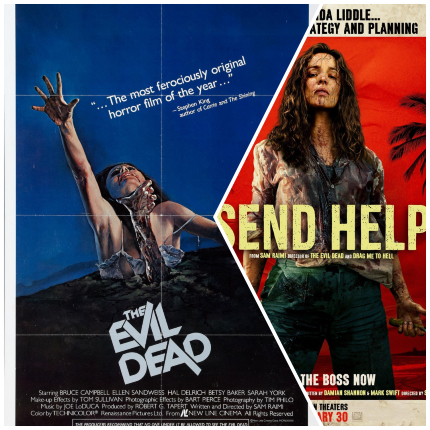
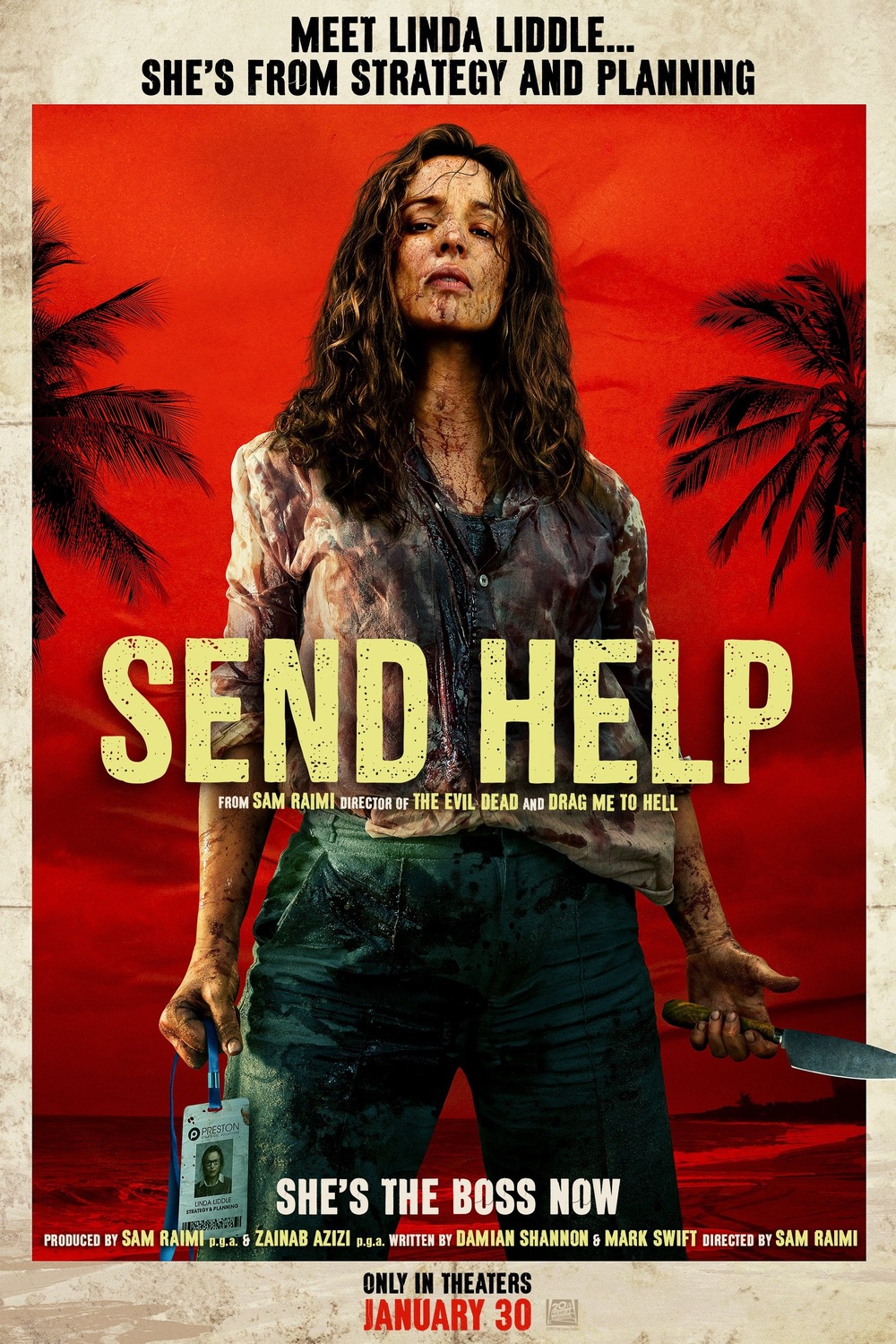
That applies to his latest, Send Help, opening widely in movie theaters and in 3D across the known world on Friday, January 30. More on that later. What's struck me about his films is how nimbly he's hopped from one genre to another, sometimes smearing them together like peanut butter and jelly, along with his own personal secret sauce that makes all his films his own.
Born in Royal Oak, Michigan, a suburb of Detroit, the younger brother of Ivan Raimi and the older brother of Ted Raimi, both of whom he has worked with throughout his career, Sam Raimi began making Super 8 movies with his friend Bruce Campbell in high school. Together with Robert Tapert and more friends, they made a short film, Within the Woods, as a 'proof in concept' and raised funds to make a full-length feature. And Raimi began directing that feature when he was just 20 years of age.
For this edition of Playback, I'm rolling back the tape -- on behalf of, and with the permission of, usual column writer Maxwell Rabb -- on Raimi's marvelous seesaw inclinations, as exhibited in his richly varied filmography.
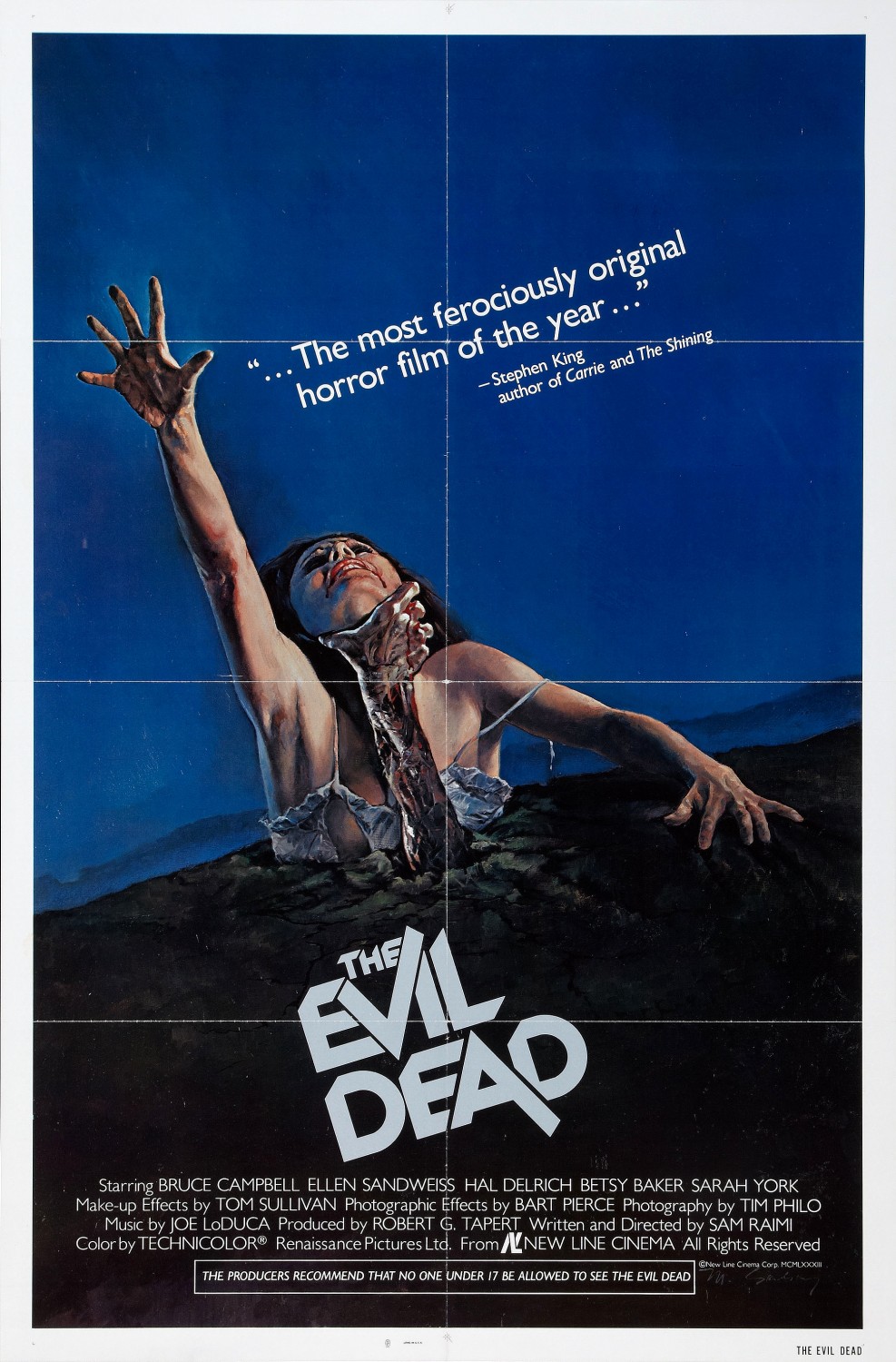
Early Horrors: The Evil Dead Trilogy
It's hard to underestimate the impact that Sam Raimi's Evil Dead trilogy had on 80s horror, influencing a generation of fans and filmmakers alike.
The first film, a naively thrilling gore flick, shot during a bitterly cold winter in Tennessee, was unfettered by any expectations, beyond furthering the hopes and dreams of high-school friends Sam Raimi and Bruce Campell, together with Robert Tapert, to somehow make a career out of filmmaking, turned grueling, monstrous horror into a midnight-movie sensation that was banned in multiple countries yet spread like wildfire wherever it played. And played. And played.
After a less than commercially successful crime comedy (see below), Raimi and longtime friend Scott Spiegel wrote Evil Dead II, which injects great gobs of macabre humor into their horror sequel, which is big -- very big -- on blood and guts, and proved to be an even greater sensation. Who could forget the memorable chainsaw arm deployed by Ash (Bruce Campbell), the sole survivor from the original?
As teased in the sequel's conclusion, Raimi made the concluding film in the trilogy more of a Middle-Ages adventure, leavened with broader humor, though also including a proper amount of blood, if less outright gore. Again, it's a very entertaining movie that may have given Bruce Campbell his best showcase to date.
The In-Betweeners
In between the Evil Dead films, Sam Raimi made two films that are a study in contrasts. First, in collaboration with Joel and Ethan Coen -- the former had worked as an assistant film editor on Evil Dead, Raimi wrote Crimewave, which was thrown completely off its intended comic-crime riffs by interfering producers. It's still quite goofy, and watchable, with plenty of Raimi-isms and a few Coen foreglimpses, along with a lot of unrealized potential.
The other in-betweener is Darkman, which I first saw on broadcast television. (I taped it, and watched it over and over again, even with the ads.) It's a wonderfully kinetic picture that is entirely mesmerizing, as Liam Neeson, who rises from near death to become a masked, avenging angel -- but only for 99 minutes at a time. Larry Drake, who I knew from his meek role on TV's L.A. Law at the time, freaked me out as a very nasty villain. Raimi energizes every frame, from his shot selection to his framing to his pacing. It's a contender as the best superhero movie of all time.
A Whirlwind of Genres
As noted above, Raimi collaborated with Joel and Ethan Coen on the Crimewave screenplay; around the same time, they also collaborated on the screenplay for The Hudsucker Proxy, which the Coens were finally able to make with their wished-for star, Paul Newman, aboard. Raimi served as a second-unit director.
Next, Raimi was selected by star and co-producer Sharon Stone to helm The Quick and the Dead, based on her viewing of Army of Darkness. Applying his skills to a Western with a terrific cast, including Gene Hackman, Russell Crowe and Leonardo DiCaprio, Raimi's outlandish signature flourishes -- especially the visible holes left by bullets after they've traveled through bodies -- helped to make the more a stylish entertainment, even if its box office returns disappointed, which is not surprising, in view of the all the revisionists Westerns that were flooding the market at the time.
Working from Scott Smith's very strong adaptation of his own novel -- which Smith always intended to be a movie -- Sam Raimi plays it straight and dreadfully with A Simple Plan. Rather than play around with the bulletproof material, Raimi puts his energies into controlling the tone as it heads inexorably and inevitably into the darkest noir territory imaginable. Establishing Bill Paxton and Billy Bob Thornton as unlikely yet convincing brothers at opposite ends of the emotional-stability scale, the film is compelling from the get-go, even as it pushes ever further towards its devastating ending.
It's a great film, and may be Raimi's best. Alas, the same could not be said of his followup, For Love of the Game, which I remember seeing in a movie theater with the greatest anticipation -- as a lifelong fan of baseball -- and leaving with a huge pit in my stomach, because even Vin Scully's narration could not enliven the snail's pace of the narrative. Kevin Costner and Kelly Preston star, along with J.K. Simmons, who would play key roles for Raimi in the succeeding years.
With The Gift, Raimi worked again with Billy Bob Thornton, but this time in Thornton's capacity as a writer. Thornton's excellent, twisty script, written with Tom Epperson, gives Raimi and his excellent cast, led by Cate Blanchett as a widowed, small-town fortune-teller, and featuring a scary villainous turn by Keanu Reeves, as well as J.K. Simmons as the town's skeptical sheriff, ample space to tell a spooky Southern Gothic tale that Raimi embellishes visually in order to convey the horror of Blanchett's clairvoyance. It's a very effective thriller.
The Spider-Man Years
Of the three, Spider-Man 2 (2004) is my favorite, if for nothing else than the subway save scene (above). Spider-Man (2002) is also a very good superhero movie, while Spider-Man 3 (2007) was overstuffed and fell short of everyone's expectations. All three were made more enjoyable by Raimi's visual style and general nervy verve.
A Palette Cleanser, a Wizard, and a Master of the Mystic Arts
I saw Drag Me to Hell at its SXSW screening in March 2009, loved it, and reviewed it for Cinematical, an online publication that has long been gone with the wind.
Happily, Screen Anarchy writer Rodney Perkins saw the film at that screening, too, and submitted his review: "In sum, Drag Me to Hell is a distillation of Raimi's best moves into a more accessible package. ... Drag Me to Hell will not change the world but it certainly is a blast." Having seen the film at least twice since then, I agree completely with those sentiments.
In essence, it's a palate cleanser, something that allowed Raimi to apply the lessons he learned from more mainstream movies and enliven a snappy horror thriller.
TBH, I skipped this one at the time of release, because the idea of a so-called "spiritual prequel" to The Wizard of Oz did not appeal to me at all. How wrong I was.
That's not to say that Oz the Great and Powerful is a masterpiece, especially in comparison to the 1939 classic. (Sorry, there's no other word to describe it but classic.) Taken on its own merits, however, Sam Raimi's treatment of the material cooked up by writers Mitchell Kapner and David Lindsay-Abaire is weird and wonderful.
Watching it now, viewers must confront the James Franco issue, since just five years later he would be accused of inappropriate or sexually exploitative behavior, and it's hard not to think of what was to come as he embodies his titular role, in which he treats women poorly and is cowardly in his behavior.
Apart from that very large that, Sam Raimi's direction is filled with light-hearted touches that take full advantage of the 3D effects that were available during its initial theatrical release, something he puts even greater emphasis upon in his newest, Send Help. If this Oz often feels very much like a Tim Burton production, Raimi is still able to inject his signature touches into the casting of friends and family members, as well as a surfeit of goofy flourishes and kooky grace notes.
(Our reviewer Brian Clark was far less enamored of the film.)
Raimi produced the 2013 remake of Evil Dead, directed by Fede Alvarez; helped develop Ash vs. Evil Dead and helmed the first episode for Starz in 2015, and then waded back into superpowered waters in 2020.
Delayed by the COVID pandemic, Doctor Strange in the Multiverse of Madness released in 2022, yet struck our critic and my fellow editor J Hurtado as quite familiar: "Frankly, it's the kind of thing we expect from Marvel films these days. Thankfully, Raimi is able to wrest control of the visuals from the formula on enough occasions to make this a genuinely fun experience, even for folks like me who have mostly given up on the genre." I couldn't agree more.
An Accountant's Revenge: Send Help
As I've prepared this article, I've noticed that I'm usually more enthusiastic about Sam Raimi's films than our reviewers are, but that's one of the reasons I enjoy serving as managing editor -- though I'm sometimes tempted to declare "you're so fired!" (I won't ever do that.)
Earlier this week, our reviewer Kyle Logan wrote, in part: "This is, of course, a Sam Raimi picture, and one might hope that his filmmaking would keep things engaging. Sadly, the few classic Raimi-isms here (a rushing POV camera, outrageous levels of blood and other bodily fluids, and so forth) simply inspire 'oh that's very Raimi' thoughts rather than injecting any energy into the proceedings."
I will note that I don't agree with Kyle, though he's a very fine writer, and makes good points in his review that I can't deny. Instead, I will say that I enjoyed the movie thoroughly and point out that reasonable people can have reasonable differences of opinion, and it doesn't deter me from expressing my opinion that, though it's not Sam Raimi's best film, Send Help reminds why all his films are so much fun to watch.



More about Playback
- Playback: Nia DaCosta, Life on the Edge, from LITTLE WOODS to 28 YEARS LATER: THE BONE TEMPLE
- Playback: Rian Johnson, Twists and Turns, from BRICK to WAKE UP DEAD MAN
- THE SECRET AGENT Review: Much Smarter Than It Pretends To Be
- Playback: Kleber Mendonça Filho, Civic Tremors, from NEIGHBORING SOUNDS to THE SECRET AGENT
- Playback: Guillermo del Toro, Monstrous Beauty from CRONOS to FRANKENSTEIN

More about Evil Dead
More about Army of Darkness
- J. Hurtado's 10 (ish) Favorite Blu-ray/DVD Releases Of 2015
- ARMY OF DARKNESS: Shout Factory's Release Will Top All Before It
- Blu-ray Review: THE ARMY OF DARKNESS THE NECRONOMICON - Klaatu Barada Nikto!
- Contest: WIN the ultimate living room evil with the ARMY OF DARKNESS THE NECRONOMICON Bluray set (x4, Australia only)


