
Playback: Rian Johnson, Twists and Turns, from BRICK to WAKE UP DEAD MAN

Rian Johnson wants you on the edge of your seat.
The American director delights in twisting beloved genres into razor-sharp puzzles, from slick noir capers to sci-fi paradoxes. His films are (mostly) clever, without condescension. In Brick (2005), he drops a hard-boiled detective story into the halls of a California high school, letting teenage angst play out like a Raymond Chandler novel.
A decade later, Knives Out (2019) revived the classic whodunit as a class satire, where privilege becomes the most suspicious motive of all. Johnson shows us that the pleasure of the mystery isn't just the answer, but all the mischief leading up to the final reveal.
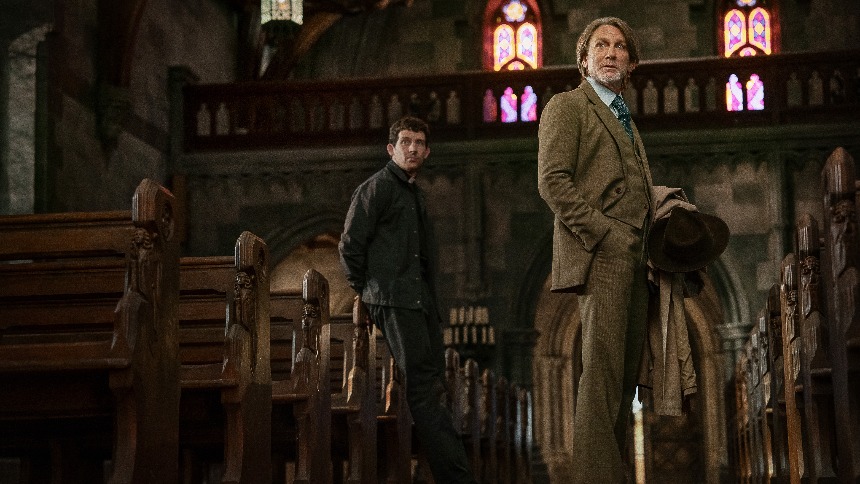
The third installment of Johnson's "Knives Out" series, Wake Up Dead Man (2025), hit theaters on November 26. This Friday, the murder mystery will reach the masses via Netflix. Daniel Craig's Benoit Blanc, ever the charming Southern detective, returns with flowing hair and newfound swagger in this sometimes delightful, often unwieldy ensemble. This time, he's in upstate New York, where a decidedly less charming deacon (Josh Brolin) has turned up dead -- foul play all but assured -- and the prime suspect is Reverend Jud Duplenticy (Josh O'Connor), a man with both a temper and a trail of bruises behind him.
Though born in Silver Spring, Maryland, Johnson, now 53, spent his childhood in Denver, Colorado, and San Clemente, California. In high school, the director started making short films with bizarre titles (and premises), namely Ninja Ko, the Origami Master (1990). He attended the University of Southern California, where he studied cinematic arts. Shortly after graduating, he made another bizarre film, based on Edgar Allen Poe's The Tell-Tale Heart, titled Evil Demon Golfball from Hell!!! (1997).
Johnson made his feature film debut in 2005 with the Joseph Gordon-Levitt-starring Brick. It recasts classic noir within a suburban high school (filmed mostly in Johnson's own high school), where a determined teen navigates its underbelly to uncover what happened to his missing ex. It grossed nearly $4 million on an (approximately) $450,000 budget. It firmly solidified Johnson as an up-and-coming director, winning a Special Jury Prize at Sundance that same year.
From directing three of Breaking Bad's most famous episodes to the bold (and, yes, controversial) Star Wars: The Last Jedi (2017), Johnson has honed a knack for reinventing the familiar with style and nerve. As a director, he can bend even the biggest franchises to his instincts. Now, he's resuscitating the whodunit with an assured vision, assembling lavish ensembles whose egos are as sharp as their alibis. These "Knives Out" stories -- particularly the first -- double as class critiques disguised as drawing-room puzzles, a dynamic Johnson himself has emphasized.
"It was the fact that whodunits are uniquely suited, for different reasons, to talking about class," Johnson told GQ in 2019. "Because you're inevitably looking at a cross-section of society with your suspects, and there's just a built-in power dynamic between whoever is killed and all the people who had motivations for wanting them killed."
For this edition of Playback, I'm rolling back the tape on Johnson's hits and head-scratchers to see how he manages to surprise, even when we think we've cracked the case.
Brick (2005)
Brick (2005) turns a California high school into a trench-coat noir labyrinth, following the teenage Brendan Frye (Joseph Gordon-Levitt) as he risks his safety to uncover what happened to his missing ex-girlfriend. In doing so, he slips into the school's hidden drug network in search of answers.
Brendan discovers his ex-girlfriend Emily's body in a storm drain shortly after she comes to him in fear, asking for help. Determined to find out what happened, he forces his way into the school's secretive drug hierarchy, run by a local dealer known as the Pin (Lukas Haas) and his enforcer, Tug (Noah Fleiss). As tensions erupt over a stolen brick of heroin, Brendan uncovers the chain of events that led to Emily's death.
Brick is Johnson's first feature, a calling-card film that proves the filmmaker's instinct for genre experimentation and tightly wound plotting. It's the blueprint for the puzzle-box storytelling he'll elaborate on in films like Looper and Knives Out.
Looper (2012)
In Looper (2012), the future literally comes gunning for the past -- and killing yourself becomes their closing contract.
In a near-future society, "loopers" execute targets sent back in time by criminal syndicates so bodies disappear without a trace. There's a catch. The hitmen know their careers end when they are forced to kill their future selves, known as "closing the loop." Joe (Gordon-Levitt) is one such hitman. When Joe's older self (Bruce Willis) arrives, he escapes, and the younger Joe hunts him down. Old Joe is targeting a child who will one day become the Rainmaker, the future's brutal crime lord.
Looper is Johnson's leap from scrappy indie ingenuity to large-scale storytelling. It proved that the director could handle spectacle without losing precision. It reinforces his belief that the twist only matters if the characters break themselves to get there. Once again, the film was another major box office success, bringing in $176 million on its $30 million budget.
Star Wars: The Last Jedi (2017)
Star Wars: The Last Jedi (2017) takes the franchise's most sacred myths and asks what happens when the legend can't live up to the story.
The eighth Star Wars movie picks up right after J.J. Abrams's Star Wars: The Force Awakens (2015), when Rey (Daisy Ridley) finds a lone Luke Skywalker (Mark Hamill) standing contemplatively on a deserted island. Johnson breaks the mold right from the beginning. Instead of the bold and optimistic hero we know, Luke is disillusioned (tossing his lightsaber over his shoulder after Rey returns it to him). Instead of continuing the triumphant arc established in Episode VII, Johnson centers Luke in a crisis of faith, wrestling with whether preserving the past has only repeated its failures.
Johnson's decided to challenge Star Wars orthodoxy, questioning chosen-one narratives and sidelining nostalgia. Here, failures define the heroes. The film flips the franchise's expectations, insisting that the Force belongs to anyone with the courage to fight. At first, it enraged fans and critics alike (and, to be fair, it deserves some of the hate). Yet, this brash take on Star Wars stands as one of the most thought-provoking installments, particularly when placed side-by-side with the dumpster fire to follow.
Wake Up Dead Man (2025) and the Knives Out Trilogy (2019-25)
Across Knives Out (2019), Glass Onion (2022), and now Wake Up Dead Man (2025), Johnson uses the whodunit as a battleground for ethics, showing how quickly wealth curdles into self-preservation when a body hits the floor.
Knives Out grappled with class head-on. The inaugural story centered on a wealthy family, whose various, self-embattled members fought among themselves in an attempt to secure their inheritance. When the patriarch's nurse ends up as the sole heir, we are introduced to Daniel Craig's charming detective, Benoit Blanc. This major success spawned a slightly less successful sequel, Glass Onion, throwing Blanc onto a tech billionaire's island with power-hungry friends circling wealth.
The latest installment, Wake Up Dead Man, follows the story of Reverend Jud Duplenticy (Josh O'Connor). This boxer-turned-priest is transferred to a far-out parish in upstate New York after letting his temper get the best of him (punching another priest). There, he is met by Monsignor Jefferson Wicks, a fire-and-brimstone preacher played by Josh Brolin.
It's no surprise or spoiler that Wicks dies fairly soon after the Reverend Duplenticy arrives. During a church service, he steps away from the podium, and soon after, collapses out of sight, stabbed in the back with a knife. The handle, go figure, is a demon head.
This murder causes the Monsignor's inner circle to point fingers and panic: the devout Martha Delacroix (Glenn Close); the alcoholic Dr. Nat Sharp (Jeremy Renner); the high-strung lawyer Vera Draven (Kerry Washington); the paranoid novelist Lee Ross (Andrew Scott); the hyer-online Cy Draven (Daryl McCormack); and the disabled cellist Simone Vivane (Cailee Spaeny).
This ensemble has the makings for a wondrous whodonit. Each of the principal characters carry their flaws and corrosive histories behind their backs, sneakily moving around one another. When it comes to crafting a premise, Rian Johnson is a master. His grip on sprawling ensembles, however, can be shakier.
In Knives Out, the familial dynamic kept every character entangled in the mystery, giving each a clear and compelling arc. Glass Onion strained under more scattered motivations, its characters orbiting the story rather than driving it. In this latest outing, some players feel even less developed, sketched in rather than meaningfully integrated. This loss is particularly felt in Washington and Spaeny.
That said, Wake Up Dead Man doesn't rely as much on the ensemble. In fact, it doesn't rely on Craig's Benoit Blanc as much as its predecessors. This is a Josh movie. Both O'Connor and Brolin deliver forceful performances that lift the film when the scattered ensemble drags it down. This is particularly true in O'Connor's role as the morally tormented deacon, struggling with his past as his present turns against him.
It's hardly a damning installment, just a strain of commanding a trilogy's court. Blanc is far from tired, and Johnson still has time to bring his ensemble work back into harmony. It may not be the series' cleanest cut, but there's no doubt I'll be eager to see Benoit Blanc again.

More about Playback
- Playback: Sam Raimi, Seesaw Inclinations, from THE EVIL DEAD to SEND HELP
- Playback: Nia DaCosta, Life on the Edge, from LITTLE WOODS to 28 YEARS LATER: THE BONE TEMPLE
- THE SECRET AGENT Review: Much Smarter Than It Pretends To Be
- Playback: Kleber Mendonça Filho, Civic Tremors, from NEIGHBORING SOUNDS to THE SECRET AGENT
- Playback: Guillermo del Toro, Monstrous Beauty from CRONOS to FRANKENSTEIN

More about Wake Up Dead Man
More about Knives Out
- WAKE UP DEAD MAN: A KNIVES OUT MYSTERY Review: When Murders Happen
- Review: GLASS ONION - A KNIVES OUT MYSTERY, Daniel Craig's Super-Sleuth Takes on the One Percent (Again)
- Now Streaming: KNIVES OUT, Twists and Turns Abound in Delightful Whodunit
- Ard's Dozen Of Musings About 2019
- ScreenAnarchy's Top Ten Films of 2019


