
THE WORLDS OF LUCILE HADZIHALILOVIC Video Interview: The Director Talks

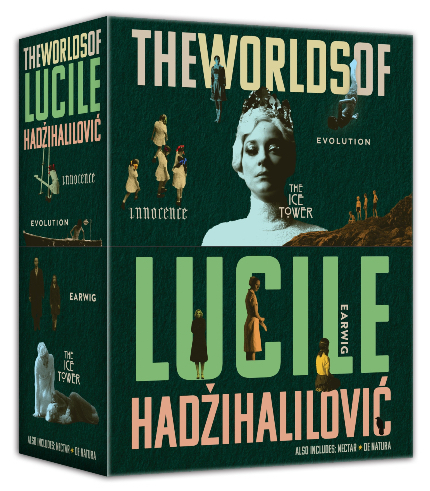
The news that Severin Films was partnering with Yellow Veil Pictures to release a box set of Belgian director Lucile Hadzihalilovic’s films came as a pleasant surprise.
But I quickly recognized that such a partnering made complete sense. While Severin is often thought of as a champion of neglected exploitation cinema, that sort of simplistic labeling makes less sense when you look at their output, which also includes films such as Peter Medak’s Drowning by Numbers (1988), Juenet and Caro’s Delicatessen (1991), and Dennis Hopper’s Out of the Blue (1980).
The truth is that the instincts that have led to Severin releasing box sets of Ray Dennis Steckler, Andy Milligan and Al Adamson, complete with hours of deep-dive extras laden with expert and academic insights, have now led them inevitably in the direction of filmmakers like Hadzihalilovic.
Her debut film Innocence (2004), which told the story of a group of tween girls being raised in an enigmatic and controlling school hidden in the wilderness of an unnamed country, could have been compelling as a simple coming of age tale. But the world this director conjures with her camera offers an atmosphere that celebrates natural beauty and childlike innocence even as it renders the viewer uneasy.
Why do the girls arive at the school in coffins? Are we being invited into a sort of voyeurism? It’s clear the girls are being groomed for something. Who are those shadowy adults watching them dance? Is our innocence something that is freely and eagerly given away? Or is it stolen from us by forces too large to resist? This examination of social dynamics and structures around the tween years has followed Hadzililovic throughout her entire oeuvre.
Her next film, Evolution (2015) shifted perspective to a group of tween boys living on a mysterious unidentified island, cared for by nurses who performed medical experiments on them. It’s a darker film than Innocence, carrying a more palpable atmosphere of danger in the way it explores the phenomena of identity and physical change in the pre-adolescent years.
The boys are clearly being lied to about their bodies by their caretakers, who hide not only the nature of the experiments from them but hide the sometimes fatal results and secretly come together to perform odd rituals around the theme of procreation. When one boy, Nicolas, forms a tentative friendship with one of his nurses, the possibility of escape presents itself. But precisely what is he escaping from?
This ambiguity of time and place is pushed even further in her next film. Earwig (2021) tells the story of a young girl who’s caretaker/?father? cares for her in a dilapidated and dour apartment building. Each night he must fashion her a set of dentures made from ice made out of her frozen saliva, which is collected throughout the day in a special device she wears.
Their existence is a spare one. She makes her own toys out of old newspaper and his only comforts are cigarettes, alcohol and a cabinet of crystal dishes which carry the memories of his past life. One day he receives a phone call instructing him to prepare the girl for life outside the building so that she can be delivered to his ?employers?
Complications and tragedy ensue and how one interprets the end of this film is surely left to chance. In Hadzililovic’s darkest film, beauty and ugliness are in the eye of the beholder.
Her latest feature, The Ice Tower (2025) is an adaptation of The Snow Queen, a classic Hans Christian Andersen fairy tale, and re-teams Hadzihalilovic with star Marian Cotillard, who she previously worked with on Innocence more than 20 years previous. Finally, the director takes us into the most ethereal and perhaps the most dangerous reality of all, setting her story on the set of a motion picture.
Jeanne, a 15-year-old runaway, takes refuge by hiding on the set of a fantasy film production. While there, she falls under the spell of the film’s star, Cristina, who plays an icy snow queen. The deep sense of foreboding pervades as the pair grow closer. Is Jeanne moving toward adulthood or something darker?
In adapting The Snow Queen, one has a sense that Hadzihalilovic has, like her characters, moved, grown. She directly acknowledges the past that made the future possible. But that future remains as potentially threatening and mysterious as ever. There are few filmmakers who are able to harness their imaginations so adroitly to such ambiguity.
The suggestion is that the answer may lie not in the ambiguity of coming of age itself but in the fearless exploration of it, even as family and social institutions seek to limit that exploration. Can the death of innocence lead to something pure, compelling, able to bear the weight of the broken world around it, or at least able to support the psyche underneath it’s thrall?
My conversation with Hadzihalilovic revealed her as a keen observer, a storyteller deeply invested in the idea that cinema, like all art, is a way of exploring the human condition and our propensity to search for meaning even as we find some peace in simply being. I count myself lucky to encounter a fellow traveller.

Do you feel this content is inappropriate or infringes upon your rights? Click here to report it, or see our DMCA policy.

More about Earwig
More about The Ice Tower (2025)
- Now Streaming: THE ICE TOWER Rules, PILLION Romances
- Shudder in June: FIND YOUR FRIENDS, FORBIDDEN FRUITS, THE VOICES OF OUR MOTHER and More
- THE ICE TOWER Official Trailer: Marion Cotillard Stars in Lucile Hadžihalilović's Dark Fantasy, In Theaters October 3rd
- Fantastic Fest 2025: Full Lineup Announced! Sequels For SISU, THE CREEP TAPES And BLACK PHONE in The Mix, WHISTLE to Close
- MotelX 2025: Lisbon Genre Fest Announces First Wave of TItles


