
European Film Awards 2026 Interview: Alice Rohrwacher on Cinema as Future Archaeology and the Politics of Experimentation

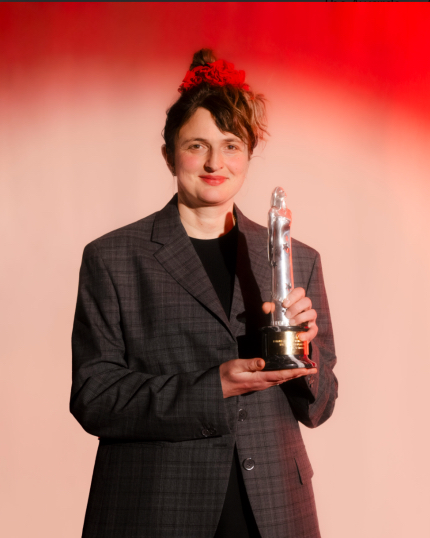
At the 38th edition of the European Film Awards, Alice Rohrwacher was honored with the European Achievement in World Cinema Award, a distinction that feels uncannily aligned with her own understanding of cinema as an act of excavation.
For Rohrwacher, filmmaking is “a kind of archaeological research, but an archaeology that comes from the future,” a way of working in the present as if it were already the remains of a civilization. Rather than documenting reality, she gathers fragments, gestures, dialects, landscapes, rituals, and assembles them into what she calls “an idea of society, an idea of life, an idea of fate.”
This approach has shaped a body of work that moves fluidly between realism and allegory, from To The Wonder to Happy as Lazzaro and most recently La Chimera. In each case, the present feels layered, sedimented, already historical. Rohrwacher has said that she works “in the present as if I were already looking back at it,” a temporal displacement that allows her to treat contemporary rural Italy not as reportage but as a site of myth, labor, faith, and quiet resistance.
Her sensitivity to perspective extends beyond mise-en-scène to questions of authorship. Reflecting on the historical exclusion of women from public storytelling, she notes that for thousands of years women “were not allowed to tell stories publicly,” speaking instead within domestic spaces. The fact that women now speak through cinema introduces, in her view, something profoundly new.
The female gaze can feel “like something alien, a point of view from the outside,” she suggests, not in opposition to existing perspectives but as an expansion of them. This plurality of gazes, including those who are neither simply women nor men, “makes us richer,” subtly shifting the coordinates of narrative authority in European cinema.
Behind the apparent singularity of Rohrwacher’s authorship lies a deeply collaborative process. She repeatedly works with the same creative partners, including her sister Alba Rohrwacher, but insists that continuity is not about repetition. “To work with the same people is an opportunity to change,” she explains.
Each reunion becomes a chance to say, “We have already done this. Now let’s try something else.” For international producers and craftspeople observing her method, this long-term collaboration functions less as aesthetic branding than as an evolving laboratory, allowing the team to search for “what is hidden behind images that we didn’t discover yet.”
Financing such experimentation remains complex. Rohrwacher acknowledges that raising funds is “always very difficult,” yet she resists framing difficulty as inherently negative. Climbing a mountain is difficult too, she remarks, but from the summit “you can look very far away.”
The deeper concern today is not hardship itself but the consolidation of resources around dominant narrative forms. When “the dominant narrative absorbs most of the money,” space for those who still want to experiment diminishes, and this, she says plainly, “is not only difficult, it is sad.” Her observation resonates within a European funding landscape increasingly shaped by market logic and platform expectations.
Myth has long been one of her essential tools for resisting those pressures. In films such as Happy as Lazzaro and La Chimera, mythological and religious undertones surface without ever hardening into dogma. For Rohrwacher, myth serves a structural function. When a story becomes intensely dramatic, she warns, “you risk becoming a victim of the drama.”
Myth allows her “to make a step back and look at the drama from another perspective,” to look not only at the story but at “the gaze on the story.” This distancing effect preserves ambiguity and tonal elasticity, enabling contemporary social dynamics, exploitation, displacement, spiritual erosion, to unfold within a larger symbolic horizon.
Rohrwacher’s path into cinema did not originate in cinephile obsession. Raised in a rural household by a beekeeper father, she grew up immersed in literature, music, landscape, and manual labor. She jokes that beekeepers often appear conspiratorial because they see the world through bees, and bees, she says, are “in advance respect as normal human beings.”
The remark is playful but revealing: perception is always mediated, always slightly estranged. One can arrive at cinema through cinema itself, she reflects, or “through everything that makes cinema that is not cinema, painting, music, bodies, relations, landscape, words.” For her, filmmaking emerged as “the natural confluence of all our passions,” an art form capacious enough to hold the textures of lived experience.
This organic metaphor extends to her understanding of creativity. Early assumptions about filmmaking have given way to a conviction that films “don’t fall from above, don’t fall from heaven, but they come from down.”
Ideas are not imposed fully formed; they grow. “As ideas grow, they change all the time,” she notes, comparing them to plants that must change in order to remain themselves. In one sense, she feels she is “exactly the same person” she was at the beginning of her career; in another, “every minute I feel I’m a different person.” Both truths coexist, much like the simultaneous innocence and awareness of her characters.
Having served on juries at major festivals, Rohrwacher approaches accolades with characteristic humility. Sitting on a jury makes one aware of how unpredictable collective decisions are and how difficult it is “to get a prize.” It also clarifies that “movies are not just about prizes.” Some films resonate immediately, others require time to unfold. The value of cinema cannot be reduced to the immediacy of recognition.
Her work however became part of the very canon she has persistently reimagined. If her cinema is an archaeology of the present viewed from the future, this award inscribes her within that future’s memory.
She once remarked, with disarming simplicity, that “even if you don’t know very good English, you can make movies.” It is an offhand comment that captures her ethos: cinema precedes fluency, belonging instead to those willing to gather fragments, cultivate ideas from below, and look at the world as if it were already, and always, in the process of being unearthed.
Cover image courtesy of © 38th European Film Awards Berlin 2026, Iris Wang.

More about To The Wonder
- The Stack: THE ART OF ELYSIUM, THE DAMNED, ERRORS OF THE HUMAN BODY, THE HOUSE OF SEVEN CORPSES, ISHTAR, And More
- Opening In Mexico: Terrence Malick's TO THE WONDER
- Review: TO THE WONDER Swirls With Grace
- 70s Rewind: DEADHEAD MILES, A Trucker Comedy Written By Terrence Malick
- Lots Of Wide Angle Ben Affleck, Must Be The TO THE WONDER Trailer


