
THE FURTHER MIS-ADVENTURES OF CLIFF BOOTH Review: Not a True Bromance
Brad Pitt, Elizabeth Debicki, and Timothy Olyphant star. David Fincher directs. Quentin Tarantino wrote the script.

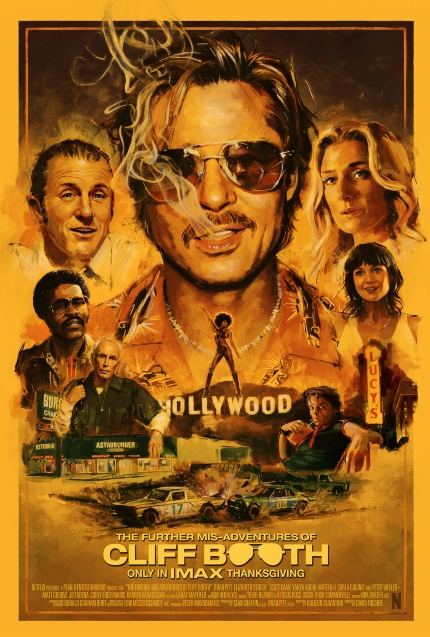
When Once Upon a Time in… Hollywood came out in 2019, and later, when Brad Pitt was nominated (and won) for playing a supporting role in that film, there was quite a discussion going on regarding whether his character, Cliff Booth, was indeed a supporting one.
Seven years later, it is finally clear that yes, he was, and Quentin Tarantino’s movie benefited greatly from not really focusing on one particular hero, instead offering several characters to the audience in measured doses.
The reason why this now comes off like such an inspired choice is The Further Mis-Adventures of Cliff Booth, based on Tarantino’s screenplay and directed by David Fincher. As advertised in the title, the film is centered around Pitt’s character, who, upon becoming the lead, proves to be absolutely insufferable.
The film picks up eight years after the events of Once Upon a Time, so we find ourselves in the Hollywood of 1977. The innovations of the New Hollywood still reign, but the release of Star Wars, which is taking over theaters, foreshadows the blockbuster era that will soon engulf the industry.
Not that the cinematic context factors all that much in Cliff’s present “mis-adventures.” While the 2019 film also depicted a transitional time period, it was above all things a story about the magic of cinema as something that shapes our mindsets so much it can actually transcend reality and rewrite history. Here, the movies are mostly reduced to the nitty-gritty industry business Cliff is now involved in as a fixer, and it’s the setting that gives him multiple opportunities to go out into the night (lit and colored insipidly in gloomy tones that are all the rage right now) to do and say cool things.
Coolness has always been a staple of Tarantino’s cinematic universe, an aesthetic tool all on its own, but here both the author of the script and the actor shamelessly overindulge in that regard. It’s hard to root for Cliff because he honestly doesn’t require it. Whether he’s sorting out some amateur crooks (Karren Karagulian and Corey Fogelmanis) who stole from his director friend or romancing a former film critic turned agent, Karen Crosby (Elizabeth Debicki), there is always a sense that the odds are forever in his favor.
As Cliff, Pitt exudes so much exuberant charisma, it becomes more jarring than actually convincing, even if Debicki – the true star of the film – seems to be contractually obligated to gaze in awe at him every time Cliff says or does something supposedly amazing. It’s also telling that Tarantino doubles down on the most controversial element of Once Upon a Time – that memorable brawl with Bruce Lee – which has apparently become Cliff’s trademark, a fact the former stuntman is now known for and gets mentioned on multiple occasions.
It doesn’t help that Tarantino’s script keeps delaying the start of an actual plot. At some point, Cliff is contacted by Karen on behalf of her client, famous actor Charlie Peters (Scott Caan). Charlie is known for doing his own stunts, so Cliff wonders what his interest in him might be, and the audience is meant to keep wondering along with him up until around the 100-minute mark.
Delayed gratification isn’t anything new when it comes to Tarantino’s writing, but this might be the first time when there is truly not much to fill the void in the story he's telling. So much so that at some point there is a whole-ass slo-mo sequence of characters playing tennis, which somehow manages to be less intense than the tennis match in Bridesmaids was.
And then there is the whole issue of David Fincher working off Tarantino’s script, which had the potential to turn into an interesting creative bromance or a spectacular clash of movie-making titans. They are just too different in almost any regard except for their shared love of casting Brad Pitt. Where Tarantino tends to be prone to nostalgia, Fincher is mostly interested in looking forward. Where one isn’t always a fan of formal stylistic perfectionism, the other sure is.
These myriads of differences promised a film that could be aesthetically patchy, but at the same time, artistically inspired. Instead, the ending result is mostly… tame. Fincher’s direction is as capable as always, but nothing in what we see and hear on screen gives an impression of him being particularly excited about the material.
In the end, The Further Mis-Adventures of Cliff Booth isn’t really a Tarantino movie or a Fincher one. In reality, it’s a movie with two hours of very talkative foreplay, all leading up to three minutes of action.
The film is now playing a limited engagement, only in IMAX theaters, via Netflix, where it will begin streaming later in December.


