Rotterdam 2025 Interview: Toshiaki Toyoda

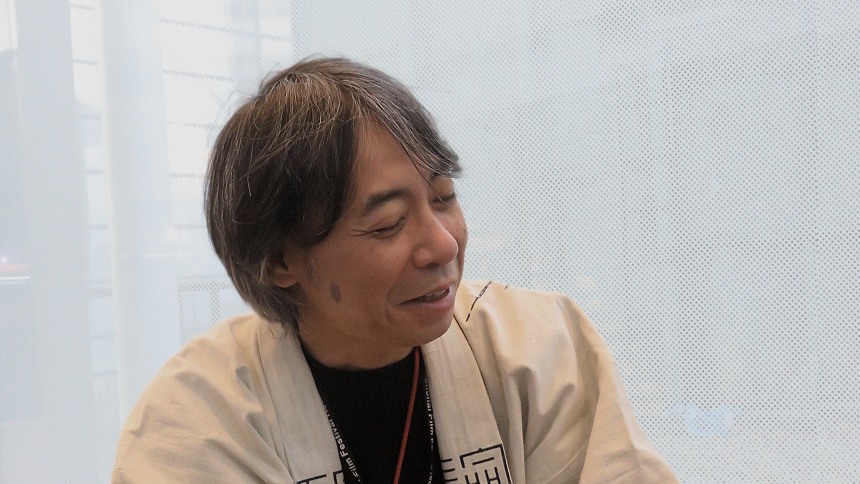
At the beginning of the year, at the International Film Festival Rotterdam, I interviewed Toshiaki Toyoda about his film Transcending Dimensions, which premiered at the festival. But life got in the way, because as they say, life is what happens when you are making other plans. So very belated, here is the interview with Toyoda, slightly truncated and edited for clarity.
Theodoor Steen: So, let's talk about Transcending Dimensions. What ideas did you want to convey with that film? Because there is a lot going on there...
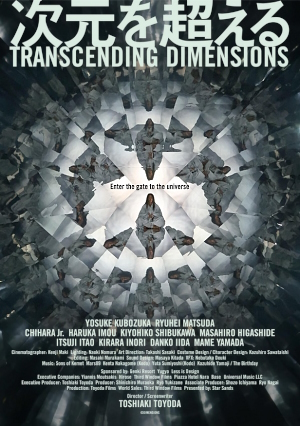
Toshiaki Toyoda: I have been a film director for about 30 years. To begin with, I was depicting loads of violence in my films, as you probably know. But then as I started getting older.... then I started thinking about depicting death in a different way. More cerebral. And when you meditate on death, the concept of a cult is kind of an easy medium for that. That's why I chose the cult as a setting, these days especially. For me Transcending Dimensions is about death and cults, basically.
TS: The Wolf Shrine-films, of which Transcending Dimensions is a part...There are five of them now, according to IMDB. They come from a place of anger. Can you talk me through the things that you are critiquing in each of the films?
TT: It's actually 6 shorts all together, and now Transcending Dimensions as the feature.You probably have been watching all these films through the Third Window release? There are actually the first three that are on the Third Window disc, and a few that have not been released and are not even on IMDB yet, so that's why, but it's actually 7 films in total, including Transcending Dimensions. So I actually have been releasing one every year for the past six years. You have Wolf's Calling, Day of Destruction, Go Seppuku Yourselves. Those are widely seen, and on the Third Window disc. Then there is something called Alive, and the other two are Right Now and Be Right There. They actually all started with the the incident where I was arrested by the Japanese police for having my granddad's unusable gun in my possession. That was the first time that I started doing this project. I was angry about that situation. And Day of Destruction, it did coincide with the COVID pandemic. And then that was sort of like, my feelings on COVID. Then Go Seppuku Yourselves, I think it is kind of like my resentment against the Japanese government, how they dealt with the fallout of COVID. Because it wasn't really good how they handled that. The tone changes with the next three. The next one is called Alive. You haven't seen it. With that one I just wanted to let everyone know that I am alive right here, right now. I still exist. The other two are very similar in theme and message. Right Now states that I am always here, right here, right now. And the last one, Be Right There, is about how if you call me, I will be there straight away. These three films let people know that if you need me, I'll be there. They fit together as a package, with the message that I am here. I'll be there to help you.
 TS: And how do they fit with Transcending Dimensions?
TT: Because this is a feature film the theme is quite different. The only thing that's consistently coming up is the shrine that you mentioned. It's always what we call the Mount Resurrection Wolf Shrine in there. That's the one theme that I used throughout those six films and now the seventh one. But having said that, Transcending Dimensions is me just throwing a question to the audience: where are we coming from and where are we going. The lead even asks that question in the film.
TS: Regarding the name Mount Resurrection in the Wolf Shrine films: resurrection is a theme in a lot of your films. Where does this interest in renewal come from?
TT: This is my message to the world about myself. Because when I was a teenager, I was into shogi, which is sort of like Japanese chess. I was doing shogi for a long time. And then I kind of left shogi to do some films. I worked in the film industry for a long time, after that. And then during my 30s, I was arrested by the police in a drug bust. I was pushed out of the industry for a while. I came back with the Blood of Rebirth. That was my grand return to the film industry. After that there was The Miracle of Crybaby Shottan. That is the story of a guy returning to where he started. My message throughout my films has been that anyone can be revived, and anyone can be resurrected or make a comeback. That has been the main message throughout my career, up until now.
TS: Yeah, and I feel like the last few films I've seen of yours really, really feel like a renewed spirit. They are bursting with energy.
TT: Thank you so much. That means a lot.
TS: I wanted to ask about the music in Transcending Dimensions because I noticed that music plays a big role in most of your films and especially in something like Shiver, which is a performance film. And Transcending Dimensions... you have the Sons of Kemet soundtrack being very present. What comes first for you? The visuals or the music?
TT: With Shiver things went differently. That one is an outlier, because the music came first. So obviously the visuals came second because without music there was no Shiver anyway. That aside, the rest of my films, the visuals definitely come first. I choose the music afterwards.
TS: Because what I noticed is how well the camerawork and the music fit together. How do you approach camera work? How much of that is already in the screenplay?
TT: Well, obviously when it is a big budget film or something...I really have to put whatever is going to be on screen very clearly on the page in the screenplay as well. Sometimes I even put some direction notes in the script. What it comes down to is that when I am gonna edit, the camerawork all needs to fit together. So when I start thinking about the camerawork, I already am taking the editing into consideration. Otherwise I won't be able to make it all fit together. The importance of my camerawork is that it needs to be visually striking, but I also need to be able to edit it easily. With these two elements in mind I came up with the camera movements. Some of the bigger set pieces, camera wise, need to be prepared quite thoroughly, so they will be present in the screen writing. All stages, writing, filming, editing, fit together.
TS: I get that. Because for instance, in Hanging Garden there is a scene with this camera that does a sort of cartwheel, while the editing skips through times. It is clear that you need to approach that quite thoroughly from an editing perspective while shooting, otherwise you wouldn't be able to do that, right?
TT: Exactly. With Hanging Garden, that was already planned during the writing stages. Because that was a really big job. In that scene you have the regeneration of the family, as well as the blood connecting through all the family members. It's all conveyed visually. That was all on the page.
TS: It's my favorite of yours. It's a stunner.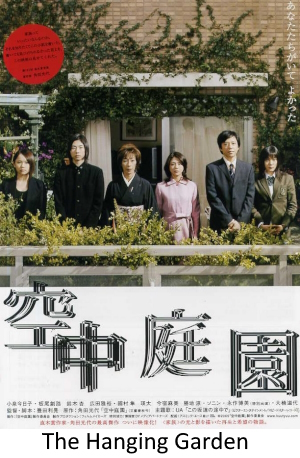
TT: I can't make that one anymore (he laughs)
TS: So when you have actors on set, thinking about for instance the suicide scene in Transcending Dimensions, the camera works really beautifully together with the actors in that scene. Do the actors have a lot of wiggle room or do they need to stick to choreography?
TT: We normally discuss everything with the actors. So I take my opinion, and I listen to their opinion, and we take both sides, and end up somewhere in between. I feel it is really important to listen to actors' opinions as well. That being said, I do have a plan in my mind when I come to the set of what goes where. And how it all fits together. I tend to stick with what I imagine, but I also let the actors do their job as well. And trust them. It is collaborative. I do want to realize the visual that is in my head. But with the actors input in there as well.
TS: To make it come to life, in a way?
TS: Exactly. But I never storyboard. I tell them verbally what to do, and it is in the screenplay. But storyboards? Never.
TS: I'm surprised by that because. It looks so...
TT: (he laughs) No, I never, ever storyboard! Because you know. Once I make a storyboard, I kind of commit myself to it, and then I can't actually have any leeway anywhere to change anything. So I don't want to do that.
TS: Not even the Hanging Garden cartwheel shot?
TT: No. Never. Not even with that one. It's hard. I don't know which is harder. Not having a storyboard, or having one.
TS: So there is a lot of room for spontaneity then on set, then?
TT: Yeah, exactly. That's why I do it how I do it.
 TS: Oh, that's wonderful. Do you have examples of something in Transcending Dimensions or the Wolf Shrine films that came up spontaneously?
TT: You know, actually the person who is in charge of the cult in Transcending Dimensions, and one of the practitioners....I think that was Kiyohiko Shibukawa, who actually came to confront him and the was trying to knock him out, but instead he got knocked down himself? The line he says after that, that bit was actually improvisation.So, you know, everything before that moment was in the script, but all lines after are improvised. When he says "No one can change me" in the tunnel, that was improvisation as well.
TS: Those are quite big lines.
TT: They are. But it worked out wonderfully. And, Ryûhei Matsuda, for instance, he really doesn't like to stick with the lines that I came up with and is always changing them or he refuses to say certain things. You know, he actually omits things that I want him to say and he doesn't say them. And it works well a lot of the time.
TS: That's wonderful and funny. In Transcending Dimensions.... I felt there was a lot of
humor, like the seat warmer in the cult made me laugh out loud and there is a very surrealist sense of humor. What is the place of comedy in your work?
TT: Well, comedy and I are inseparable because I am from the Osaka region, which is like a Mecca of Japanese Comedy. And an actor like Chihara Junia, the person who plays the cult leader. I've known him since he was 19 and he's a renowned comedian in Japan as well. He brings a lot of fun to that character. So, you know, honestly, it's so inseparable with my work for me. I kind of grew up in comedy. So you know that that says it all, really.
TS: Yeah. I thought it was a very funny film. And they do evolve, in my opinion. Because I feel like Wolf's Calling and Day of Destruction and Go Seppuku Yourselves are very angry films and here there's more air in this film, more room to breathe.
TT: This one is more of a comedy, yes. But that is because this one is a feature film. The rest of the Wolf Shrine films are shorts of course, and you need to be to the point there. But when it comes to features, I always put in a lot of comedy. Because you can't have a long film without some levity. And this one is no different than my other features. That is why you see more of that in there.
TS: That makes sense.
TT: I also often cast the actor Itsuji Itao in my films. He's a really good, well known comedian as well. He wasn't in this film, but he was the father in Hanging Garden for instance. He is a really renowned comedian. I always tend to cast comedians in my films.
TS: Final question. I did write an article about some of your music videos once, and I wanted to ask, do you approach those music videos differently than your feature films or shorts?
TT: I am gonna shoot a new music video in a few weeks actually. It's a really, really, really low budget thing. It's actually ¥500,000, which is like it's nothing. But you know that that's what the music industry is today in Japan. You know, they don't really have any money to spend. I am doing it for my friend. All the music videos are favors. I am friends with all of these people. That's why I'm doing it. So not for fame or money, or anything like that. What video have you written about?
TS: I focused on Asian Kung Fu Generation's A Flower Named You and I compared it to some of the scenes in Hanging Garden.
TT: Yeah, after 9 Souls, I kind of like I was experimenting with style, you know?
I really wanted to try it, so that's why I did it like that. I always want to evolve my filmmaking.