
Locarno 2026: Virginie Efira on Her Crooked Path From TV, a 20-Minute Japanese Take in Heels, and Why Acting Begins With Listening

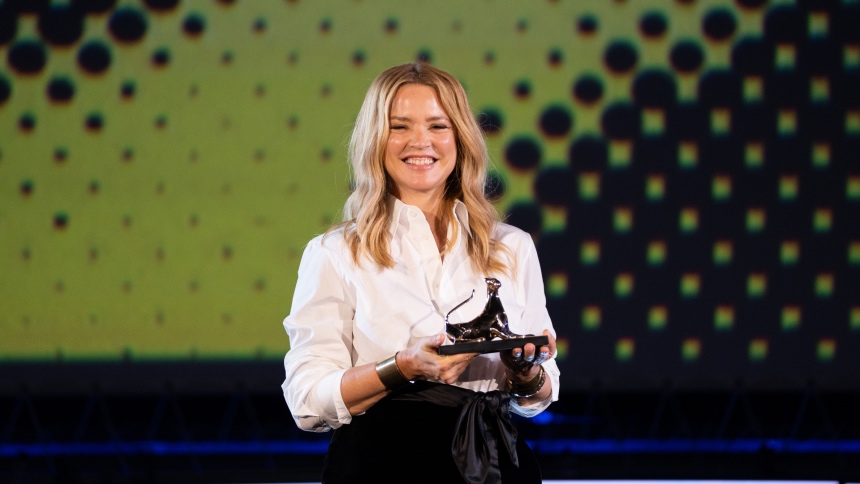
The morning after Virginie Efira accepted the Leopard Club Award in the Piazza Grande, the 79th Locarno Film Festival offered a less ceremonial measure of her career.
In a public conversation moderated by Cahiers du cinéma critic Thierry Méranger, the Belgian-born actor moved from television and romantic comedy to Paul Verhoeven, Justine Triet and Ryūsuke Hamaguchi without presenting any of it as a tidy ascent.
Efira’s filmography can accommodate the provocations of Benedetta, the bruised aftermath of Revoir Paris, the social tensions of Other People’s Children and the expansive duration of Hamaguchi’s All of Sudden. Yet her account of getting there was allergic to the familiar story of an actor engineering a prestige phase. She returned instead to encounters, embarrassment, curiosity and entering a filmmaker’s system before knowing the result.
Efira grew up wanting to act. As a child she kept her own cinema notebook and wrote reviews for herself. She had made cinema so sacred that achieving the dream risked diminishing it. “If I managed to get there, then I couldn’t really get there, because it would lose something sacred,” she recalled. “So I sabotaged myself.” Television presenting arrived by another route, and for a time she decided an adult did not have to remain faithful to childhood desire. She tried to find value in the job at hand.
Only after leaving Belgium did she recognize its insistence on self-mockery, distance from oneself and a taste for the absurd. Those qualities eventually helped with the status anxiety of entering French cinema from television rather than the Comédie-Française. The useful change came when she stopped trying to replace the history that had made her. “Your path is crooked, it’s a little strange, but it’s yours,” Efira said. “It creates an identity that is valid in itself.”
Comedy was not a commercial apprenticeship to discard once serious films arrived. Efira joked that a “friendly face” and “good cheeks,” combined with television fame, made early offers inevitable. But when it works, she said, comedy is an act of generosity, using lightness to reach depth. That conviction resists the industry habit of treating popular work as a guilty past and auteur cinema as absolution. It also connects to the tangible, ordinary women she later played in small-budget social dramas.
“I never really think about the end result,” Efira said. “It’s in the present: do we feel that something can be made? Of course with a character, but perhaps above all with a director.” Delphine Deloget’s documentary background and personal way of looking at the characters of All to Play For created that possibility before image or outcome entered the room.
This helps explain why so many crucial collaborations have been with women, including Triet, Rebecca Zlotowski, Catherine Corsini, Anne Fontaine and Deloget. It was never a checklist, Efira stressed. Women remain more present in auteur cinema at small and middle budgets. Those same lower budgets can permit greater storytelling and formal freedom because fewer edges must be smoothed away. Following the most personal work has led her repeatedly to women directors.
Victoria, her first film with Triet, became “almost a small inner revolution.” Efira learned to shed some self-consciousness and locate herself inside the film rather than ask the film to organize itself around the actor. Their return on Sibyl carried a different risk. Familiarity can become a machine that runs too easily.
Gena Rowlands supplied an earlier model. Her physical solidity helped Efira accept a body that did not fit her idea of a more ethereal, Parisian femininity. More enduringly, Rowlands represented performance as collaboration, her creativity cannot be separated from the formal conditions John Cassavetes created around it. “People often speak about her through Cassavetes,” Efira said, “but Cassavetes is also understood through her.” That two-way authorship is foundational for an actor who chooses filmmakers by the quality of a possible encounter.
Efira also registered material changes after #MeToo. She entered cinema from television with more economic power than many young actors possess. Among actresses of her generation who started earlier, she said, almost everyone had a story that was “not all right.” Abuse is far from solved, but what was invisible can now be named. Productions hold collective discussions and designate representatives, while scripts are less reflexively trapped in stories of maternal guilt and male infidelity. Progress is precisely the reason, she argued, to keep pushing.
All of a Sudden may be the most radical version yet of Efira surrendering to an apparatus. Locarno presented Hamaguchi’s 196-minute French-Japanese drama alongside its tribute to the actor, who had shared the Best Actress prize at Cannes with co-star Tao Okamoto. Efira plays Marie-Lou Fontaine, the director of a care home whose life opens outward through an encounter with Mari Morisaki, a terminally ill Japanese theatre director played by Okamoto.
The source material is a correspondence between philosopher Maoko Miyano and medical anthropologist Maho Isono. One receives the sentence that supplies the French title: suddenly, your condition could deteriorate. Efira admitted that a theoretical description of a three-hour film about care and the end of life might sound like something to postpone. Reading the script produced the opposite response. Its ideas were already generating emotion. “Perhaps it even finds a solution, and the solution is the other,” she said. “It is never a moralizing film. It is so intelligent and poetic. It’s a film that opens you up.”
Efira had seen only Drive My Car when the project reached her. After meeting Hamaguchi and encountering his extraordinary attention, she watched the rest and “entered the religion,” as she put it. All of Sudden remains alert to Japanese experiences of time and detail while becoming a French film, including a work of social cinema. For Efira, that formal pressure changes acting more deeply than a list of character traits can.
She cleared her schedule and studied Japanese obsessively. Hamaguchi required her to begin by learning to read the language, a demand to be inside the material rather than reproduce its surface. She also had to discover how emotion travels through a different grammar. French intensity may enlarge gesture and accent. In a language and culture of greater restraint, she found that force could require a phrase to become more condensed, even quicker. The work altered “your way of being and thinking.”
One scene distilled the challenge into a feat worthy of an action film. For nearly 20 minutes, Efira delivered Japanese dialogue with the educated accent of a Waseda University graduate while descending the long wooden steps at Paris’s Bibliothèque nationale. It was raining, the edges were difficult to see and she wore heels beside the taller Okamoto. A mistake meant returning to the beginning while the light faded. “You have to get rid of the stress,” she said. Completing the take meant finally living inside a structure that had seemed impossible.
Hamaguchi displaced conventional actor direction. The cast read the text repeatedly without intention, “like a sequence of numbers,” and received 17 questions designed to circle a character’s mystery rather than imprison it in psychology. They filmed scenes that would not enter the feature, building memories for the characters to carry. Most revealingly, he often concentrated on the actor who was not on camera. “Your quality of listening will inevitably have an impact on how I am,” Efira explained. “That, too, is acting.” Attention became technique and ethic on a set she experienced as collective and unusually free of hierarchy.
Verhoeven offered an opposite route to uncertainty on Benedetta. When Efira asked how to prepare to play a seventeenth-century nun seized by religious and erotic visions, he told her: “You know what you must do.” She did not, so she worked privately and arrived with proposals. His direction protected ambiguity, while his refusal to alter Efira’s modern appearance freed her from anxious historical naturalism. She imagined prayer as a telephone call to God. Verhoeven’s verdict was perfect: strange, but probably good.
Efira believes in preparation followed by forgetting. Do the work, then arrive in the here and now, receptive to the surrounding world. Early in her career, a sad scene meant trying to summon sadness first. Later she discovered that breath and physical action could produce the feeling. The actor activates the body and emotion follows. For someone who admits to controlling too many details off set, acting’s demand to let go is not a personality trait but a necessary counterpractice.
Choice is the other half of the job. Efira has made dozens of features, but an actor’s work also happens between shoots. What to accept, how to accept it and how to refuse. She does not anticipate what an audience wants. The relationship she values is built across a filmography, as viewers recognize an inner resonance connecting one risky choice to the next, even if, she joked, only five people follow the thread.
That thread is political without requiring every actor to become a social-media pundit. “A thought that can move us forward doesn’t fit in two sentences,” Efira said. A film choice, however, already carries a view of the world. The question is whether its director is hostage to received ideas or has a perspective that can open them. She extended that politics to the conditions of production. Work with Hamaguchi and Asghar Farhadi depends partly on France’s commitment to financing films other systems cannot sustain.
Her advice to a young filmmaker in the audience followed the same anti-gatekeeping logic: make things. Tools are more accessible. Stories can be invented and shot with people who make one another laugh and have something personal to ask. “Don’t wait,” Efira said. “Follow your own path.” Desire can generate desire in others, while merely entering the industry guarantees neither nourishment nor interesting company.
Image courtesy of Locarno Film Festival / Ti-Press



-thumb-80x80-107109.jpg)

