
AVATAR: FIRE AND ASH Review: Another Visual Marvel Undercut by Sloppy Storytelling, Underdeveloped Characters, and Cliched Dialogue

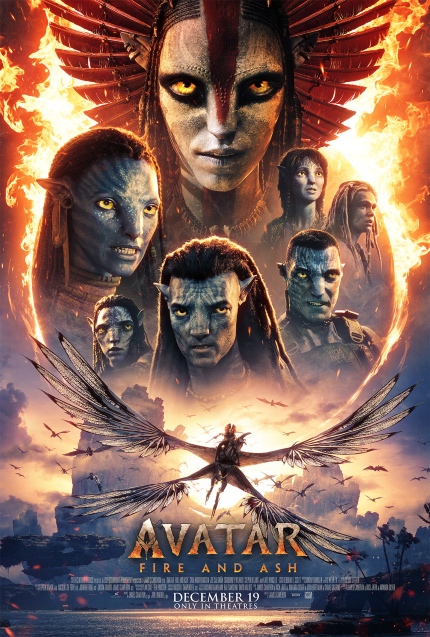
Despite their supposed lack of pop cultural impact or influence, the James Cameron-directed Avatar films (2009, 2022) have collectively grossed more than five billion dollars, suggesting that, whatever the series’s inability to break through to the terminally online, Avatar and Avatar: The Way of Water resonated with global audiences, albeit as singular "event" experiences.
Cultural impact or influence aside, the Avatar series remains technologically innovative, the apex of motion capture and world-building, both the direct result of Cameron’s (Titanic, Aliens, The Terminator) single-minded obsession with digital technology. Where Cameron’s vision collided with technological roadblocks, he found ways around — or more accurately, through — them, but for all of Cameron’s irrefutable technical achievements as a filmmaker, his limitations as a narrative storyteller sadly remain unchanged, up to and including stock situations, genre tropes, and cliched, cringe-inducing dialogue.
The third of a planned five-film cycle, Avatar: Fire and Ash suffers from all three problems, made worse by Cameron’s over-reliance on emotional beats and plot turns lifted wholesale from the previous film, Avatar: The Way of Water, pointing toward, if not creative exhaustion, then whatever immediately precedes creative exhaustion.
Picking up roughly a year after Avatar: The Way of Water's events, Avatar: Fire and Ash finds Jake Sully (Sam Worthington), the former Colonial Marine turned Na’vi super-warrior, husband, and father, on Pandora, a lush, resource-rich moon orbiting a planet in the Alpha Centauri system. Scully went “native” Dances with Wolves-style, leaving behind both his humanity and the rapacious, settler-colonists funded by the Resources Development Administration (RDA), an Earth-based mega-corporation more powerful than any national or international government. Scully’s side-changing betrayal made him a savior to the Na’vi, and a traitor to the humans he left behind.
The death of Scully’s oldest son, Neteyam (Jamie Flatters), in the second film, continues to haunt Scully and his immediate family: Neytiri (Zoe Saldaña), Scully’s partner; Neteyam’s mother, Lo’ak (Britain Dalton); Neteyam’s younger sister, Kiri (Sigourney Weaver); Scully and Neytiri’s adopted daughter, Tuk (Trinity Jo-Li Bliss), the youngest and seemingly the most superfluous member of the Scully clan; and Spider (Jack Champion), a self-exiled human and the biological son of Scully’s resurrected foe, Colonel Miles Quaritch (Stephen Lang).
A jarhead limited by his military training/indoctrination through and through — and in desperate need of counseling and/or therapy — Scully remains tethered to anger, denial, and grief at Neteyam’s loss. Acceptance, if it comes at all, has to wait for the third film’s final moments. An obstinate, inflexible Scully refuses to acknowledge the deep, possibly irreversible wounds his loss has had on his family, specifically Lo’ak, the family screw-up and Scully’s least favored offspring, and Neytiri, who's focused her justifiable anger at the human settler-colonists toward the loyal, if desperately naive, Spider.
This time out, Cameron bizarrely decided to center the plot on Spider, initially on the batteries his breathing apparatus requires to survive on Pandora, and later, through a combination of contrivances, coincidences, and circumstances, on Spider holding the key to humans surviving outside their artificial buildings and cities on Pandora proper. Humans acclimating fully to Pandora’s atmosphere would lead to the expansion of human settlements on Pandora and its likely destruction as the RDA extracts every resource possible.
Cameron and his co-screenwriters, Rick Jaffa and Amanda Silver, elevate the usual stakes (humans vs. Na’vi) by adding a third Na’vi clan, the Mangkwan, defined by their brutality, violence, and expansionist territorial impulses. Led by the sado-masochistic, sociopathic Varang (Oona Chaplin), the Mangkwan represent a real existential danger to Scully, his family, and their adopted clan, the seafaring Metkayina (the “Reef People”).
Crudely mirroring American history and the temporary alliances British and American settler-colonists formed with Native-American tribes against other Native-American tribes, the Mangkwan and their alliance of convenience with Quaritch and the RDA represent not just a third, new-to-the-series Na’vi tribe, but the only real or significant addition of any real consequence. Instead, Cameron heavily relies on a greatest hits compendium of the first and second films’ narrative highlights or key plot points.
An early, magnificently choreographed set piece involving Mangkwan raiders attacking merchant Wind Traders, and Na’vi who fly the skies above Pandora aboard ships powered by diaphonous, organic, sail-like creatures, throws everything at Scully, his family, and the audience on the other side of the screen. Narratively, it serves to separate Scully and his family from each other, leading to multiple, often unsuccessful attempts to reunite. As a sensory-expanding spectacle, it’s unmatched, a testament to Cameron’s ability to choreograph multiple, interweaving set pieces.
Unfortunately, Avatar: Fire and Ash never matches the level of invention, imagination, or immersion of that set piece again. Instead, the third film devolves into a painfully familiar series of escalating complications, many lifted with minimal variation from the first or second film, an overlong, if oddly charming sequence involving the whale-like Tulkuns, a peace and/or war council, and Payakan, the Tulkun outcast who broke the pacifict norms of his species to engage whaling ships in the second film.
Payakan once again argues not just for self-defense, but for preemptive defense (i.e., attack in force and in kind). In opposition, the Tulkun elders stubbornly refuse to acknowledge the danger humans and their technology represent.
Wind Trader sequence and Payakan-centered counsel aside, Avatar: Fire and Ash devolves into a series of repetitive, borderline redundant set pieces as Scully, his family, and their allies battle Quaritch, the RDA, and the Mangkwan clan in the air, on the ground, and on the sea for the better part of a sensory-deadening hour. Superficially satisfying? Maybe. Enervating? Without doubt, hesitation, or reservation.
To Cameron’s minor credit, Avatar: Fire and Ash feels like a conclusive finale to the three-story arc begun sixteen years ago, and not just another open-ended sequel. Of course, Cameron left himself several outs, specifically one or two dangling plot threads that could be picked up in the fourth and fifth films (assuming they, in fact, happen as planned). For that, at least, we can be somewhat thankful.
Avatar: Fire and Ash opens Friday, December 19, only in movie theaters, via Disney Pictures. Visit Fandango for locations, showtimes, and ticket information.
Avatar: Fire and Ash
Director(s)
- James Cameron
Writer(s)
- James Cameron
- Josh Friedman
- Rick Jaffa
Cast
- Kate Winslet
- Zoe Saldaña
- Edie Falco

Do you feel this content is inappropriate or infringes upon your rights? Click here to report it, or see our DMCA policy.


