
Locarno 2026: James Gray on Why Every Director "Steals Like Crazy"

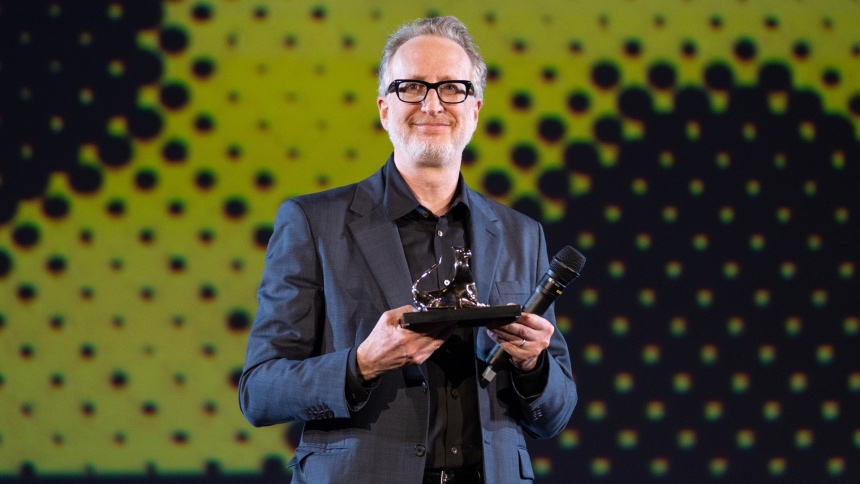
The 79th edition of Locarno Film Festival welcomed James Gray and honored him with the Pardo alla Carriera. He presented his latest feature, Paper Tiger, in one of the largest open air cinemas in the world, Piazza Grande.
A career award might invite a filmmaker to impose order on three decades of work. Gray did almost the opposite. In a sprawling, profane and frequently self-mocking conversation, he described a life in cinema ruled by luck, borrowed forms, difficult actors, technical frustration and the stubborn pursuit of an emotion that cannot be reduced to a concept.
The useful argument underneath the performance was simple. Filmmakers control far less than the mythology of a career suggests. What they can control is the honesty of their attention.
Gray returned repeatedly to sincerity, against novelty as a market demand, ironic distance as a protective pose, machinery that separates actors from experience, and political art that knows its moral answer before confronting the ugliness of human behavior.
His own beginnings supplied the corrective to every tidy breakthrough narrative. Gray shot his debut Little Odessa at 23. The company that financed it did not know what to do with the finished film and considered shelving it. Italian partners sent it to Venice, where festival director Gillo Pontecorvo put it in Competition.
Gray remembers the premiere as half-empty and dead silent. He flew to Los Angeles believing his career was finished, only to be summoned back after the film won the Silver Lion. One jury’s response changed the meaning of the same object overnight.
Gray credits the support of jury president David Lynch and fellow juror Nagisa Oshima with rescuing the film, but he refuses to retrofit the accident into strategy. “We like to think, ‘I planned it out. I went to Venice and I got that prize,’” he said. “No. I was a shithead. I didn’t know what I was doing. I was nervous, and it somehow worked out in that moment.” The lesson for a first-time filmmaker is not to wait for luck. It is to stop confusing an outcome with proof that everybody involved foresaw it.
The part Gray does claim as a strength is his work with actors. His films have repeatedly joined emerging performers to established movie stars, from the ensemble of The Yards to his long collaboration with Joaquin Phoenix.
He grew up in New York with Elia Kazan as an early model and heard Stella Adler speak about acting when he was 12. That history left him with a hierarchy that can be uncomfortable on a production obsessed with coverage. The person inside the frame comes first. “You cannot do anything to fix a close-up with an actor that isn’t thinking or isn’t interesting to watch,” Gray said. “There’s nothing you can do to solve that.”
Camera position, lens, set and light all matter to him. Cinema is, in his phrase, “totally unforgiving.” But technical precision cannot manufacture interior life. For filmmakers, that shifts preparation away from collecting attractive shots and toward building circumstances in which an actor can think.
Casting, trust, playable direction and the time to watch what happens are not soft additions to the image. They are the image’s irreplaceable content. An imperfect shot of a living response may carry more cinema than an immaculate close-up of a predetermined result.
Gray’s faith in actors connects to his preference for what he calls operatic emotion. He resisted describing We Own the Night as melodrama, not because the film lacks heightened feeling, but because melodrama is often used to imply excess or manipulation. Opera means something more exact to him: Total commitment to the authenticity of the moment, without the safety valve of distanced irony. Puccini’s emotional directness matters more than fashionable restraint.
That commitment became sharper on Two Lovers, his first feature with creative control. Gray recalls being given $9.8 million, Phoenix and Gwyneth Paltrow, and then being left alone. The freedom was not merely pleasant. It reduced the number of battles surrounding the thousands of decisions from which a movie is built. “You make 10,000 decisions on a movie,” he said. “If you make 9,900 of them correct, the movie is god-awful.” Fighting for the remaining hundred while also fighting for permission is how coherence disappears.
Creative control, then, is not an auteur’s ornamental privilege. It is decision architecture. The smaller budget on Two Lovers bought Gray a cleaner relationship between intention and result. Independent filmmakers cannot always secure final cut, but the principle is portable. Identify the decisions that define the film, know who has authority over each one, and reduce the places where taste can be renegotiated by surprise.
Across Gray’s filmography, sincerity has required different formal containers. The Immigrant was conceived as an opera without vocals or a conventional score, extending compassion toward a woman whose experience echoed stories from Gray’s own family. Armageddon Time pushed the personal method almost to an extreme. The production filmed near his childhood home and reconstructed rooms from family photographs, down to the plates. The detail mattered because Gray wanted no escape from his own implication in the story.
The Lost City of Z tested sincerity against physical hardship. Four months in the jungle brought predawn insects, violent rain, disappearing light, illness, and animals indifferent to the schedule. Gray’s larger point was not that suffering makes art legitimate. It was that material conditions enter the film, whether a director wants them to or not. The arduousness became part of the image.
Ad Astra presented the reverse problem. Instead of the jungle’s uncontrollable reality, Gray faced wires, green screen, repeat passes for visual effects and an apparatus that made intimate behavior increasingly difficult. He was trying to make what he called a “myth of man,” but kept asking whether he could reach sincere emotion with the machine in the way. The issue was not effects themselves. The finished film’s visual power is real. It was whether process was helping the actor inhabit experience or asking performance to survive an abstraction.
Paper Tiger brought Gray back to Brighton Beach and the Russian-American world of his debut, with Adam Driver, Miles Teller and Scarlett Johansson caught in a story of family, debt and a criminal opportunity collapsing into nightmare. It also gave him the sharpest formulation of his position on influence. Asked about a climactic shootout and the films behind it, Gray rejected the ritual claim of originality. “Every director steals like crazy,” he said.
Gray pointed to visual ideas moving through film history, including imagery in the 1925 German science-fiction film Our Heavenly Bodies that anticipates the rotating-spacecraft illusion of 2001: A Space Odyssey. His purpose was not to prosecute Stanley Kubrick for influence. It was to dissolve the shame around learning from existing work. Cinema is a continuum of solutions. Compositions, lenses, rhythms and staging can be studied, remembered and transformed. Denying that inheritance produces mystification, not originality.
The crucial distinction is between the source of style and the source of feeling. Gray acknowledged a memory of Masaki Kobayashi in the tall-reeds sequence in Paper Tiger, but said its terror came from getting lost in tall grass with his brother as a child. The borrowed element helped answer where a lens might go. For this film, he deliberately avoided a new round of reference screenings. His cinephilia was already inside him. He wanted memory to distort the sources and characterization to lead.
“Be very, very scared of the word ‘fresh,’” Gray said. “What is fresh today is spoiled tomorrow. Don’t be about what’s fresh. Be about what’s honest. Be more daring and more sincere.”
His attack on newness is really an attack on novelty as product language, the promise that this year’s soap is “new and improved.” It does not excuse cliché.
Gray argues that inherited material becomes particular when it passes through a specific person. The practical method is study, then separation. Watch widely enough to acquire a vocabulary, identify what a reference solves, stop looking at it before imitation hardens, reconnect the scene to something observed, feared or loved. Voice emerges less from hiding influences than from metabolizing them.
Painting sometimes supplies Gray with a route that film references cannot. A technically proficient but self-described “bad painter,” he remains absorbed by Caravaggio, Giorgio de Chirico, Jackson Pollock, Mark Rothko, Barnett Newman and Edward Hopper. He shows paintings to collaborators because their effect is harder for him to explain. A lens chart can describe space; an image from another medium can communicate temperature, loneliness or spiritual pressure without prescribing coverage.
Gray’s answer to anxiety about artificial intelligence is a humanist. He asked whether anyone would watch an Olympics contested entirely by robots.
Achievement matters because a person does it. He believes actors will not be replaced and directors will be replaced only “if we let it”, if audiences and institutions accept industrial approximation as equivalent to authored experience. His confidence is less a technological forecast than a demand that cinema keep offering evidence of a consciousness.
He is not naïve about the present. An iPhone makes decent image quality radically accessible, while the American independent-distribution system that supported earlier generations is weaker. Gray’s response is to distrust forecasts. Cultural conditions can change with startling speed, artists cannot know when an audience will become hungry for what the market currently dismisses. “Just be ready by being truthful,” he said.
The most contentious part of the Locarno conversation concerned political art. Gray described the market as a system that rewards the party who cares less and therefore incentivizes cruelty, insensitivity and total transactionality. Yet he resisted assigning the artist the job of providing a correct solution. That demand, he argued, allows political and economic institutions to outsource their failures to representation, and encourages films that address viewers from a position of moral completion.
Gray’s alternative is not political neutrality. Armageddon Time is inseparable from race, class and the Trump family, but he wanted oppression and complicity to remain unstable rather than sort themselves into reassuring categories. He cited Apocalypse Now as a film powerful enough to admit that fascist excitement is not safely outside the viewer. “The ugliness is us,” he said. Art that denies the attraction can become less honest than art that forces an audience to feel it and recoil.
Gray’s Locarno field guide is less romantic than its language of soul and transcendence might suggest. Accept that luck will shape the career. Put the actor’s thought above decorative control. Convert authority into a coherent decision process. Borrow technique without borrowing emotion. Use technology only when it serves human presence. Let politics retain moral danger. Study the past, then stop asking whether the result looks new. "Artists remind us of who we are in the continuum,” he said.



-thumb-80x80-107109.jpg)

