
Locarno 2026 Industry: Marco Perego on Killing the Producer's Ego

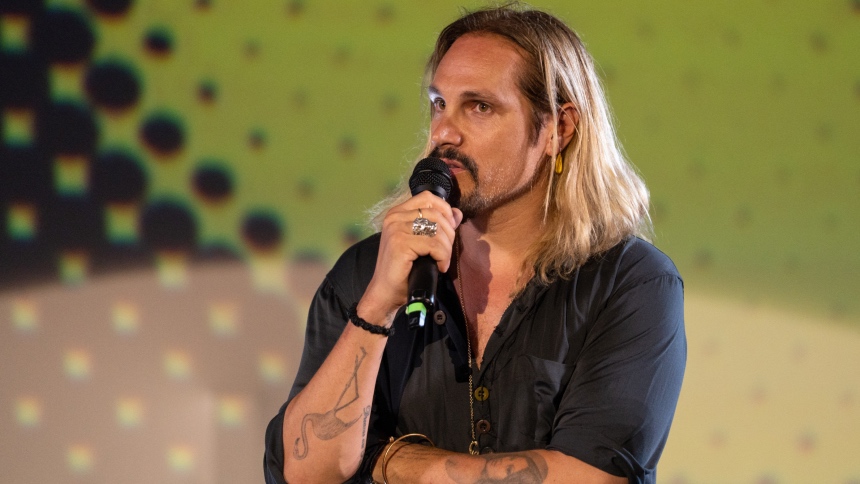
Producer Marco Perego came to Locarno's industry strand with the sort of recent record that normally invites a victory lap.
At the 2026 Cannes Film Festival, he was a producer on three Competition titles: Cristian Mungiu’s Fjord, Andrey Zvyagintsev’s Minotaur and James Gray’s Paper Tiger, as well as Kantemir Balagov’s Directors’ Fortnight opener Butterfly Jam. Fjord won the Palme d’Or and Minotaur the Grand Prix, making Perego the first producer associated with both top prizes in the same edition.
His conversation at the Swiss festival was not a masterclass in replicating that result. Perego spoke more like an anxious convert building a philosophy in public, a former footballer and visual artist, a relatively new producer and a filmmaker whose difficult experience directing The Absence of Eden changed what he believes producers owe directors.
Perego’s first rule is to stop treating failure as disqualification. “I failed so many times, and I can try,” he said. “I’m not afraid to fail, and I’m not afraid to surround myself with people who are better than me.” Football gave him discipline and an instinct for the team, art taught him to enter the unknown, cinema gave those habits a human subject.
The filmmaker’s job is not to conceal every weakness. It is to identify the missing skill early enough to recruit it. Perego describes himself as dyslexic and unsatisfied with his command of written English, so he cold-emailed Oscar-winning writer Alexander Dinelaris and asked for an hour on Zoom. Their collaboration has continued for years.
Dinelaris did not flatter him. Perego remembers taking pages to New York only to be told that the scenes had no action and did not work. He values the relationship because somebody better equipped can tell him the truth. “Understand where you lack something,” Perego said. “Be humble enough to say, ‘I need that writer, that producer.’ The ego needs to be killed, because the moment you kill the ego, you can arrive at the mission much better.”
The principle extends to every department and to producing itself. Perego has sought out veteran collaborators, including cinematographer Janusz Kamiński, and speaks openly about learning from experienced producers rather than competing for the most prominent credit.
In an industry where a film may carry 25 producer names with no visible division of labor, he proposes a blunt test: What value did each person bring? Financing, creative judgment, access, distribution leverage and emotional honesty are legitimate answers. Status is not.
That test leads to his most radical claim. On an independent film, the producer is not a substitute auteur. “The artist is the most important,” Perego said. “You’re just a vessel helping to realize the vision. It’s not your vision. It’s their vision.”
A producer may challenge, suggest and assemble, but once they sign on because they believe in a director’s language, panic over sales cannot become permission to redesign the film by committee. Ten thousand notes can turn an identifiable failure into an anonymous one.
Perego’s protection requires understanding the film well enough to preserve its essential choices while confronting the material limits honestly. He wants collaborators capable of saying a scene fails, a budget is impossible or a production method contradicts the stated ambition. The distinction is between criticism in service of the vision and intervention that replaces it. “We’re working for the director,” he said. “The director is not working for us.”
For first-time directors, creative control begins with arithmetic. Perego’s clearest advice was to reduce the container until the filmmaker can actually govern it.
He cited budgets in the $5 million to $10 million range for established auteurs such as Mungiu and Zvyagintsev, but his recommendation to newcomers was far lower. If the five-million-dollar debut remains trapped in the cycle of cast attachments and conditional financing, ask whether the same core film can be made for $750,000 or $500,000. Tax incentives and fewer locations may then turn an abstract impossibility into a finite gap.
Rising budgets do not only purchase production value, they bring more stakeholders, recoupment pressure, and reasons for financiers to override a risky decision. Perego’s rule is therefore to calculate backward from the level at which the director can remain accountable for the film. Cut the scene, company move or technical flourish if necessary, but do not cut the reason for making it.
Perego can deploy private capital, call celebrated craftspeople and use the credibility generated by Cannes, while most first-time filmmakers cannot. Even $500,000 is not “small” to somebody outside established finance networks. The transferable insight is the question beneath them, which expenses reveal the film’s identity, and which merely imitate a scale the project cannot yet sustain?
“If you’re a first-time filmmaker and you want to make a drama, operate as small as possible,” Perego said. “Use that smallness as your freedom. Go to the essence of the process. What do you really need to tell that story?”
His short Dovecote supplied the working example. Perego shot inside Venice’s Giudecca women’s prison with incarcerated women alongside a small group of professional actors led by Zoe Saldaña. The location imposed uncertainty and ethical responsibility, but it also clarified the film’s central question: What does freedom mean to people who feel visible inside the prison community and invisible outside it? Changes in aspect ratio, color and shot duration grew from that idea. Perego condensed the lesson into a phrase: “Form follows function.”
Constraint, in this account, is productive only when it sharpens intention. “When the budget is very restrained, your creativity becomes bigger,” he said. The danger is turning austerity into a virtue in itself, or using artistic purity to excuse unsafe and unpaid work. Perego’s stronger point is that every formal choice should be traceable to the story, not to an insecure attempt to make an independent film resemble a larger production.
Protection also continues after picture lock. “The movie is not just making the film,” Perego said. “After that, you need to support it, to bring the movie to the place it is supposed to be and to the people who are supposed to see it.”
His role changes by project, early backing, gap financing, introductions, festival positioning or pushing distributors in the United States. Production and distribution are not separate moral universes. A producer who defends a difficult film during the shoot and abandons it at the point of public contact has completed only half the job.
That does not mean imposing one release doctrine. Perego prefers celluloid and theatrical presentation for his own directing; he described reserving money to finish a film for 70mm because the large-screen experience was part of its design from the beginning. Another filmmaker may value immediate worldwide access and choose a platform. MUBI’s acquisition of Minotaur belongs to a different but compatible route.
Perego applies similar pragmatism to artificial intelligence. He has used AI in visual art and refuses an easy technophobic posture.
If a visual-effects tool lowers the cost of realizing an authored image, he sees a calculator, not a rival filmmaker. The larger concern is cultural; when generative systems can manufacture competent media at scale, the independent sector must become clearer about why singular human perception matters. Efficiency cannot be the only value used to choose which stories survive.
This is where his rhetoric of “purity” is most persuasive and most vulnerable. No film is pure in the literal sense. It is built from contracts, labor, compromise, technology and other people’s money. Perego is really arguing for coherence, the ability to trace those compromises back to one legible vision. AI, a streaming deal or a private investor is not automatically the enemy. A process that makes the film answer to predicted outcomes before it exists is.
His advice to producers is correspondingly severe. “If you decide to be a producer in the independent world, don’t do it for the money,” he said. “Go be a banker. Independent film is for people who take risks and have the courage to do something completely different.”
The line is theatrical, and independent films still need sustainable businesses, paid crews and recoupable investment. But it names a real category error: Treating short-term certainty as the main criterion in a form whose lasting value often emerges only with time.
Perego cited Raging Bull and Once Upon a Time in America as films whose initial fortunes did not predict their cultural life. His point was not that every rejected cut becomes a classic. It was that opening-week response cannot answer every question a film asks.
Producers who support a director only while the market signals approval are not protecting a vision. They are renting confidence from the audience. “If the vision fails,” Perego said, “I want to support it again.”
The same tolerance for uncertainty shapes his view of political cinema. He resisted the demand that every film issue a prescribed political statement. Support the artist, he argued, and if the vision is political, support the politics. The producer’s responsibility is not to neutralize those positions for market access or manufacture relevance where the director has none.
For sustaining a career, Perego offered less glamorous advice. Be quiet and make things. The industry’s social surface is, in his description, a circus and an illusion. Work is the more reliable signal.
He watches a film almost every weekday, seeks collaborators whose criticism hurts, and treats the gap between a good film and a great one as a zone of work rather than branding. “Making a good movie is a war, but making a great movie is a miracle,” he said, paraphrasing Alejandro González Iñárritu.
Perego told the Locarno audience to assume the money may disappear, the performance may fail and the film may not work. That pessimistic rehearsal permits risk because failure has already been admitted to the room. “You don’t feel uncomfortable? Don’t make film,” he said.
Perego’s final instruction to the first-timers was therefore also his simplest. Make the short, strip down the feature, shoot the scenes that prove the language and keep looking for the route around the locked door. “There is always a way,” he said. “You need to be prepared to find that way. Keep pushing and keep doing, and be ready to fail.”
Image courtesy of Locarno Film Festival / Ti-Press



-thumb-80x80-107109.jpg)

