
GHOST ELEPHANTS Interview: Werner Herzog and Dr. Steve Boyes Speak of Dreams, Ritual, and the Vast Mondo Wilderness

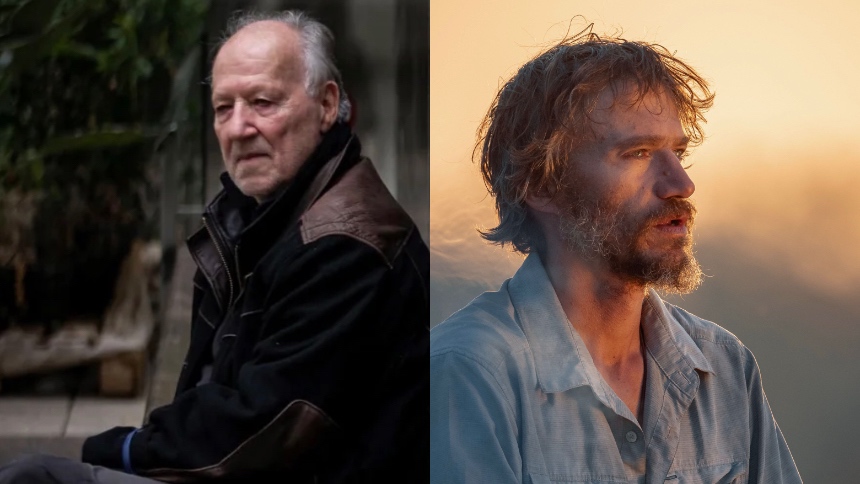
Werner Herzog needs no introduction. He has been one of cinema's most fascinating and deliberate risk-takers for over five decades of extraordinary cinema. The enlightenments he discovers through his pursuit of the "ecstatic truth" are often intense and absurd in varying measure.
Well into his 80s at this point, he has not slowed down in his filmmaking, and seemed to have no reservations traipsing around the "terra incognito" of the rugged and uninhabited Angolan wilderness along with his current documentary subject, South African biological conservationist Dr. Steve Boyes.
Boyes has been an advocate and activist for the preservation of the lakes and flora and fauna of the Bié Plateau in Central Angola. Since 2015, Boyes has led the National Geographic Okavango Wilderness Project, a collection of government and private organizations and local researchers from Namibia, Angola, and Botswana, to survey and help preserve the vast stretches of water-rich lands, the so called "Water Tower of Africa" which feeds most of the continent's major rivers.
His team has discovered over 100 new and unique species (mainly plants, insects and spiders) in the last decade, but the big prize is the Ghost Elephant. A highland species of the worlds largest mammal, its existence has only been hinted at with the shooting of the largest animal on record in 1955, which now resides at the Smithsoinan Museum in Washington D.C., in the United States.
Herzog chronicles the sizeable expedition (with a delightful number of tangents and hanging out with the interesting locals) to film and photograph the Ghost Elephants, as well as trying to get a sample of their DNA with the help of Namibian and Luchazi master trackers, and a custom made arrow-head, across the difficult landscape of steep valleys, dense forests, and peat wetlands via Toyota off-road vehicles and small motorcycles, until eventually walking dozens of miles on foot.
Both men, adventurers, documentarians and to a great degree, poets, took time to sit down via Zoom from different parts of the globe to discuss their film and their discoveries in Ghost Elephants.
The below transcript of our conversation has been lightly edited for clarity and flow.
Dr. Steve Boyes: It was a wonderful dinner, that first dinner. I think the restaurant closed on us as we spoke about life. And it was at that time where, just then, the first photographs [arrived]. I was driving into Cape Town, I had to pull off the road. Kerllen [Costa, an Angolan born Environmental Scientist] was sending the first ghostly images of elephants from our camera traps. He had just come back off the motorbikes with the SD cards from those trail camps.
So it was really it.
I think, when I saw this, it was just, okay, now they're going to go. We were integrating ourselves with the Ju/'hoansi, with the master trackers, going to the homesteads and living with them. And it got to the point where Werner camped in Namibia, when they're preparing to leave. To go to Angola. To spend several months up there with the best trackers in the world. Not to finish this but to get the genetic samples they need. And hopefully interact with one or two of these elephants. So it was that. And Werner arrived in Namibia, the first interviews with, him and myself, were, “What would the world be like without telephones?”
[A long pause, and a deep breath from this interviewer, as Herzog stares penetratingly through the screen as he says that last sentence.]
Herzog: All ritualized. For example, when Steve hands over two photos to the king, he has to clap his hands, he approaches with reverence, and puts it on the ground. One of the men in the court picks it up from the ground, and then hands it over to the king. And Steve has to walk backwards from the king. So that he does not turn his back towards him. So it is very, very ritualized, and very beautiful and very natural. It is much more natural than lets say, the British throne.
Are you saying the [Angolan] pomp and circumstance is more honest?
Herzog: Not honest, no. Formalities. It is performative. But, performative in a way that has a certain beauty.
Many years ago, I saw you present BAD LIEUTENANT: PORT OF CALL NEW ORLEANS at the Toronto International Film Festival. One of the things that stood out, weirdly, to me, was that unprompted on stage you told the audience that you brought the film, I believe it was to Millennium Film’s Avi Lerner, ahead of time and under budget. That level of gleeful pragmatism was interesting to me at the time.
Herzog: I do not feel any tension between being pragmatic and let’s say, being visionary. [Laughs]. It comes with ease. I do what I do. I love what I do. And I do not have to struggle with myself. It comes with great ease. And you can see how relaxed I am. And I am saying, “working on your musical instrument without a schedule for the day, surrounded by chickens. It cannot get better than this!” The humour comes across. Everyone in the theatre laughs out. Everywhere. In Venice. In New York City. Everywhere.
You have worked on all seven continents. I believe you are the only filmmaker to make a film on every continent on earth (although I believe Micheal Winterbottom is also close to that mark). After shooting GHOST ELEPHANTS in the depths of the Angola wilderness, do you feel the world is getting bigger or smaller, in the more we look. All the discoveries of species [in the past decade] that are mentioned, almost in passing, in Dr. Boyes' work, and then you seem to find amazing places to illuminate.
Herzog: The world stays as big and as awesome as it ever has been.
Boyes: I think the film celebrates the unknown. And that makes the world’s forests, and remote places even more interesting. What will we find there?
Thank you both so much for your time. I appreciate the work that both of you did to deliver this film to audiences, and open eyes to unknown parts of our world. But Mr. Herzog, If I may ask one very brief last question on the recent of passing of Frederick Wiseman. I know your careers are very different and your styles are very very different, but you had to have swum in the same circles over the decades at the same film festivals. Is there an anecdote, or a comment on his incredible oeuvre, and life?
Herzog: Yes. A truly great filmmaker. But whenever we met in public we would lock horns. And do combat!
Ghost Elephants opened in select North American theaters on February 27, and will air on National Geographic on March 7 followed by streaming on Disney+ and Hulu on March 8. It will also release in select international territories, including Benelux, France, Mexico, and Lithuania.



-thumb-80x80-107109.jpg)

