Berlinale 2026 Interview: IN A WHISPER Director-Writer Leyla Bouzid on Queerness and Her Narrative Approach as a Tunisian Filmmaker

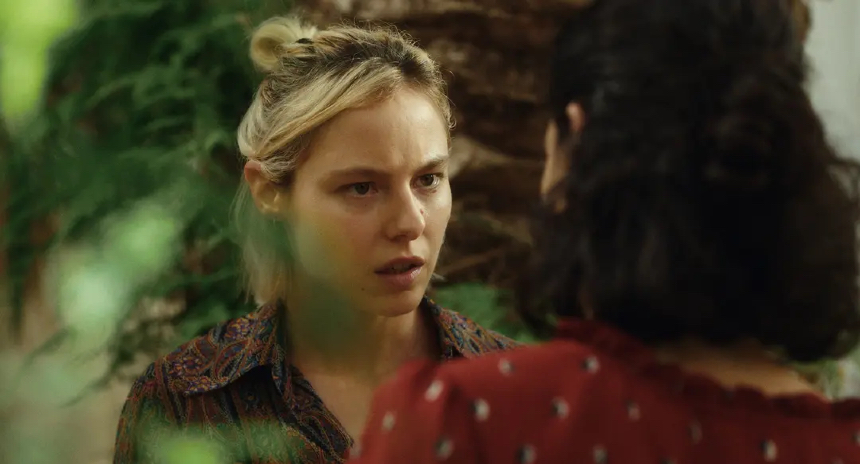
As a Tunisian queer filmmaker, one must exercise particular care when addressing an issue that remains deeply taboo in society to this day.
Yet this does not prevent Leyla Bouzid from boldly portraying the increasingly precarious reality faced by homosexual people within her community. With In a Whisper, she sets the story in her own former family home, revolving around three generations of women who inhabit the same space.
During a roundtable discussion near the Berlinale Palast, Bouzid shared her personal perspective on the situation of queer people in Tunisia, as well as her understanding of the characters she created. In this half-suspense, half-drama story, she weaves what she witnessed growing up in a fairly conservative social environment into the fabric of the narrative.
Screen Anarchy: Why did you want to represent love between two women in this film?
Leyla Bouzid: In an Arab country, this kind of representation does not exist at all — at least not publicly. In reality, of course, these women exist, but on screen they are invisible. For me, it was really important that this character could be filmed and exist cinematically.
Do you think about meaning in life, either personally or through your characters?
As an artist and filmmaker, maybe I think about it a little bit. But for Daly, “meaningless” is very concrete: it means not being able to live the love story that is deeply important to him, not being able to have a job -- it is an operation of destruction.
So yes, I think about what the aim of life is if everything becomes impossible. If you stay home and everything that was happening feels meaningless, that is a very real question.
How did you assert your distinctive vision within a co-production context?
It is not easy to make your own story in a way that is not expected. During the screenplay process, I received many comments like: “Why is Lilia’s mother so modern? Why isn’t she more conservative? Why don’t they beat her? Why aren’t they portrayed as ugly, oppressive people?”
I always try to make things as precise and faithful as possible to what I know and observe. Writing is also a process of fighting clichés. Sometimes clichés enter without you realizing it, so I reread, revise, and constantly ask myself: is this accurate?
I also speak a lot with the actors. They bring something real to the characters and help deepen them beyond stereotypes.
Why does Alice appear to force the coming out?
Alice is in a very difficult position. Arriving as a blonde French girl into this strong, charismatic Tunisian family is already complicated. Before the film begins, I imagine the couple was functioning, but they reached a point where they could not move forward.
Lilia had promised many times to bring Alice to Tunisia, even as a “roommate”, but it never happened. Alice may begin to feel that the relationship cannot evolve further. They are blocked, like in front of a wall.
When she arrives in Tunisia, she feels that either something will move forward, or something will end between them. When she realises that Lilia’s mother may not be as homophobic as Lilia thought, she senses an open gate. She feels this opportunity should be followed because Lilia herself will never take the step.
So she forces it. It is selfish and egoistic, but she is also living her own story. In relationships, sometimes someone makes a decision thinking it is good for both, and later regrets it -- as shown when she sends the SMS apologising.
Life is messy. It is a complicated situation for Alice, and it is difficult for her not to appear as a cliché.
Would you choose freedom over family?
Personally, yes, probably. But family is extremely important in Tunisian society, perhaps much more than in the Western world. That is something I wanted to show.
The family is like roots. In the house, Lilia is almost never alone. There is always someone present. With the ending -- when she arrives with the child -- I wanted to show that she is creating a family that grows from the same roots, not in isolation.
Did you have to be discreet while shooting?
Yes, we had to be a little discreet.
Can you speak about the three generations of women and their different attitudes?
I wanted to show both the gaps and the connections between generations. Each character belongs to her own epoch and has her own relationship to homosexuality.
The uncle could not live his love story and was forced to marry a woman. It destroyed him internally. Lilia is modern but chooses to live her sexuality in the Western world rather than in Tunisia.
There are also the boys in the bar who decide to live openly in Tunisia despite the risks. And we see Daly’s friend being arrested, especially when you come from a poor countryside background, you are more vulnerable to police violence.
Each character comes from a specific time, background, and lived experience. Even the grandmother, who is strict, seems softer with her granddaughter than she was with her own children. That nuance was important.
Is homophobia a class issue in Tunisia?
I don’t think it is a class issue. You can find very poor families who are tolerant and accept a gay family member openly. And you can find very rich, highly educated people who are extremely homophobic.
In the film, the grandmother is bourgeois and educated, but she did not allow her son to be himself. She destroyed him. Homophobia is universal; it can exist in any social class.
How do you see parallels between Tunisia and other conservative societies, [such as in] East Asia?
Many journalists focus on Arab countries, but the film could not be shown in Russia, and similar attitudes exist in parts of South America and Asia.
There is often this idea: “You can live it, but don’t show it.” This is also a form of homophobia. I was not consciously comparing Tunisia to Asia while writing, but I would be very interested to know how similar or different these contexts are.
Do you think things are getting better for queer people? In the past, it might have been more violent or repressive -- arrests, attacks -- whereas now we see figures like the mother gradually learning to accept. What is your outlook for the future?
It is a complicated time. On the one hand, individual rights are being discussed more openly, and that is positive. On the other hand, strong forces are trying to return to older ways of thinking.
It feels like everything is happening at the same time. There are wars, political tensions, and regressive movements. I hope the old world is dying, but it still feels very weirdly present.
Did you draw inspiration from queer film culture?
There are beautiful films I admire. I love Carol, and I also like Mulholland Drive. At one point, I imagined Lilia and Alice almost like a younger version of those two actresses -- the sensual brunette and the fragile blonde -- there is a visual resonance.
Were you worried about casting a strong star like Hiam Abbass?
I searched among Tunisian actresses but could not find the specific energy and silence I was looking for. When I met Hiam Abbass by chance at a festival, I immediately offered her the role.
She is very charismatic, and I was concerned whether the actress playing Lilia could match that presence. But Eya Bouteraa had the strength to stand in front of her. The same applies to the grandmother and the other actresses.
I paid attention to ensuring each character could stand at that level.
Why did you include thriller elements in the film?
At the beginning of the screenplay, the elements of death and investigation were stronger. It gradually became less central. What I liked was that the investigation became a way to understand Daly’s life more deeply and to bring Lilia back into her own context.
Today, we are very used to stories centred on death and investigation. These are the most successful series. Everyone watches crime and mystery on television all the time. But what interests me more is something else: when there is a mysterious death of someone close to you, how does it transform you? How does it make you question your own life?
When you connect to death, it is never something neutral. It is one of the fundamental moments in life, like birth. It transforms you. So I wanted to include this mystery and investigation, but not as the central narrative engine. Instead, I wanted to show how it resonates within someone and changes their state of mind.
So the film deals with these elements -- death, investigation, power dynamics, clientelism, corruption -- but they remain on the periphery. What truly matters is the emotional and existential transformation that unfolds inside the characters.
Did you make peace with the house where you shot the film?
Yes. I love this house very much. I really believe it has a soul. It may sound crazy, but I truly feel that. And I think part of the soul of the house is present in the film.
It was emotionally very powerful to be there and to bring it back to life. When my family came to see it during the shoot, they were deeply moved to see the house alive again.
Did you change the house a lot for the film?
No, not really. Most of the furniture had always been there. We only added small details.
I paid close attention to colours and composition to shape the image, but everything was already part of the house. We simply brought it back into focus.
There is a line in the film: “You get used to everything in this country.” It feels very strong. Was it meant as something general?
Yes, of course, the line is spoken by this gay man who cannot even go to the police to report what happened to him. But the sentence resonates beyond him.
We are in a country where tragedy exists, and people are obliged to get used to everything. It shows how much people struggle, and how they face situations that are often much harder than in Western countries. And yet, they continue to live. They joke. They try to have beautiful lives. They try to enjoy themselves. For me, it is a very important sentence.
At the same time, I didn’t want him to complain or position himself as a victim. He simply says it quietly, and you understand that he has lived through very hard experiences.
The actor who plays this role is gay and very famous in Tunisia. He comes from a very poor background. He dances at weddings and became known through television. It is incredible how much he has gone through. People accept him, but they do not speak about his identity. They accept him, but his sexual identity remains unspoken.
The audience seems to understand the secrets early on, but the family does not. How did you balance that narrative rhythm?
In the writing process, this was not easy. I kept asking: how much information should I give, and when?
I tried many versions. For example, should the audience know from the very beginning that Lilia and Alice are a couple? Or should it be revealed later? It was delicate to manage.
I didn’t want to create a big surprise 20 minutes later, like “Oh, now we discover Lilia is a lesbian.” I also didn’t want to build unnecessary mystery around it.
Some viewers immediately assume the two girls are a couple when Lilia puts Alice at the hotel. Others may not. Similarly, when the man kisses Daly’s body very early in the film, some think he is a family member, while others suspect something more.
So I wanted to avoid making it a mystery, but also avoid explaining everything explicitly. During the writing stage, I tried many different structures before finding the right balance -- the right harmony between what the audience knows and what the characters know.
The film enjoyed its world premiere at the 2026 Berlinale. Visit their official site for more information.