Rotterdam 2026 Review: ROID, An Ode to the Bengali Landscape and Its Cinema
Director Mejbaur Rahman Sumon's evocative tale from the Bengali countryside about love and fate, echoing the freshness of Satyajit Ray’s cinema.

The feature film Roid (Bengali: রইদ) is set in the Bengali countryside in a not-so-distant past, in a pre-digital world where life is shaped by hierarchy and tradition.
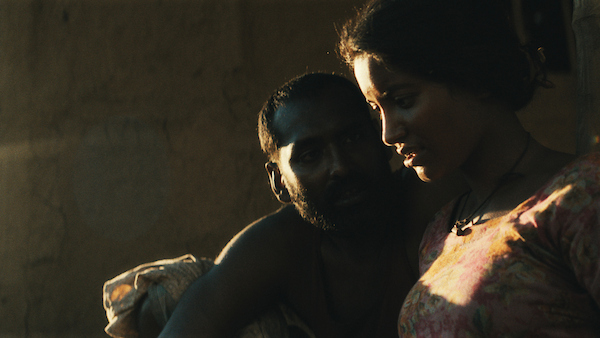
Sadu is a poor tenant farmer working for a large landowner in what was then East Pakistan, now Bangladesh. He is married to a wild young woman, Sadhur Bou, who keeps her real name to herself and is regarded by the villagers as insane. In her dealings with her husband, she is impulsive and untamable.
Sadu himself is a young, somewhat slow but kind-hearted and hardworking farmer. Sadhur Bou’s untamed nature expresses itself in her intimate love for a little goat that lives with them in their self-built, meager shelter.
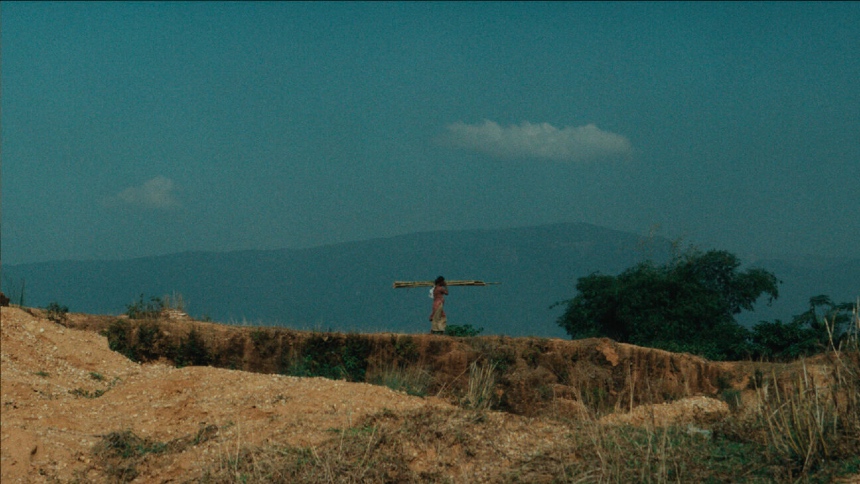
The monsoon rains — water pouring endlessly from the sky in countless variations — and the clearings with ever-changing colored skies form the breathing rhythm of their daily existence. Within that cadence resonates something of the poetic sensitivity we know from the work of the great Bengali master Satyajit Ray.
Then comes a moment when Sadu has silently made a decision. He has promised his “crazy” wife, convincingly and humanely portrayed by Nazifa Tushi, a visit to a traveling circus. When she reminds him of it again one afternoon, he agrees and they leave at once. He places her in his dinghy — a slender Bengali rowboat that serves both as a fishing vessel and a means of transport — and they row away.
For hours they glide through a shifting waterscape, with rolling hills always visible in the distance. The subcontinent unfolds as an endless sequence of tableaux. When night falls and his wife has fallen asleep, Sadu rows on tirelessly.
Deep in the night they dock in a forest. In the darkness, the outlines are barely visible, but the trees stand far apart. When she asks him trustingly which direction they should take, he answers, “Just straight ahead.” While she walks in front, he quietly slips away. By the time she realizes she is alone, he has already vanished. Without looking back or responding to her distant calls, he rows into the darkness.
Up to that moment everything is immersed in a widescreen stream of enchanting images. It is a world of sensory impressions — human, animal, and nature — an environment without digital signs or engines, as once existed everywhere on the subcontinent. The story takes place more than half a century ago and comes from tales that director Mejbaur Rahman Sumon’s grandfather told his descendants.
Grandson Sumon, for whom this is his second feature film, drew and painted from an early age and trained in the visual arts. He later worked in television drama and advertising. His earlier film Hawa (2022) was submitted by Bangladesh as the country’s entry for the Academy Awards in the non-English-language film category.
Director Rahman Sumon has also been a musician for more than 20 years. That versatility is reflected in his film: in Kamrul Hasan Khosru’s cinematography, in the careful framing, in the rhythm of editing and music in his storytelling. And in the fusion of sweeping imagery and Bengali sounds, one hears his sincere admiration for Ray’s early cinema.
But the story of Roid does not end with the abandonment in the forest. After a long and now lonely period, Sadu once again hears the clear voice of his wife. She calls to him, returned filthy and with matted hair, marked by a long wandering journey yet still bursting with energy and zest for life. Actress Nazifa Tushi, who plays her, says she found her character by observing and experimenting for as long as it took, until the performance came naturally — like putting on a costume that slowly becomes a second skin.
Upon her return, his wife proves to have remained the same. None of her wildness has disappeared. Only one thing has changed: she can now make the most delicious palm cake Sadu has ever tasted. It seems like the beginning of a new life, but above all it is the start of a new chapter in a love story that stubbornly pushes through everything, carried by a fate that develops, in the same imperturbable rhythm, toward tragedy.
Roid thus becomes a sensory and moving film about love and the inescapable force of fate amid landscapes and natural forces that are sometimes literally overwhelming.
ROID Mejbaur Rahman Sumon Bangladesh 2026 109' Tiger Competition, 2026 International Film Festival of Rotterdam.
-thumb-80x80-102332.jpg)