Berlinale 2026 Review: LIGHT PILLAR Casts a Melancholic Glow on Disconnection
In his animated feature debut, Zao Xu applies a production designer's precision to a near future fable that examines precarious labor, mediated intimacy and the fragile architectures, both physical and digital, that shape contemporary isolation.

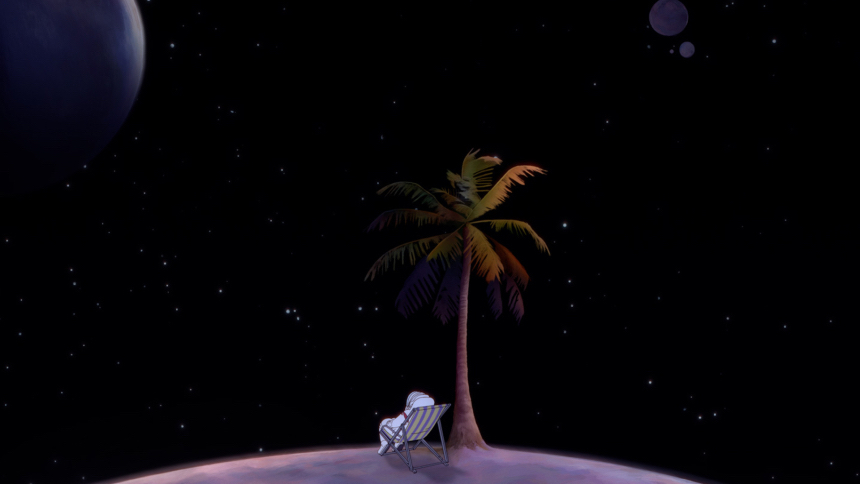
The Berlinale’s Perspective section hosted another Chinese animated feature, Light Pillar, the debut feature of Zao Xu.
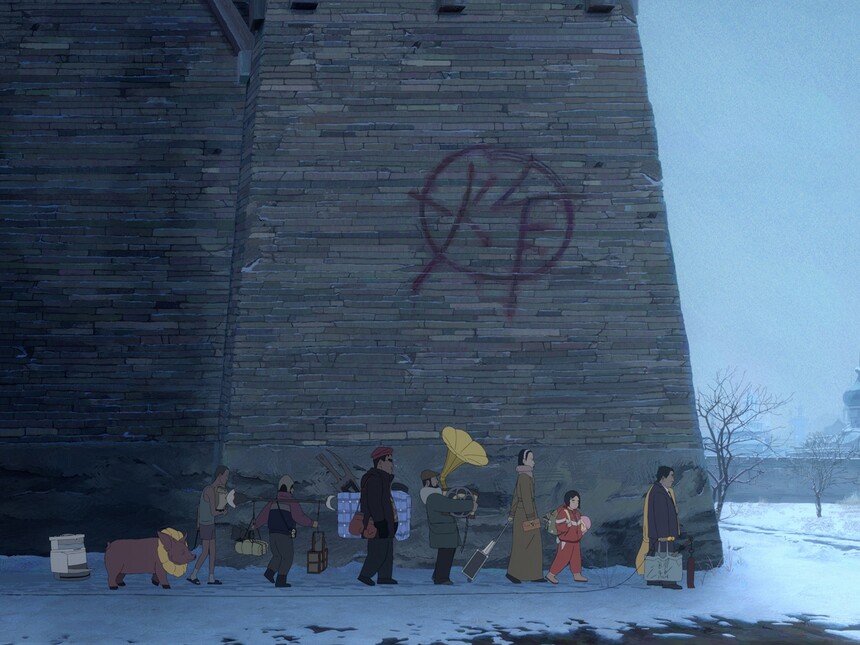
A once-expansive film studio, its backlots modeled on the Great Sphinx of Giza and the Forbidden City, now stands bankrupt and abandoned. Its monuments appear as pale winter silhouettes. A small group of remaining employees maintains the deteriorating premises, among them a damaged Roomba that has become part of the studio’s residue.
The protagonist, Zha, is a solitary middle-aged janitor who forms an unlikely companionship with a former feline screen star. Although the film is set in the near future, Xu presents a muted and unembellished environment. Zha receives lower pay than his colleagues because, as the owner and accountant state, he has no family to support.
When his employer replaces his wages with a virtual reality headset, he enters Home Sweet Home, a digital entertainment platform resembling VRChat. Notably, while Light Pillar is predominantly rendered in 2D animation, the virtual space is depicted in low-resolution Hi8 live action footage, introducing a deliberate shift in texture and medium.
A graduate of the Beijing Film Academy’s School of Fine Arts, Xu approaches filmmaking with the sensibility of a production designer. His earlier short No Changes Have Taken In Our Life premiered at the International Film Festival Rotterdam and demonstrated an interest in stillness, spatial irony and restrained humor.
The subsequent short Love Music Friend continued his focus on marginal figures navigating environments that dwarf them. Across these works, dialogue remains minimal and composition carries narrative weight.
Light Pillar extends these formal strategies. Verbal exchanges are sparse, and Zha’s introversion shapes the film’s rhythm. His routine begins to shift after he encounters a young woman in Home Sweet Home, whose impulsive temperament contrasts with his reserve. She persuades him to consider lunar tourism, now an accessible commodity in this imagined future. Zha begins saving for the trip, projecting his hopes onto a distant and commodified frontier.
Xu’s background in visual design informs the film’s spatial logic. The fictional Old New East West Film Studios compresses Chinese and Western architectural references into a single enclosed world, generating understated visual gags through juxtaposition rather than excess. The compositions remain controlled and uncluttered.
Narratively, the film interweaves two trajectories. One follows the studio’s temporary reinvention as a theme park, an attempt at economic survival that develops into a financial liability. The other traces Zha’s emerging attachment, which introduces a subdued criminal turn. These strands intersect without overt dramatic emphasis, reinforcing the film’s observational tone.
Melancholy and dry humor shape the film’s register. Xu consolidates the motifs present in his shorts: marginal protagonists, environments functioning as emotional topographies, and a restrained absurdism. His debut positions itself within contemporary Chinese independent animation while maintaining a measured formal economy. By foregrounding production design and limiting exposition, Xu constructs a cinema attentive to spatial experience and interior states.
Light Pillar examines loneliness and hesitant forms of connection. Its narrative progression privileges atmosphere and subjective perception over linear plotting. Rather than advancing through dramatic escalation, the film unfolds through the protagonist’s introverted engagement with his surroundings, allowing space and texture to articulate what dialogue leaves unsaid.
The film enjoyed its world premiere at the 2026 Berlinale. Visit their official site for more information.
Light Pillar
Director(s)
- Jingwei Xu
Cast
- Da Peng
- Qing Yi