
IN THE BLINK OF AN EYE Review: Pixar's Andrew Stanton's Underwhelming Return to Live-Action Filmmaking

As a writer and/or director of finely crafted, populist animated entertainments, Andrew Stanton (Finding Dory, WALL-E, Finding Nemo) has few, if any, equals. Stanton’s only foray into live-action filmmaking, however, John Carter, an expensive adaptation of Edgar Rice Burroughs' titular character and his Martian-based adventures, met with critical disinterest and commercial disappointment more than a decade ago.
Since then, Stanton returned to Pixar as part of its senior creative team, helping to mold and guide younger filmmakers to animated success. Aside from the long-mooted Toy Story 5, Stanton has retreated to a behind-the-scenes role at Pixar, but an obvious, longtime interest in returning to live-action filmmaking led him to direct In the Blink of an Eye, an underwhelming science-fiction drama based on an original screenplay written by Colby Day (Spaceman).
Self-consciously reminiscent of 2001: A Space Odyssey, Interstellar, The Clan of the Cave Bear, and closest structurally and thematically, Cloud Atlas, In the Blink of an Eye interweaves three abstractly related stories, the first following a struggling Neanderthal family 45,000 years ago, another unfolding in the present and centered on an academic couple, and the third and last in the 25th century aboard a generational, sub-light spaceship headed towards humanity’s new home, Keppler 22-b in the Cygnus constellation.
In the subtitle-free Neanderthal storyline, the cave-dwelling Thorn (Jorge Vargas), his companion, Hera (Tanaya Beatty), their daughter, Lark (Skywalker Hughes), and a newborn daughter, struggle to eke out a subsistence existence near a vast, unknowable shoreline. A simple slip-and-fall on a mossy rock poses grave risks to Thorn’s life and, with it, his family’s survival.
Pregnancy and birth pose an even greater risk to Hera, while later, as their over-familiar story slowly winds down toward its inevitable conclusion, encroachment from a tribe of Homo sapiens. The same tribe of Homo sapiens threatens both the Neanderthal family’s principal food source and, quite possibly, their lives.
In the present day, Claire Robertson (Rashida Jones), an anthropologist working on her dissertation, splits her focus between the bones and possessions of a Neanderthal under her university’s care, her mother's terminal illness, and a budding romance with Greg Greene (Daveed Diggs), a statistics professor at the same university. Claire faces the usual challenges of a modern career woman, balancing her professional and personal lives, life events (a parent’s passing, a pregnancy of her own, scientific discoveries), and the natural limits of a lifespan presumably well spent.
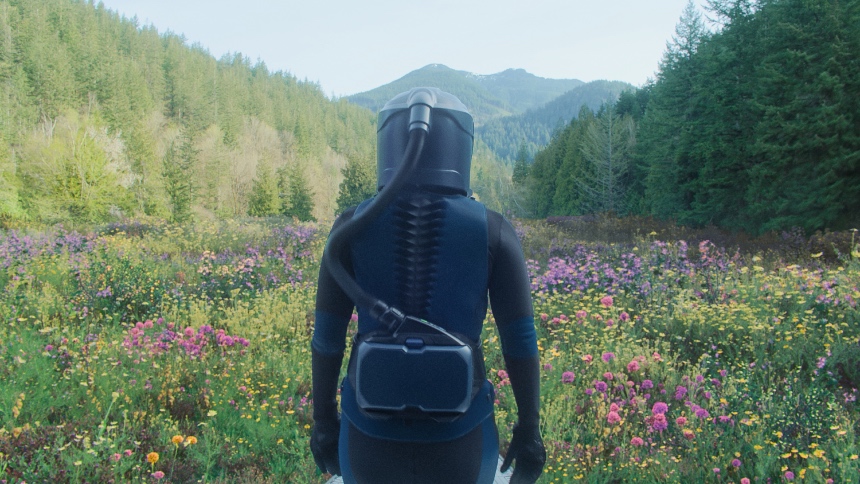
The third and final storyline unfolds aboard a generational spaceship carrying humanity’s last, best hopes, frozen embryos, to an extra-planetary system. The ship’s pilot and captain, Coakley (Kate McKinnon), works closely with Rosco (voiced by Rhona Rees), a benevolent, non-rogue AI, to keep the ship on course and its life-sustaining systems at optimal levels. Challenges arise, obstacles appear, and throughout, Coakley calmly uses her intellect, wits, and an indomitable spirit that Stanton and Colby want to celebrate to find the solutions necessary to complete the mission.
Colby’s undernourished script relies heavily on forced symmetries linking the three interwoven storylines (births, deaths, and related challenges) and on a subtext-free acorn passed between Neanderthal generations. Later, it’s found clutched in the hand of Claire’s specimen. In time, it becomes a totem kept and passed to her children. Even later still, the same acorn finds itself aboard the generational seed ship sailing between the stars toward their final destination, Keppler 22-b.
Stanton’s competent, workmanlike direction fails to elevate Colby’s screenplay. In theory, interweaving the three stories should expose thematic and subtextual linkages between and among them. Instead, the constant back-and-forth between the stories and their respective time periods adds little and subtracts much.
Separately, the three stories can’t — and don’t — stand or hold up on their own. Collectively, they don’t either. Hopping haphazardly between the three stories adds a frustratingly arbitrary element, meant more to keep otherwise inattentive audiences engaged than to serve any real narrative or thematic purpose.
In the Blink of an Eye premiered at the 2026 Sundance Film Festival, where it received the Alfred P. Sloan Prize for cinematic achievement in science or technology. It is now streaming on Hulu in the U.S. and Disney+ in Canada and elsewhere.

Do you feel this content is inappropriate or infringes upon your rights? Click here to report it, or see our DMCA policy.


