Sundance 2026 Review: EVERYBODY TO KENMURE STREET, Collective Presence Stalls the System
Director Felipe Bustos Sierra documents a spontaneous act of civic resistance in Glasgow, examining how collective presence can momentarily disrupt the mechanisms of state authority.

Chilean Belgian filmmaker Felipe Bustos Sierra premiered his latest documentary, Everybody to Kenmure Street, in Sundance’s World Cinema Documentary Competition.
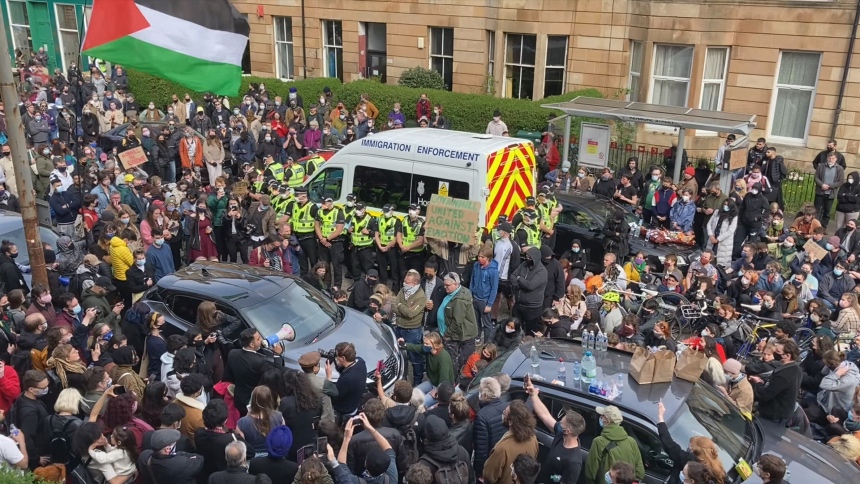
The film revisits events that unfolded on May 12, 2021, the first day of Eid, when a U.K. Home Office raid detained two men in Pollokshields, Glasgow’s most ethnically diverse neighborhood. As the arrest took place, neighbors began to gather, joined by passersby and activists who decided, in real time, to prevent the police vehicle from leaving.
At one point, a man slid beneath the van to immobilize it. Over the course of eight hours, a street-level standoff developed as residents confronted police in what gradually became a hostage situation.
Bustos Sierra’s work returns to moments where political history intersects with collective action. His earlier feature Nae Pasaran examined an act of industrial solidarity by Scottish factory workers who refused to service engines bound for Chile during Augusto Pinochet’s dictatorship. That film moved between past and present, using archival research to reconstruct an episode whose consequences extended decades beyond its original context.
Everybody to Kenmure Street similarly situates a single confrontation within broader histories of colonialism and racism, while maintaining a tight focus on the immediate event. The film is assembled from crowd sourced footage, interviews conducted by participants involved in the attempt to stop the deportation, and staged reconstructions.
In these scenes, actors deliver verbatim testimony from individuals who chose to remain anonymous. The approach captures how ordinary residents managed, through nonviolent civic resistance, to interrupt the operations of law enforcement.
The documentary employs familiar elements of observational nonfiction, including talking heads and found footage, but the staged reconstructions add a distinct layer tension. They compensate for the physical distance of much of the recorded material, which was captured from windows or across the street, and provide access to voices otherwise absent from the screen.
Bustos Sierra frames the events through a clear political lens, supplementing the immediate narrative with historical context that reaches back to the transatlantic slave trade and forward to more recent episodes of local activism, including the 2005 case of the Glasgow Girls, whose campaign drew public attention to the treatment of asylum seekers.
What ultimately distinguishes the film is its sense of immersion and its measured pacing. Both are shaped by the editing of Colin Monie, who also worked on Nae Pasaran as well as another Sundance-premiered film, Olive Nwosu’s Lady. Monie steadily builds momentum, repeatedly returning to faces in the crowd as hours pass and the stakes become more apparent. The situation evolves from a routine administrative action into a volatile public confrontation, intensified as more civilians arrive and police presence increases.
Maintaining a largely chronological structure drawn from footage recorded on the ground and in close proximity, the documentary constructs a tactile portrait of the unfolding events. As tensions escalate, the situation turns into a pressure cooker, functioning both as an account of a specific protest and as a cinematic experience. Although the staged sequences momentarily disrupt the visual continuity of the found footage, they function effectively as substitutes for conventional interviews, offering insight from participants unwilling to appear on camera.
Everybody to Kenmure Street examines how small scale acts can resonate beyond their immediate circumstances. Where Nae Pasaran demonstrated how a nearly forgotten refusal could reemerge decades later with tangible consequences, this film considers what it means to show up, to wait, and to remain present long enough for an administrative process to falter, even briefly, under the sustained pressure of collective resistance.
Everybody to Kenmure Street won the World Cinema Documentary Special Jury Award for Civil Resistance at the 2026 Sundance Film Festival.
Everybody to Kenmure Street
Director(s)
- Felipe Bustos Sierra
Cast
- Keira Lucchesi