Sundance 2026 Review: BIRDS OF WAR, War Reporting and Love Collide
Directors Janay Boulos and Abd Alkader Habak are also the film's protagonists, following a 13-year collaboration that unfolds from professional exchange into personal involvement amid the realities of reporting on the Syrian war.

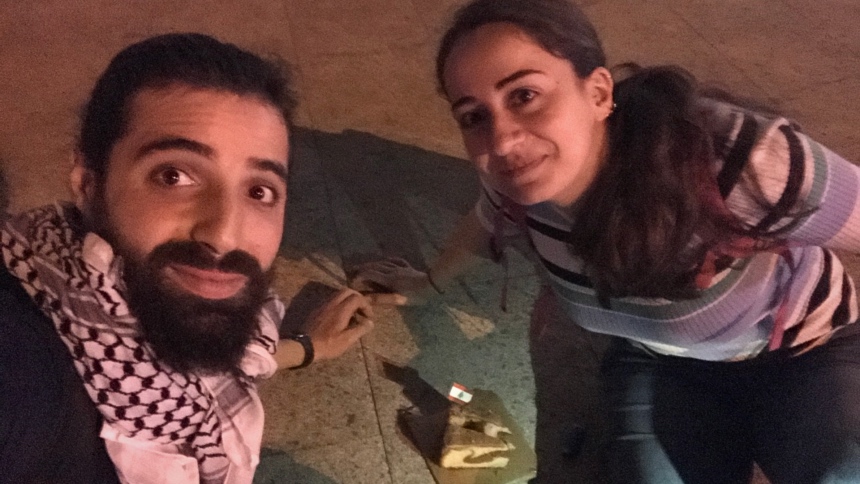
The feature-length debut by Janay Boulos and Abd Alkader Habak, Birds of War, which premiered in Sundance’s World Cinema Documentary Competition, revisits established conventions of war reporting.
Boulos is a Lebanon-born, London-based BBC journalist, while Habak is a Syrian cinematographer and activist. The film draws on thirteen years of personal archives compiled by Habak as he documented Syria, including the civil war and the destruction of Aleppo.
What begins as a professional exchange, with Boulos sourcing Habak’s footage for BBC reports, gradually evolves into a personal relationship. Over more than a decade, the documentary traces how professional commitment, intimacy, and survival become increasingly intertwined as revolution hardens into prolonged conflict and mobility gives way to exile.
The film maps the development of the relationship between the two co-directors through autobiographical passages that outline their respective backgrounds and the formative role of place in shaping their identities. Boulos reflects on her decision to leave Lebanon for Britain, while Habak explains why he chose to remain in Syria and continue filming from within an active war zone. In doing so, Birds of War foregrounds not only what is reported, but the conditions under which reporting takes place, including the personal risks and long-term costs embedded in journalistic practice.
As international journalists were barred from entering Syria during much of the conflict, global media outlets increasingly relied on collaborators operating inside the country. Boulos’s initial contact with Habak, who began supplying her with footage, developed into a sustained professional collaboration that eventually became personal. The film situates this relationship within the structural realities of contemporary war reporting, shaped by dependency, and uneven exposure to risk.
Habak’s footage offers direct access to moments rarely captured from within, including the bombardment of Aleppo, civilians seeking shelter underground, and the improvised emergency treatment of children injured in attacks. His early work is marked by immediacy, recording bodies in space and events as they unfold, with minimal mediation.
By contrast, Boulos’s journalism is shaped by institutional frameworks and remote editorial coordination. The film draws much of its tension from this asymmetry. Their relationship develops through assignments, deadlines, and editorial negotiations, underscoring the structural gap between those reporting from within and those working at a distance while channeling Boulos´s growing frustration about the situation.
Dialogue functions as a central organizing principle of the film, both structurally and literally. Personal message exchanges are incorporated into the narration, charting the gradual deepening of their connection.
The question of how to sustain a long-distance relationship becomes increasingly pressing, particularly after a moment that shifts Habak’s circumstances. Footage of his rescue of a child during a street attack circulates widely, making him identifiable and placing him at risk, ultimately forcing him to seek asylum.
The emerging relationship provides a human counterpoint to the mechanics of war reporting and operates as a connective thread between two individuals with shared regional histories but differing positions and perspectives. Their decisions and viewpoints begin to influence one another. Habak’s commitment to remaining in Syria prompts Boulos to reconsider her own relationship to home and displacement.
At the same time, the personal narrative offsets the accumulation of images depicting destruction and civilian casualties, introducing moments of intimacy that recalibrate the viewing experience without softening the reality of the conflict. Interwoven with scenes of violence and loss, the relationship offers a parallel narrative that situates war reporting within emotional and ethical entanglements.
Birds of War received the World Cinema Documentary Special Jury Award for Journalistic Impact at the 2026 Sundance Film Festival.