DRACULA Review: Slick, Horny, and Surprisingly Silly
Caleb Landry Jones, Zoë Bleu, Matilda De Angelis, and Christoph Waltz star in director Luc Besson's new, romantic version of the classic tale.

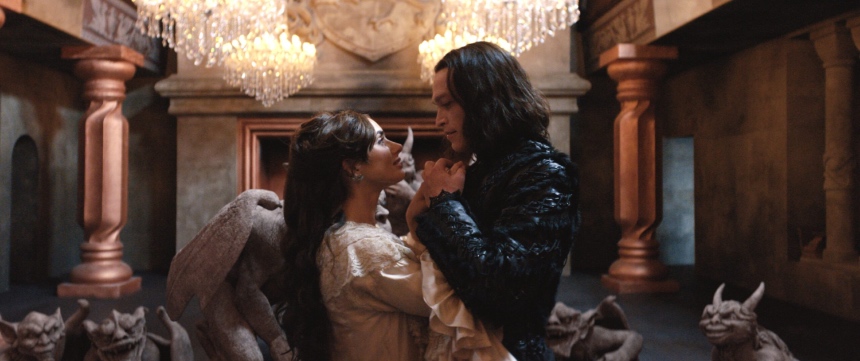
After arriving in some European cinemas in July, less than a year after Robert Eggers's Nosferatu and a few months before Christoph Waltz appeared in Guillermo del Toro's Frankenstein, Luc Besson's Christoph Waltz-starring Dracula has finally made its way to US multiplex screens.
Waltz doesn't play the titular blood-sucker of Bram Stoker's oft-adapted novel; that honor goes to Caleb Landry Jones. Instead, Waltz plays a version of the book's Van Helsing. He's an unnamed priest dispatched by a secret order who have been investigating and combatting vampires for the last four centuries.
Dracula (2025) makes several changes to the novel's characters, and most interestingly combines Mina's (Zoë Bleu) friend Lucy and Dracula's faithful servant Renfield into the character of Maria (Matilda De Angelis). In this version of the tale, Maria is one of several vampires that Dracula has had scouring the world for the reincarnation of his beloved Elisabeta (Bleu again, natch) for over a century.
It's not the most thematically interesting adjustment, but it allows De Angelis to almost literally chew the scenery as she shifts between insatiable for blood and sex, and overjoyed to have succeeded in her task. The most thematic heft we get from a change to the source text here is lifted from previous adaptations, most famously Coppola's, in that Mina is the reincarnation of Dracula's true love. Which, like the other changes made for this film, seems more in service of making the movie cool, funny, and horny than anything.
There's an extended opening sequence that draws viewers into the very heightened historical world of a Transylvanian crusader who fights against "barbarian" Muslims in Christ's name. The armor Dracula and his men wear is styled after animals and monsters, with small plates that look like feathers and fur, and headpieces that have massive teeth close over the wearer's face and give them horns.
When Dracula's castle is attacked, Elisabeta is sent away in a massive, deep purple velvet fur-lined cloak and a veil so long that it reaches the ground when she's seated atop a horse. Neither piece spends much time draped, though; they're there to flow beautifully behind her as she's chased. She doesn't survive that chase, Dracula curses God for refusing to return his beloved to him, and is then, in turn, cursed to never die (a natural death at least).
The changes that make the film funny are almost jaw-dropping. Rather than the classic Brides, Dracula's aides in the film are little stone gargoyles who do bits. At one point when suspending Jonathan Harker (Ewens Abid) using a pulley system, they're told to "lower him down," and their version of that is to all put their hands up as if proving their innocence, letting the suspended man crash to the floor. One licks clean a bowl of blood after Dracula doesn't drink it. Their combat style is mostly drop kicks. It's downright silly stuff.
But wait, there's more! Between Elisabeta's death and the 19th century, Dracula spent years searching for her and investigating ways to perhaps bring her to him. The most promising of those methods was to create a perfume so strong that it allows the immortal being to mind control the mortal smellers. When he first puts it on the movie almost becomes a magnificently costumed Axe body spray ad we might have seen in the 2000s, but we soon learn that it affects all genders.
In an absolutely ridiculous musical montage that combines harpsichord and Casio-sounding beats, Landry Jones visits various courts in different outfits befitting their cultures. He dons a large slanted hat and ruff in a dark and cavernous Spanish court, a pastel pink courtier's outfit at the brightly lit Versailles, and a series of other over-the-top costumes in a sequence that's pure fun.
After decades, if not centuries, of seeking his true love, he gives up on the perfume drawing her to him and decides he needs emissaries, which bring us to the horny. As Dracula bites, several of his female-only bitees gasp in initial horror and shock that gives way to pleasure. Among them is Maria, whose initial introduction to the film in an asylum scene, generally reserved for Renfield, features her chittering, smiling, seducing, and generally being a chaotic horny menace.
Of course, the real romantic longing comes from Dracula and Mina/Elisabeta. The film opens with the two in the 15th century in true blissful love, as full of playful pillow and food fights as it is of ravenous lovemaking (as expected, the former sometimes leads to the latter). When the aforementioned attack arrives, Dracula's men literally tear the two of them apart, as he keeps running back to her after they get a piece or two of armor onto him.
When he later seduces Mina, with the power of his perfume and a music box he gifted Elisabeta, her sense memories of their love in a past life come to her in flashes of their faces and bodies entwined. He makes impassioned speeches about his need for her and when she finally fully remembers and embraces him, the romance of the eternal love lands.
Dracula (2025) is a strange beast. It's told with a completely earnest heart on its sleeve for its central romance (the film is also referred to as Dracula: A Love Tale in some marketing). It serves up some stunning imagery with its costuming and sets. There are several object wipes throughout, and when Dracula first sees Mina, a surprisingly modern glitchy effect removes people from the world around her until all he sees is her and an empty room. And in the midst of all this, there's an almost giddy sense of playfulness in the humor.
It's not the most daringly original cinematic take on Stoker's novel, but its aesthetic pleasures (both of production design and seeing hot people kiss), emotional earnestness, and unexpected silliness make it a welcome addition.
The film is now playing in U.S. theaters, via Vertical Entertainment.