
THE RED SPECTACLES Review: Mamoru Oshii's Absurdist Take on Authoritarianism Gets a Second Life

Memory hardens around those who experience violence, turning guilt or pain into an armor they must carry long after the wounds close. That burden is the doorway into Mamoru Oshii's The Red Spectacles, a film where guilt materializes as a haunted cityscape.
Once dismissed and largely forgotten after its troubled 1987 debut, The Red Spectacles is gaining a second life. Oshii, known for his dystopic anime like Angel's Egg and Ghost in the Shell, released his first live-action project -- and the inaugural live-action entry in the "Kerberos" saga -- to a damningly poor reception. "I don't even remember if there was any applause," Oshii said in his director's statement for the re-release.
The Red Spectacles drifted into near-lost media status, where its memory was kept alive by die-hard fans. That obscurity has now been upended by fan-funded 4K restoration, drawing the support of nearly 3,000 backers. Already having returned to Japan, its re-release will premiere at New York's Metrograph on November 21. You won't find anything else quite like it.
The Red Spectacles transpires in the near-distant future, filmed in 1987 and set in 1991. Japan has transformed into a hyper-militarized police state, where a paramilitary unit known as the Kerberos Panzer Cops or "Watchdogs of Hell" emerged to control crime (with a heavy, heavy hand). Over time, these forces grew so autonomous and violent that the government turned against them.
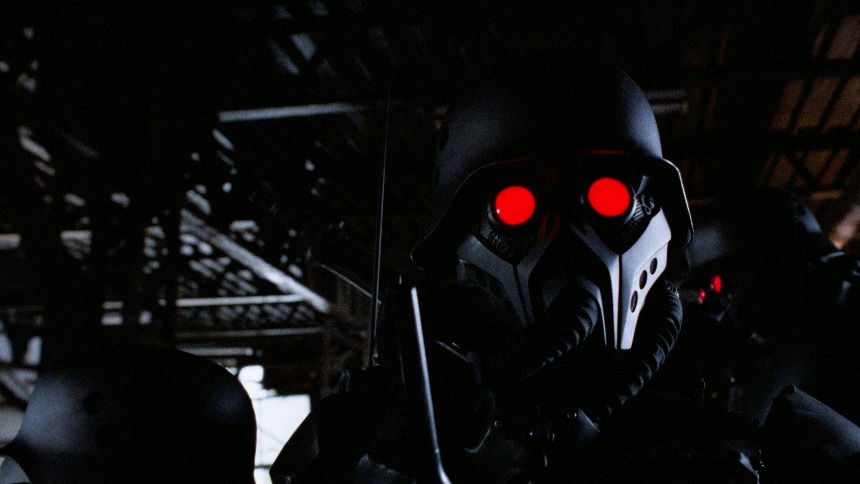
A brutal, near-mythic standoff between the government and three rogue Kerberos agents -- Koichi Todome (Shigeru Chiba), Midori Washio (Machiko Washio), and Soichiro Toribe (Hideyuki Tanaka) -- opens the film. The soldiers sport dieselpunk armored suits, characterized by their piecing red-eyed masks. One of two sequences in color, the undeniably electric battle ends with Midori and Soichiro too injured to go on; only Koichi manages to escape, promising to return.
Three years later, the story picks up with Koichi sneaking back into Japan alone, haunted by the choices that shattered the unit in the first place. The film shifts to a neo-noir greyscale as Koichi discovers Tokyo is a bastardized shell of the city he once knew. Searching the city for his comrades, he is soon entangled with the ghosts of the city, from government officials to seedy characters in an underground noodle shop. The city's escalating absurdity evokes Franz Kafka's "The Castle," in which the protagonist is exhausted by a world so contradictory and theatrical that it becomes impossible to understand, let alone navigate.
This surreal saga starts after Koichi is attacked in the shower of a hotel. He fights off the horde of hitmen with ease, spiraling into the new Japanese underworld. In distress, Koichi aims to find respite (and his friend Ginji, a professional dine-and-dasher or tachiguishi) at a noodle shop. To his dismay, he learns that these food stalls have been made illegal and deemed criminal hotspots as part of the increasingly comical dystopian laws.
Along Koichi's journey, he plays a game of cat-and-mouse with Bunmei Muroto (Tessho Genda). The bespectacled government investigator is the film's most overtly comic and unsettling antagonist. He jumps between theatrical friendliness and crazed hostility, hyper-focused on Koichi. During one interrogation, Bunmei and his henchmen arrive on a train car with massive, cartoonish grins. More than anything, he is a nuisance for Koichi; an embodiment of the city's farcical bureaucracy and power. Everything and everyone is deliberately confusing.
Perhaps the reason for its tough initial reception is The Red Spectacles's eruptive tonal shifts. At times, the film is steeped in dystopian despair, focusing on the consequences of state-sanctioned violence and police brutality. Comical bursts puncture this bleakness. Several times, characters are poisoned by their noodles and rush to the bathroom, clutching their cheeks.
At first, the slapstick is disruptive; adjusting to the film's turbulent narrative might push audiences away. In many ways, Oshii's filmmaking leans into the storytelling techniques associated with anime. Most of all, he exaggerates everything, through these oversized characters or the film's bizarre circumstances. Its swelling absurdity becomes central to how The Red Spectacles communicates tone and meaning.
That said, after leaning into the nonsensical behaviors and turns, the story truly asserts its manic framework. Oshii engulfs us into the troubled mind of a broken soldier; of a man haunted with guilt as he confronts a legacy of violence. The city is deliberately obfuscated, marred by the same fascist past as our protagonist. We experience first-hand what it means to spiral into Koichi's self-fulfilling mania.
The Red Spectacles tackles some well-worn fears of authoritarianism, yet refracts them through Oshii's unmistakably strange, singular vision. What was once a misunderstood black comedy is now being reconsidered as a legendary and provocative part of Oshii's filmography. And its feverish depiction of dystopia somehow rings truer, as madness becomes an ever more normal part of our daily lives.
The film opens at New York's Metrograph on Friday, November 21. Visit their official site to see showtimes and purchase tickets.
The Red Spectacles
Director(s)
- Mamoru Oshii
Writer(s)
- Mamoru Oshii
- Kazunori Itô
Cast
- Shigeru Chiba
- Machiko Washio
- Hideyuki Tanaka

More about The Red Spectacles

More about Angel's Egg
More about Ghost in the Shell
- Now Streaming: THE GHOST IN THE SHELL Hearkens Back to the 90s
- Opening This Week: SISU: ROAD TO REVENGE, ANGEL'S EGG, Plus 2 FYC Contenders and a Drama
- Pretty Packaging: GHOST IN THE SHELL Lands An Ultimate Edition
- Have Your Say: What's Your Best Major?
- Have Your Say: Does GHOST IN THE SHELL Still Have A Future?


