
QUEEN AT SEA Review: Masterclass in Acting, Writing, and Directing

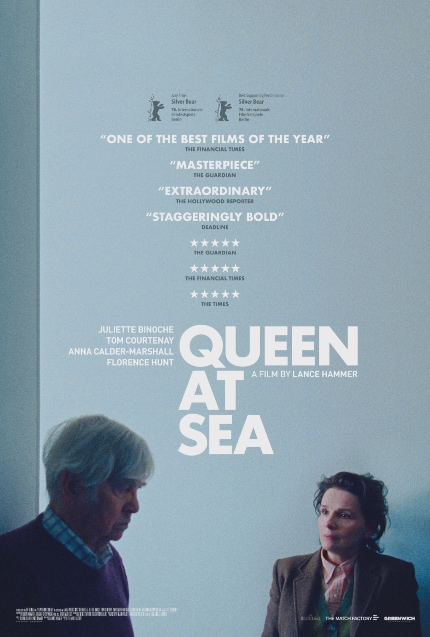
Returning to feature-film filmmaking after an altogether too long 18-year hiatus, writer-director Lance Hammer’s (Ballast) drama, Queen at Sea, revolves around an incredibly difficult, nearly impossible end-of-life decision.
As Leslie’s (Anna Calder-Marshall) dementia robs her of her mind, memory, and identity, how much agency or autonomy should she continue to receive, whether from her loving husband, Martin (Tom Courteney), of almost 20 years, her daughter, Amanda (Juliette Binoche), a middle-aged professor on sabbatical, or the state’s relevant institutions, when, inevitably, they’re called upon to intervene on Leslie's behalf and her best interests?
From its first moments mirroring Freud’s primal scenes to its last devastating moments, that question hovers over Queen at Sea as it unfolds over several days, weeks, and months. For the visiting Amanda, finding Martin and Leslie in bed together sends her into paroxysms of anger, most of it directed toward Martin, her stepfather. Why?
Because Martin reneged on a previously agreed-upon decision to avoid sexual intimacy with Leslie. That Leslie, visibly weakened and confused by advancing dementia, may or may not be capable of consent convinces a conflicted Amanda to bring law enforcement to help her solve — and resolve — a seemingly intractable dilemma.
Amanda’s decision, however, further complicates an already complicated, volatile problem: The representatives of the state (first law enforcement, later social workers) take an approach carefully calibrated to reflect the seriousness and severity of Amanda’s accusations against Martin. After interviewing both Leslie and Martin, they send Leslie to a nearby hospital for medical examination, arrest Martin on charges of possible sexual assault, and leave all three, Leslie, Martin, and Amanda, worse off than before Amanda called the police on her stepfather.
Hammer contrasts the decision surrounding Leslie’s future (e.g., returning to the status quo, a residential care facility, or something else altogether) with Amanda’s relationship with her own daughter, Sara (Florence Hunt). There’s love there, but also rebellion, as Sara, frustrated and angry at her own lack of agency as a teen, begins to assert herself with increasing frequency, sometimes verbally in escalating arguments with her mother about their shared and individual futures (London or Newcastle, Amanda’s breakup with Sara’s father), and tentatively starting a romance with an age-appropriate classmate, James (Cody Molko), who shares her interests and outlook.
That romance doesn’t qualify as rebellion per se — James is anything but a “bad boy” — but a necessary means for Sara to assert the same kind of agency and autonomy that Leslie has steadily lost through age and infirmity. Amanda hovers between twin duties, twin obligations to both her mother and daughter, relying as much on feeling and instinct as on thought and rationality. All the doctors, therapists, and social workers can only offer limited options, none likely to make Amanda, Leslie, or Martin completely or even partially happy.
Hammer offers few, if any, judgments, leaving those answers, if any, to the real world beyond the two-dimensional screen. Instead, he leans into an empathetic, compassionate approach to the characters and their respective wants, desires, and dilemmas. Martin might enter the film as a potential villain, but in Hammer’s nuanced direction, he’s anything but. Hammer leaves little doubt that Martin truly loves his life partner and wants what’s best for her, yet he also recognizes a kind of willful blindness or ignorance in Martin’s ultimately self-defeating actions.
And while Leslie gave Amanda, not Martin, the power of attorney, giving Amanda the legal right to decide Leslie’s future, it doesn’t morally or ethically exonerate her from a decision that will likely haunt her for the rest of her life. Amanda must choose from several non-optimal options, watching her mother slowly fade into oblivion while an increasingly brokenhearted, powerless Martin watches from the sidelines, hoping against hope for an outcome that keeps him and Leslie together.
Hammer’s deliberately studied approach extends to an unobtrusive directing style, marked by long, static shots, often framed within doorways, frames, and windows, separating characters even as they technically share the same space. He employs close-ups sparingly, only turning to them to underscore a key plot turn or underline an emotional beat.
Hammer’s minimalist style demands much of his actors, and they deliver unfailingly. Binoche adds layers of complexity to her portrayal as the conflicted Amanda. First-timer Hunt holds her own against far more seasoned performers, delivering a naturalistic, grounded turn as another character reaching an important milestone in her life, the first of many as she enters adulthood.
Unsurprisingly, Courteney and Calder-Marshall shared the Silver Bear for Best Supporting Performance at the 76th Berlin International Film Festival earlier this year. Queen at Sea doubled the award count by receiving the Silver Bear Jury Prize, the most significant award after the Golden Bear and the Silver Bear Grand Jury Prize(s).
Queen at Sea opens today, only in movie theaters, via Greenwich Entertainment. Check the official site for local showtimes.

Do you feel this content is inappropriate or infringes upon your rights? Click here to report it, or see our DMCA policy.


