New York 2026 Review: A STATEMENT, One of the Timeliest Films You'll See This Season
Tom McCarthy directs Paul Rudd, Amy Ryan, Paul Giametti, and more.

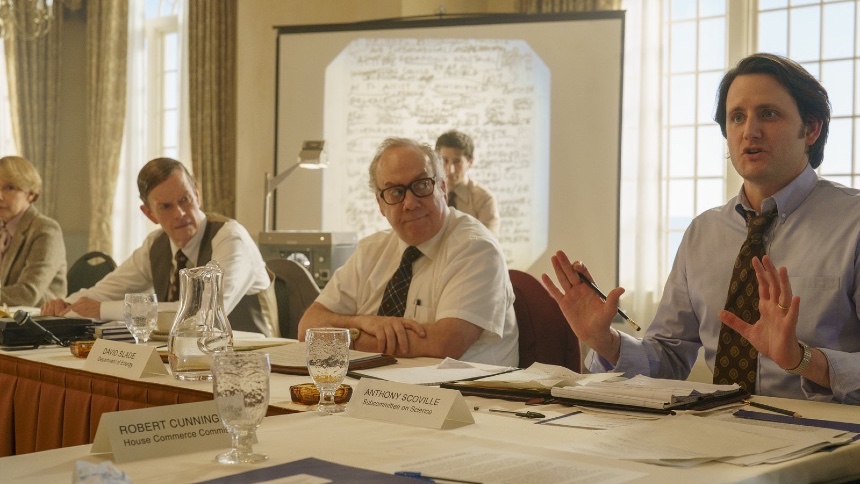
At the end of October 1980, an unusual group gathers at the Don CeSar Hotel in St. Petersburg, Florida.
When some of the participants inform the staff or other guests that they are here for a conference on the dangers of carbon dioxide emissions, they mostly get weird looks or a joke cracked. This is an era when climate change wasn’t on the general public’s collective mind, even though the scientific community was actively ringing alarm bells.
But just as the 20 people, including scientists, activists, bureaucrats, and lawyers, commence the first session of the planned four, it becomes painfully clear that even this group is having trouble fully agreeing on the issue. Not to mention coming to a consensus on the proposed congressional statement they are tasked with drafting.
Some care a lot, to the point of being too caught up in their passion, like environmental lobbyist Rafe Pomerance (Evan Peters). Some need to skirt the line between their views and bureaucracy, like the meeting moderator, Thomas Jorling (Paul Rudd), and the Department of Energy employee, David Slade (Paul Giamatti). And some, like public health specialist Annemarie Crocetti (Amy Ryan), are just desperately trying to make sense of things.
Just like Tom McCarthy’s Best Picture-winning Spotlight, his latest feature, A Statement, is also based on real events. The St. Petersburg convention did take place and later became a chapter in Nathaniel Rich’s book, Losing Earth, which this film is based on. The transcript of that meeting also served as the basis for all of the dialogue spoken within that hotel conference room (which is most of the dialogue in the movie).
With films like this, the ones that (more or less) confine the story to one location, populated with a bunch of characters engaged almost exclusively in talking, there is a preconceived notion of the authors shooting themselves in the leg, an unspoken expectation of a theatrical setting that would stand in the way of a true cinematic experience. Good news: A Statement is a film that is aware of its limitations, and its authors are consistently making interesting cinematic choices to overcome them.
One thing that the film doesn’t escape is that, being an ensemble feature, it relies heavily on the efforts of its cast. And while there is no obvious protagonist in this case, there are still characters who come out more prominent than the others; and, let's be honest, certain roles are just naturally juicier.
John Turturro, playing an eccentric nuclear engineer with lots of attitude, is the clear MVP here. Amy Ryan, and Tatiana Maslany as environmental lawyer Edith Brown Weiss, both have a more reserved presence, lying in wait for their chance to shine. And it’s always nice to see Evan Peters get out of the confines of Ryan Murphy’s universe, endlessly reprising the roles of Tate Langdon and James Patrick March.
There is an underlying sense of irony running throughout the film, which even gets mentioned in passing at some point: This is a direct antithesis to the way this setup often plays out on screen in superhero blockbusters where a bunch of people must work together, despite their differences, to save the planet. But as Tom McCarthy’s body of work proves time and again, he is never just interested in the event itself, enthralled instead by the very fact that those people – most people, really – are very much not superheroes.
The messiness of human nature, with all the passions, doubts, collective guilt, and moral compromises caked into it, is what’s at the core of A Statement, just as it was in Spotlight. Ironically, for a film where characters spend all of the time talking, there is much more that’s not being said out loud: The undercurrents running in the dynamics of this group of complicated people, stuck between agenda, bright-eyed idealism, and mostly good intentions.
The biggest heap of irony here is that what makes this film so timely isn't exclusively about the fact that climate change remains a global problem no one has any idea how to resolve. It's also that fighting over not so much the possible solutions but the vocabulary to best describe the problem is now even more relevant than it was in October 1980.