New York 2026 Review: 9 TEMPLES TO HEAVEN, Obtaining Merits
Apichatpong Weerasethakul's long time assistant director, Sompot Chidgasornpongse, makes a directorial debut.

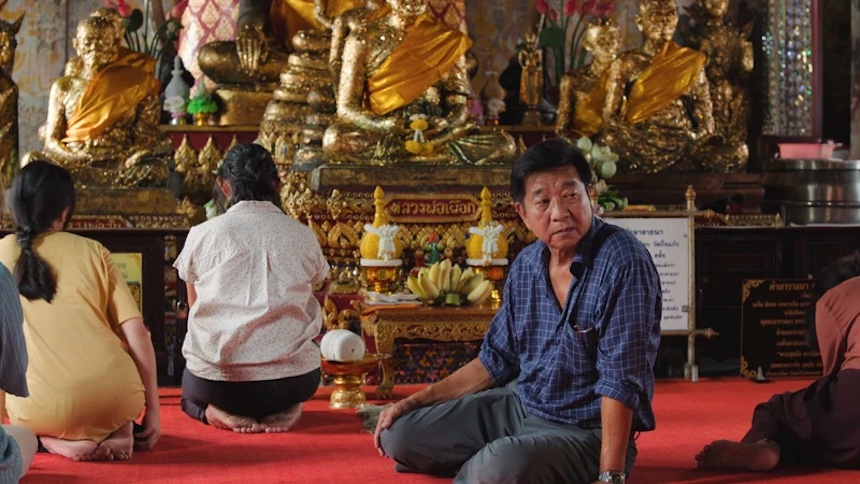
Following advice from his boss, who had a premonition of his mother's death, Sakol, a middle-aged businessman, embarks on a trip of merit making to nine Buddhist temples in one day, to prolong his mother's life before her birthday, which is coming up in two weeks. He enlists nine family members, spanning three generations, into a rental van to visit all nine temples.
The number 9 is considered a lucky number in Thailand, with it being similar sounding as the word 'progress', or 'moving forward'. With Buddhism ingrained in everyday life of a Thai, Sokol is dead serious about making the pilgrimages. With nine individuals in one van -- Sakol's nephew and his girlfriend are also on the trip, following them in their car -- things are bound to go sideways. It is especially true regarding grandma, who is slightly annoyed about the whole situation. She is seen nodding off in the van most of the time, and refuses to get out of the van after three temples, even though it’s all for her, supposedly. She is tired and wants to go home.
The monks at the temples, eager to receive donations and money for merit making visitors, are a jovial bunch, giving Sokol generally vague advice in achieving merits: Gifts, money and praying hard. The family argues among themselves about who would look after the grandma if her health deteriorates. They argue about the efficacy of the trip and giving gifts for merits to the temple.
The younger ones, not very into the idea of Buddhism and its traditions -- one is brought up Catholic, to say the least -- find the trip old-fashioned and tedious. They talk about their plans for the future instead. Some will go abroad to study.
The golden Buddha statues glisten in the courtyards with their gold leaf skin flaking off in the wind. Temples get progressively more opulent as they visit each one. The gifts from the visitors stack up in the holding room like a bounty in a pirate's chamber; they sell gift box packages at the stores for the temple, as it turns out. The roadside meals are distributed according to their choices on the plastic table outdoors or in the van in the parking lot. As we follow along the road trip, we get to see a slice of life in bustling modern Thailand, where past and present exist side-by-side.
Yet there is a spectacular Weerasethakul moment near the end, as a celestial event -- a solar eclipse -- occurs, marked by sudden gusts of wind and darkness enveloping all characters. All the resentment and bickering falls silent, and the screen goes dark completely, at least for a moment.
As the film bookends with the funeral preparations of the grandma, whether the merit making business worked or the family made to all 9 temples is irrelevant. People die and life goes on regardless.
Sompot Chidgasornpongse, who has served on many of Apichatpong Weerasethakul's films as an Assistant Director (Tropical Malady, Syndromes and a Century, Cemetery of Splendor, Memoria), may not share the otherworldly sensibility of his mentor (who produced the film), but his acute observation on changing Thai society, the generational gap and family dynamics feels something more akin to Taiwanese master Edward Yang's films. 9 Temples to Heaven is a great debut of a promising filmmaker.
9 Temples to Heaven plays several dates at New York Film Festival. For more information, please visit the festival website.
Dustin Chang is a freelance writer. His musings and opinions on everything cinema and beyond can be found at www.dustinchnag.com