
Shanghai 2026 Interview: 9 TEMPLES TO HEAVEN Director Sompot Chidgasornpongse on His Debut Feature and Thai Independent Cinema

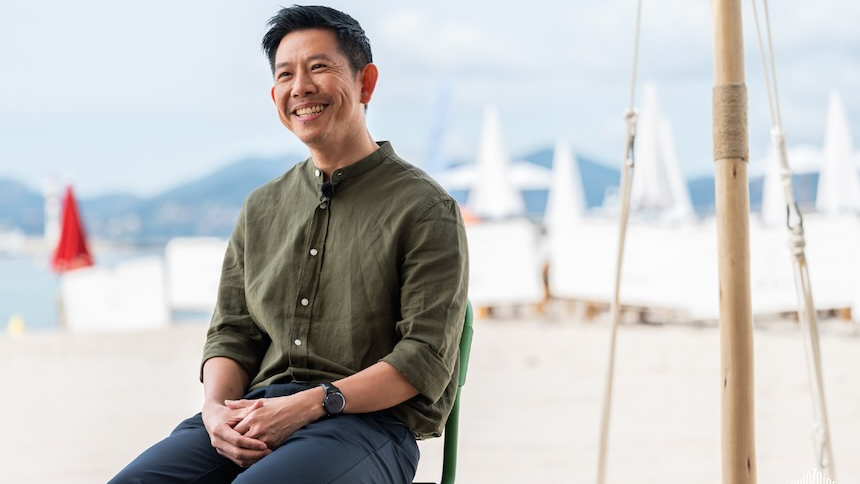
Independent Thai cinema has been rising on the international festival circuit in recent years.
Following the success of A Useful Ghost in 2025, Thai independent filmmaker and longtime collaborator of Apichatpong Weerasethakul, Sompot Chidgasornpongse, premiered his feature debut, 9 Temples to Heaven, in the Directors' Fortnight at Cannes earlier this year. The film later continued its festival run at the Shanghai International Film Festival, where it won the Golden Goblet Awards for Best Director and Best Actor in the Asian New Talent section.
In Shanghai, Screen Anarchy sat down with Sompot to discuss the family memories that inspired this deeply personal and spiritual debut. We also talked about religious culture in Thailand, the current state of Thailand's independent film scene, and the challenges of securing funding.
Screen Anarchy: Can you tell us about how your life experience inspired the making of this film?
Sompot Chidgasornpongse: I grew up with my grandmother and have a very close relationship with her. She took me to the temples, she prayed, and she would give food to the monks every morning. My whole family is very religious as well. We go to the temples like it is a recreation trip, a fun thing that we do instead of going to the beach or mountains.
The 9 temple trip specifically is something quite common in Thailand. For us, 9 is a lucky number. I myself have been going on this kind of trip with my family many times. I found it quite fascinating because you will make merit and repeat the rituals again and again. Then, gradually, it makes you question if this is really working.
I wanted to use this trip as a way to talk about subjects like fear, uncertainty, family bonding, love, and care. It is a film about family, about faith, and also involves societal topics.
Your previous documentary RAILWAY SLEEPERS follows people sleeping on trains, while this film centers on a family's road trip. I noticed that journeys and observing people doing the same thing seem to be a recurring theme of your work. What draws you to this kind of storytelling?
In Railway Sleepers, the camera is always on the train, and you just observe how people act and interact. You encounter many faces of Thai people through travelling different parts of Thailand. In a way, the film is capturing the everyday life of these people.
As a viewer, once you begin noticing the small details, you gradually build up your own understanding of what Thailand is like. I want the film to tell many things about Thailand naturally without me having to force anything.
I was trying to do the same thing in this film as well. Of course this one is fictional, but I still wanted it to feel a bit like a documentary. I want the audience to have a chance to observe the characters.
In the film, we see different family members approach this journey to the temples with very different attitudes. Yet the grandmother remains silent for most of the trip. How should we understand her relationship with religion?
On this trip, the grandmother’s body is becoming weaker, and she's simply very tired. At this stage, she no longer really cares whether she can live longer or not. She's been going to temples her entire life. If all those years of making merits haven't changed anything, she probably doesn't believe that one more day of temple visits will make much difference.
But of course you never know what she really thinks. So in the end, she changed her mind and said she still wants to go to the temples.
How did you portray the younger characters of this family trip? And what is the relationship between young people and Buddhism in Thailand today?
I first came up with the idea for this film when I was very young, so naturally I initially felt closer to the younger characters. But the development process took so long that I grew older. I began paying much more attention to what my parents and the older generation were thinking. Now I feel connected to both sides.
The younger characters are inspired by myself, my friends, my sister, and my nieces. I'm the only grandson in my family, but I have many nieces, so the younger girl in the film comes from observing them. The two brothers are different sides of myself. One part of me questions the religious rituals, while another part of me just simply accepts them to make the family happy. I've always wondered what it would be like to have siblings, so this film became a way of imagining that relationship.
I think young people are beginning to question religion more now. Interestingly, religion has also become fashionable among some younger generations, almost becoming trendy. They're practicing it differently from previous generations. But at least in my culture, and perhaps across much of Asia, spiritual beliefs and superstition remain deeply embedded in our psyche. As long as people still have suffering or unhappiness or uncertainty in life, religion is the last resort to go to.
The 9 temple trip idea initially comes from the father’s boss. It almost feels as though the father character is obeying authority more than religion itself. Is that a common mindset in Thailand?
This actually happened to my family in real life. You won’t see the boss’s face in the film. So you begin to wonder who this person really is and why he has so much authority. For me, the boss can represent many things. If you read the film metaphorically, he can represent a higher power. Religion has power over people's lives, so people like the boss can use religion as a tool of authority.
It's similar to a short film, Bangkok in the Evening, I made about people standing still for the Thai national anthem. Whenever the anthem starts, everyone stops. That's how authority works. It doesn't just control your mind but also controls your body.
You studied architecture before becoming a filmmaker, and your film features many beautiful close-ups of temples. Were you trying to critique the lavish architecture of Thai temples and the wealth behind them?
Maybe it's all those things at once. Temples are undeniably beautiful and deeply spiritual places. For someone like me who studied architecture and is interested in visual art, they are fascinating spaces to look at and appreciate aesthetically.
At the same time, building and maintaining such magnificent temples does require an enormous amount of money. On one hand, people expect temples to be beautiful because they are sacred places. On the other hand, that beauty attracts visitors, which brings in donations and inevitably creates a kind of capitalist cycle.
Faith draws people in, people donate money, and temples become wealthier. In Thailand, monks don't need to pay tax, so some temples accumulate enormous amounts of wealth without much public scrutiny. That raises difficult questions. How should we live with this contradiction? Does a temple have to be poor to feel spiritual? Or does it need to be beautiful to welcome people?
Of course, temples need money to operate. But once that money starts accumulating, people naturally begin to ask how it is being used. The problem is that religious institutions are difficult to regulate. There are regulations in theory, but in practice senior monks hold a great deal of power, so the system can easily become problematic.
Am I right to understand that you are trying to critique religious beliefs in this film?
Definitely. Thai Buddhism has blended with many other belief systems, including Hinduism and animism. Religion permeates every part of our lives because we've all grown up in this environment. I'm certainly trying to comment on that.
But I wanted to do it gently rather than attacking religion directly. I simply wanted to present it as how it exists in everyday life.
You have worked with Apichatpong Weerasethakul for over 20years. When you are making your own film, did you try to distinguish yourself from him?
Yes and no. I say yes because I have worked with him for 23 years. I worked as an assistant director and in casting. I realised that if I forced myself to be different from him, it simply wouldn't work. I've spent almost my entire filmmaking career working alongside him, from the start of my career. If I tried to erase every influence of Apichatpong, there would be nothing left. I just wanted to make this film as honestly and as naturally as I can.
But with that said, I also know that there's something that Apichatpong at least hasn't done. He's never made a film about a family. I don’t know why, but that is something I wanted to explore myself.
You helped Apichatpong with casting in his film, how did you cast all these great actors in yours?
I have a casting team, but I also cast some of them myself. I try to find people who can be themselves in front of the camera, who can appear natural. I also try to cast people who already have something like the characters that I wrote.
More importantly is that all the cast must match as a family. That took a long time to mix and match these nine characters. It's a very big challenge.
Are they professionals?
No. Only two of them have been in a feature film before. One was in a feature film 20, 30 years ago. The actor of the father has had a small role in a Thai film before, but that's also a long time ago.
Once I'd cast everyone, we spent a lot of time rehearsing. They shared many personal stories with each other, and I also rewrote parts of the script around them. In the end, the film became much more about who they really are.
It took nine years to make this film. What took it so long?
It's very hard to find funding for the film, and that's why we co-produced with eight other countries. It took nine years for us to collect all the money.
At first, we couldn't find funding in Thailand. Although we have money from other countries, it's very hard to find funding abroad when you don't have the initial funds from your own country. And sometimes the regulation is that you have to have at least 25% fund secure before you can apply for international funds. So without that 25%, we cannot even start.
The reason that we got A Useful Ghost and even my film is that these two films are partially supported by a new fund called Taka in Thailand. This funding is provided by the previous government, but now we have a new government, so we don’t know what is going to happen to the funding for film. There are so many political uncertainties that there is simply no consistency in film policy. Many talented Thai filmmakers are still waiting for their opportunity.
Are you already thinking about your next feature?
Let's see, I don't know what kind of opportunities will come next, but it's gonna be a challenge because it's not going to be my first feature film anymore. And the funding is going to be trickier because many funds only support first-time filmmakers.

Do you feel this content is inappropriate or infringes upon your rights? Click here to report it, or see our DMCA policy.


