
MUSK Review: Must-See Doc That Sadly Will Go Mostly Unseen

At 12:01 p.m. on January 20th, 2029, the 48th president of the United States will be sworn into office.
His name — because more likely than not, the next president will be a “he” — will not be Donald J. Trump.
Barred by the 22nd Amendment from running or holding public office again, Trump’s second and final term will end the same morning, but a key figure in his inner circle, Trump’s most fervent supporter, and his biggest benefactor, Elon Musk, the unelected tech trillionaire (give or take a few billion), will remain an ally to other tech oligarchs and amoral corporations who rule America, and a virulent opponent of multiculturalism, multi-ethnic democracy, and civil and/or criminal liability.
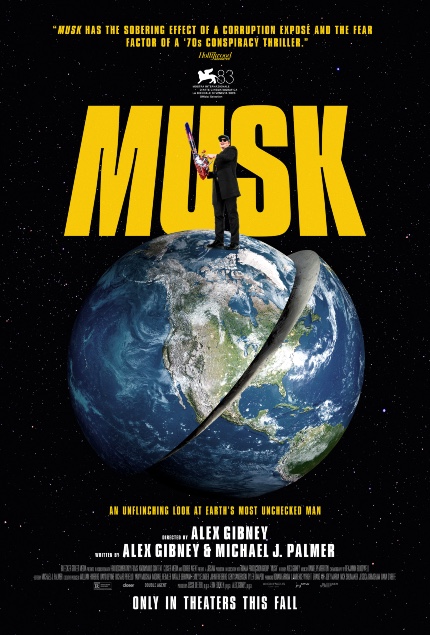
A prolific documentarian (Steve Jobs: The Man in the Machine, Taxi to the Darkside, Enron: The Smartest Guys in the Room), Alex Gibney’s latest documentary, Musk, doesn’t answer the central question facing the United States: How to, or even whether, a tech trillionaire like Musk can be held accountable for his outsized power and perniciously destructive influence over American politics. It is, however, the singular question anyone — and everyone — who sits through Gibney’s exhaustive, sometimes exhausting, documentary must ask themselves. It’s not an exaggeration to suggest that the answer will determine the near, not-so-near, and distant future.
Musk is the ever-present “reply guy” who purchased Twitter in the spring of 2022 on a lark, claimed the “free speech” absolutist mantle for himself (it was a lie), then rapidly turned the social media app into a tool for right-wing misinformation, disinformation, and propaganda. Within months, if not weeks, of Musk’s takeover of Twitter, Musk personally fired more than half of its employees, many crucial to its day-to-day function, rebranded Twitter as “X,” and started a campaign to silence left-wing/progressive voices on the platform.
Within two years, Twitter had lost more than half of its pre-purchase value of $44B, bleeding advertisers at an alarming rate, but, as Gibney outlines in his documentary, that was of little importance to Musk. Between his investments and portfolio, he was still the wealthiest man alive. A narcissist with messianic belief in his own super-powered genius, Musk had turned a platform once described as a “public square” into a de facto extension of the GOP, specifically the Trump-aligned MAGA cultists who overwhelmed the once Grand Old Party.
The fall of Twitter and the rise of X make up only a single chapter in Gibney’s decades-spanning documentary about Musk. It’s not quite a cradle to (pre-) grave documentary, but it’s close. Gibney shuffles the timeline slightly, opening closer to the present than the past, before hitting the rewind button and re-introducing the title character as a tech entrepreneur with an unquenchable hunger for power, influence, and, unlike many of his peers, the kind of celebrity that only a super-genius could claim in the public sphere or pop culture.
The South African-born Musk parlayed the one-time success of a long-forgotten start-up, Zip2, into a new venture with Peter Thiel that became PayPal. More a skilled investor than an actual inventor, Musk played key roles in funding first Tesla and later SpaceX, companies that predated Musk’s arrival or involvement, but which the media-savvy Musk leveraged into the myth of Musk as not just a super-genius, but a visionary without equal, a near-deity among mere mortals. When Musk talked about the electric-powered future, everyone listened. When he set his sights on interplanetary colonization (Mars, mostly), everyone didn’t just listen; they applauded him, too.
As myth-making went (and goes), it worked beyond even Musk’s imaginings, allowing him to leverage perception into reality. As Tesla’s stock price continued to rise well beyond reason or rationale, Musk’s optimistic message, his promise of a utopian future, held individual and institutional investors in an almost hypnotic state. As Gibney clearly delineates, Musk also converted Tesla from a company that made next-gen electric cars, but more importantly to his and the company’s bottom line, an active seller of ZEV (zero-emission vehicle) credits to polluting corporations in the U.S.
And yet, as Gibney repeatedly notes in the documentary, sometimes with barely veiled frustration, Musk remains relatively untouched by economic downturns or political blowback for his open support of right-wing causes or parties (Germany’s AfD, once considered extreme (i.e., “white replacement theory”), and Tesla and now SpaceX’s stock float at prices far beyond any reasonable valuation.
In a work of fiction, a character like Musk survives and thrives thanks to writer-provided “plot armor.” No matter how real-world economic, political, and cultural damage he’s done or, presumably, will do, turning newly purchased companies (Twitter) inside out, throwing away previously held concerns about AI to pursue maximum profit, or assuming an unelected position as the supposed enemy of government bureaucracy (the Department of Government Efficiency or DOGE), destroying livelihoods and stealing terabytes of personal data (still unaccounted for), he remains unscathed, blissfully leading his terminally online life as the world’s richest Internet troll.
Musk interweaves copious amounts of licensed archival footage, new-to-the-documentary interviews, including podcaster and ex-Musk friend and podcaster-philosopher Sam Harris, Cory Doctorow, the tech author, journalist, and activist most famous for coining the term “enshittification,” Justine Wilson (formerly Justine Musk), Musk’s first wife, Kara Swisher, tech journalist and podcaster, and among others too numerous to list here, Ashley St. Clair, a one-time far-right influencer, romantic partner, and eventually, the biological mother of one of his children. They didn’t “meet cute”; they met online after Musk, following an MO honed over several years, dropped into her DMs unannounced, if not exactly unwanted.
That raises Musk’s embrace of “pronatalism,” a fancy word to describe white supremacists who believe inferior non-whites are outbreeding them and, thus, whites with superior genes like Musk must follow one and only one rule: Procreate. Musk has at least 14 children by different women, including his first wife, St. Clair, and Grmes (among others). That pronatalist vision, however, is strictly hetero and strictly patriarchal: Rather than embrace his trans daughter, Vivian, for who and what she is, Musk blamed the “woke-mind virus” and made it his mission (one among many) to eradicate it from American culture.
Purchasing Twitter and turning the platform into a deluge of right-wing disinformation and misinformation was crucial to this mission. Readers can take some comfort, though: It’s one, like same-sex marriage two decades ago, that is bound to fail, if not in this decade, then in the next one or the decade after that one. Actuarial tables suggest Musk will live another 20 or 30 years, so hopefully, he’ll see the defeat of his crusade against the “woke-mind virus.”
Until the wheels of time and memory inevitably turn, Gibney’s documentary gives us, if not a blueprint for defeating Musk and his anti-democratic, pro-oligarchic views, then it’s a vital first step. We can take heart from a long-ago, though never forgotten, Saturday afternoon cartoon, G.I. Joe: “Knowing is half the battle.” Knowing who Musk is and what he represents starts with Gibney’s documentary. Everything else is up to everyone who wants a fairer, more equal world.
Musk is now playing in select movie theaters, and will expand wider on Friday, October 16, via Bleecker Street. Check the official site for locations and showtimes in your area.

Do you feel this content is inappropriate or infringes upon your rights? Click here to report it, or see our DMCA policy.


