Karlovy Vary 2026 Interview: RAIN CATCHER Filmmaker Michele Fiascaris on Voyeurism and Building a Neo-Noir on a Limited Budget

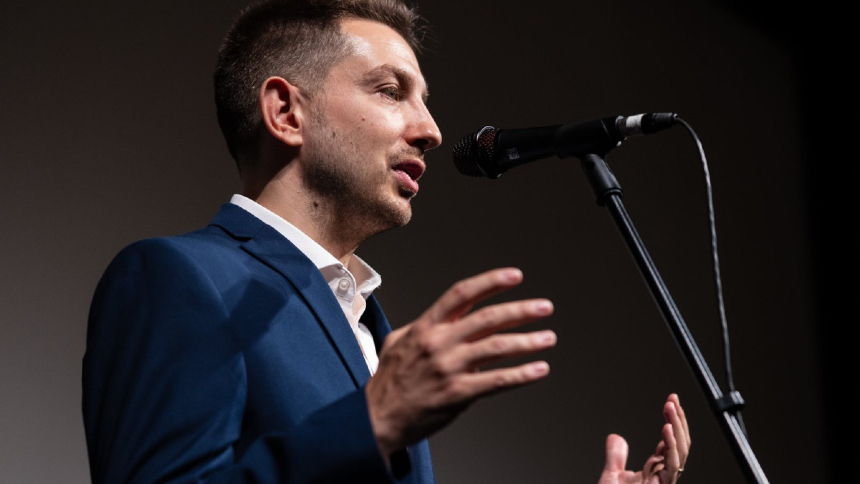
Michele Fiascaris’s feature debut, the mystery thriller Rain Catcher, enjoyed its world premiere at the 60th Karlovy Vary International Film Festival.
Dudley O’Shaughnessy stars as the enigmatic title character, a London photographer who covertly captures strangers and publishes the resulting urban portraits online under the moniker Rain Catcher, cultivating a Banksy-like reputation. To make ends meet, he also takes on illicit assignments, but when one such job goes wrong, he is drawn into a mind-bending journey through voyeurism, trauma and fractured perception.
Screen Anarchy sat down with Fiascaris to discuss the traditions of neo-noir, the film’s stylized vision of London, and the practical challenges of shooting across the city.
Screen Anarchy: You have said that Dudley O’Shaughnessy helped shape the character. How did he become involved?
Michele Fiascaris: It was completely random. In 2017, my co-writer Filippo Polesel and I started writing the script after seeing a viral video online. A videographer in London was filming somebody from very far away, maybe 300, 400 or 500 metres. You could not initially tell how far away he was because the lens was so long.
Then the person in the crowd suddenly turned, looked directly into the camera and started walking towards it. The videographer zoomed out, and you realized just how far away this guy had been. He walked all the way up to the camera.
We thought, “That’s crazy. How did he see him from there? Why is he so upset?” It gave us the central concept: you are photographing somebody, or spying on somebody, and that person looks back at you and starts coming after you.
Originally, we had seen another actor in a short film and thought he might be right for the role. Then, at a party, we randomly met Dudley’s cousin. She said, “My cousin is an actor, and he needs a new showreel. Could you help him?”
She showed us his picture, and I immediately recognized him from Rihanna’s We Found Love video. I knew of him, although I did not know him personally. We met, and Filippo and I started thinking that perhaps he could be Rain Catcher.
It was still very early, but Dudley was interested. One of his first reactions was that the character felt like somebody from a video game. He is a gamer, and that observation was especially relevant to the short film. He really identified with the character. He also had a vibe that matched what we were imagining and helped us expand it. We had an idea of who Rain Catcher was, but when we met Dudley, we suddenly had many more ideas.
He is a very interesting person. He is extremely nice, but also mysterious. He is quiet, observant, and he has this great presence. We would look at him and think, “He could do this. He could do that.” We shaped the character together, drawing from Dudley himself. His performance in the short then gave us more ammunition for the feature. We could see what elements might be developed further.
His eyes are particularly striking in the film.
Exactly. He is a watcher of people and a photographer, so his eyes are his main tool. Dudley has these very sharp, bright, magnetic eyes, and his face frames them almost geometrically.
There is a lot of symmetry and geometry in the film, the framing, the brutalist architecture, and he fits into that world. His face almost looks as though it was designed by the same architect who designed the Barbican. It has that same geometry.
Dudley described the character in terms of video games. Were games also an influence on you?
Atmospherically, perhaps. There are elements that may remind people of certain games. I am not really a gamer now, but I played a lot when I was a child and a teenager. I was into shooters such as Quake and Duke Nukem, and later games such as Half-Life and Max Payne.
Those games definitely transfer into cinema, and cinema transfers into them. They are interconnected. Half-Life, for example, was strikingly strong in terms of storytelling at the time. It was not the first game to do that, but it used dialogue and cinematic techniques in a very powerful way.
RAIN CATCHER uses recognizable mystery and thriller conventions. Which filmmakers were your principal references?
There are probably five directors I really love and study: David Fincher, Brian De Palma, Martin Scorsese, Francis Ford Coppola and Quentin Tarantino. I would not say I consciously draw from all five of them in every film, but they are always present somewhere in the choices I make.
For Rain Catcher, the strongest influences were probably De Palma and Fincher. The short film was particularly influenced by Fincher. Between making the short and the feature, however, I watched and studied a lot of Brian De Palma, especially his long sequences and Steadicam work.
I love Steadicam. On the feature, we had slightly more money, so we could use it. I actually wanted a Steadicam operator every day because it gives you so much freedom.
We had an amazing Romanian operator named Horia. He was extremely creative. Whenever I gave him an idea for a sequence, he would add something at the beginning, at the end or somewhere in the middle. It was fantastic to work with him.
I would love to keep shooting with him and with my cinematographer, Evgeny Sinelnikov, who is Russian-British. There was an Eastern European sensibility within the technical crew, combined with the more Italian, Brian De Palma-inspired energy I wanted to bring.
Evgeny and I have worked together for many years, so we know each other very well. Because we had already made the short, we understood exactly what we wanted from the feature.
On set, it became a question of pushing things further, making the choices more unique and committing completely to the style. I am always pushing Evgeny, saying, “Let’s go further. Let’s make it more daring.”
He naturally begins from a subtler position, which is good because it keeps me grounded. Then I try to take it somewhere slightly crazier. De Palma and Fincher are very different filmmakers, but both were major influences. At the same time, I tried to bring in my own style. The film clearly comes from the tradition of neo-noir and mystery thrillers.
There are also moments that border on horror, particularly in the appearances of the woman.
Yes. Sometimes I watch the film and think we could have pushed the horror further. But we wanted the audience to keep guessing whether the woman was real. If she began doing obviously paranormal things, viewers would immediately decide she was a ghost or some other supernatural presence. That could mislead the audience or reveal too much about where the story was going.
On the other hand, if she became too tangible, if she and the protagonist simply met and had a conventional conversation, then she would become completely real. We wanted to keep her on that blurred line. You should never quite know which direction the film is going to take.
Without revealing the ending, why did you decide that the story needed such a significant final reversal?
Initially, we wanted to keep everything within one dimension and make the story entirely linear. We wrote several versions that remained grounded until the end, but they were not fully satisfying. We received feedback from different people in the industry who felt there should be more to it. The expectations created by the mystery were quite high, but the resolution felt slightly too simple or mundane.
We already had elements relating to pills, trauma and the protagonist’s psychological condition. We began thinking about how those elements could create another level within the story. Eventually, we restructured the film around the opening sequence with the music producer. That scene became the core of the story, the origin and source of everything. In a sense, the rest of the film surrounds it.
We approached it almost as a near-death experience. What happens in somebody’s mind when they are about to die? Are they trying to process what has happened? Are they attempting to redeem themselves and recast themselves as the good person in their own story?
Psychologically, we tried to enter the lead character’s mind at the moment when he is completely defeated and about to pass away. What would he imagine in those final moments? What would he construct while he was intoxicated and dying? The twist is there in service of that idea. It is not simply there because we felt the film needed a trick.
Was the film shot entirely on location?
Yes, everything was shot on location. There was nothing filmed in a studio. Even the car sequences were done for real.
Initially, we considered using a studio so that we could control the city background, but the rain made that difficult. We would have had to limit the rain too much, so we decided to shoot on real streets using a low-loader truck. It was logistically challenging, but it gave us so much more.
The city provided backgrounds and unexpected details that we could incorporate into the film. We know London extremely well, and we wanted to use that knowledge. We wanted to show different parts of the city and different kinds of architecture from what people normally see in films about London. It was essential that we did not shoot it in a studio.
The Barbican apartment is one of the film’s defining locations. How did you secure it?
We could have built the apartment in a studio, but the view was the difficult part. Creating a huge photographic backing of London and the Barbican estate would have been extremely expensive. The Barbican has three towers with around 40 floors each, so there are many apartments. The residents have an online forum called Barbican Talk. We posted there asking whether anybody would be willing to rent their flat to us for three or four weeks.
We received several responses and visited different apartments. Some were empty but, on the market, which made them difficult to secure. Other owners had second homes and were potentially able to leave for a while. Eventually, we found a very nice couple. They were artists themselves and agreed to rent us their apartment as long as we paid for them to go on holiday. So they went to Scotland, had a good time, and we took over their home for almost a month.
Their furniture was already incredible, very stylish, so we kept some of it and brought in additional pieces. Our production designer, Daniel Vincent, who is Hungarian, transformed the entire space. He created these amazing neon columns surrounded by glass and covered the walls with dark wooden panels featuring these ripped, linear patterns. The apartment became much darker, with blue light coming through the glass columns. Between building the set, filming and dismantling everything, we were there for nearly a month.
The film also creates the impression that the characters are watching one another across the towers.
We found three separate flats that allowed us to create those lines of sight. We were very lucky to secure two flats at the same height in two different towers. Then we found a third apartment directly beneath our main location. That became Mrs Blood’s flat.
Logistically, it was complicated. Moving from one tower to another takes time because they are extremely tall and are roughly 100 to 150 metres apart. When you are transporting equipment, that journey is not easy. Even though the apartments are reasonably large, as soon as you bring a film crew inside, everything becomes small.
How large was the film crew?
It depended on the day. Most days, there were perhaps 30 people. At the largest, we had around 50, not including the supporting artists.
The biggest day was probably the art-exhibition sequence towards the end of the film. We had many supporting artists, additional assistant directors and people managing the crowd.
Did the limited budget force you to change much from the screenplay?
We had to scale down certain scenes. There was originally a sequence on a London Underground train in which a mob of people chased Rain Catcher through the carriages. In the finished film, that became the moment where he tears down the poster in the tunnel and runs away.
Filming inside the train would have been extremely expensive and logistically complicated. It was theoretically possible, but it would have consumed too much of the budget. This was a small-budget film, and we tried to squeeze everything we could out of the money we had.
We were also very fortunate with the crew. Many of them normally work on enormous productions, but they accepted reduced rates because they liked the story and had space in their schedules. A lot of people sacrificed their usual demands in order to be part of the film.
The crew appears to have been very international.
It was predominantly British and European, although everybody was based in London. Horia, our Steadicam operator, is Romanian. Daniel Vincent, the production designer, is Hungarian. We also had Czech crew members. Marek Lichtenberg, who is from Prague, worked with us in the locations department. It was a very European crew.
That is interesting because the film also belongs to a recognizably American tradition of thrillers.
It does, although many of my favorite American filmmakers are Italian-American. There is already a European quality within their work. Brian De Palma, Martin Scorsese and Francis Ford Coppola are crossover figures. They were deeply influenced by European cinema. The New Hollywood filmmakers were bringing a European sensibility into Hollywood.
There has always been an interchange between the two traditions. Much of the cinema that later moved into Hollywood had roots in Europe.
I see Rain Catcher as a mixture of styles. I look at Nicolas Winding Refn, but also at De Palma, Scorsese and Tarantino. Those filmmakers, in turn, are looking at French and Italian cinema.
I am also looking at Italian films from the 1970s. The genre may have been popularized most visibly by American cinema, but its visual and thematic language comes from many different places. For a British film, Rain Catcher is certainly different from the majority of British productions in terms of style.
At times, the highly aestheticized imagery almost evokes a music video.
It is partly a question of taste, but it also comes from the atmosphere of the story. We wanted a strong neo-noir quality, and we wanted to portray London in a way it had not often been portrayed before. London is usually presented like a postcard. You see Big Ben and the familiar landmarks, but you do not often see their brutalist or industrial dimensions, even though those are a huge part of the city.
That is why we filmed around King’s Cross and St Pancras. The King’s Cross section is especially industrial. It has appeared in films such as Harry Potter, but there it was made to look much brighter. We largely kept it as it is. We did not have the means to relight such an enormous space anyway, but it already looked fantastic: dim and green rather than bright and yellow.
Architecturally, we had a specific combination in mind, Brutalism, Art Deco and industrial design. All three are present throughout London. Brutalism is especially prevalent in the city’s 1970s buildings, from the South Bank to the Barbican.
We wanted to film at the National Theatre, although that proved difficult logistically. I felt Art Deco would complement the Brutalism. London has some amazing Art Deco buildings and venues. The bar in the film is Bar Américain in Piccadilly, beneath a listed historic hotel. I loved it and had wanted to use it for a long time.
Whenever I walk around London and see an interesting place, I photograph it and save the location. I had accumulated this enormous list of places that I wanted to use. When we had the opportunity to make the feature, I thought, “Let’s use this building, this bar, that location.” The challenge was making all those spaces feel cohesive. They had to belong to the same world.
You wanted the film to have an immediately recognizable visual identity.
Yes. I wanted it to be highly stylized and to have a very clear flavor. I did not want it to feel generic. Ideally, you should be able to watch one minute and understand what the film tastes like. It should feel as though it could not belong to another film. It is a bubble: The world of Rain Catcher. That was the intention.
Of course, I draw from other films, both thematically and aesthetically. I study films very closely. I watch and rewatch the same scenes, sometimes obsessively, to understand how they were made.
I have repeatedly studied the final railway-station sequence in De Palma’s Carlito’s Way, for example. The way he uses Steadicam is brilliant. I wanted to incorporate some of that language, even though we obviously did not have the same resources.
Aesthetically, I was also looking at films such as Drive, as well as Italian gialli, Dario Argento and Hitchcock. You absorb certain ideas, then try to incorporate them and transform them into your own style.
Evgeny and I wanted every scene to possess its own visual identity while remaining connected to the film’s central ideas about photography, framing, spying and looking. The film is fundamentally about viewing the world through a frame. That led us towards symmetry and towards using the geometry of the locations and buildings. That visual order also reflects the mind of the protagonist. He is a photographer, so he naturally stylizes everything. His home is stylized. The world around him is stylized. The design becomes a statement about how he sees.
The project was associated with Netflix during its development. What was the extent of that involvement?
Netflix was not directly involved in producing the film. The script was shortlisted for one of their programmes and reached the final ten, but it did not move into active development. I do not think the programme itself ultimately came fully to life.
What the shortlist gave us was recognition. It allowed us to approach other people, pitch the project and be taken more seriously.
As a filmmaker working in 2026, you know that more people may eventually see the film through video on demand than in a cinema. Does that affect the way you conceive the image?
No. I always shoot for the cinema. That is why we filmed anamorphically and in a widescreen scope format. We wanted Rain Catcher to be a cinematic experience.
Even when somebody watches it on a television, it should still feel like a cinema film. I never wanted to make something that felt like television. Personally, when I start watching something and it feels too much like television, I often switch it off. Even when I am watching at home, I want to feel connected to cinema. I try to see films theatrically whenever I can.
There are obviously excellent television dramas, including excellent BBC productions. I am talking more about that older visual language that feels very video-like or excessively digital. It creates a distance for me.
It was important that Rain Catcher felt wide, cinematic and large in scope, perhaps even larger than the film physically was. The world needed to feel bigger than the budget.
Cover image courtey of Karlovy Vary Film Festival Servis.