
PRESSURE Review: WWII Drama Sheds Light on a Key D-Day Story
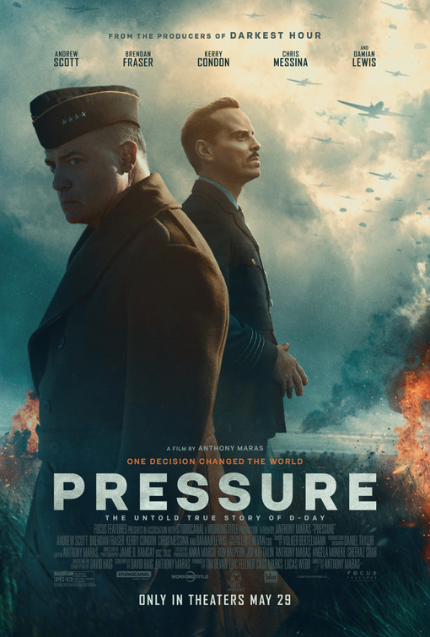
Andrew Scott, Brendan Fraser, Kerry Condon, Chris Messina, and Damian Lewis star in director Anthony Maras' historical military drama.

Produced by 20th Century Fox co-founder Daryl F. Zanuck and released in 1962, The Longest Day, an epic retelling of the June 6th, 1944 invasion of Nornandy by Allied forces, ran two minutes shy of three hours, featured a cast of thousands, including some of the most recognizable actors of the era (e.g., John Wayne, Richard Burton, Sean Connery), and still only spent five minutes on the positively pivotal “Go” or “No Go” decision to proceed on the 5th as originally planned or postpone the invasion due to inclement weather.
The fate of Western democracy and the war against Nazi Germany literally hung in the balance.
In most accounts of the D-Day invasion, “Operation Overlord,” the weather-based “Go” or “No Go” decision rarely merits more than a footnote, let alone a paragraph in a high-school history book, but under the assured direction of Anthony Maras (Hotel Mumbai), Pressure, a World War II drama centered on the 72 hours before the Normandy invasion, it’s anything but a footnote or a paragraph in a history book. Pressure is a well-crafted, old-school throwback to an earlier, simpler time in film history, when movie studios churned out World War II dramas with a regularity and frequency second only to the American Western.
The film is sturdily constructed as a battle of wills between Group Captain James Stagg (Andrew Scott), Winston Churchill’s favorite meteorologist, and Dwight 'Ike' Eisenhower (Brendan Fraser), an American general, future president of the United States, and the Supreme Commander of the Allied Forces in Europe. The ultimate decision to invade Normandy (the “when”) falls exclusively on Eisenhower, a leader, in Maras’ telling, riven with guilt, grief, and doubt over a failed D-Day rehearsal, Exercise Tiger, that went tragically awry for a variety of reasons, some foreseeable, some not, leaving 749 American servicemen dead.
Desperate for certainty, Eisenhower pushes his new meteorologist for a reliable forecast of the Normandy coast and the English Channel over the next two to three days. Relying on historical analogs, Eisenhower’s newly demoted meteorologist, Irving Krick (Chris Messina), forecasts nothing but clear skies and calm weather for early June. Breaking from tradition, Stagg leans heavily on acquiring as much meteorological information from as far away as possible to make an accurate prediction and give Eisenhower the answer he needs, if not wants.
Working from a screenplay co-adapted from David Haig’s 2014 stage play, Maras broadly sketches out character backgrounds, personalities, and fault-lines in the first few minutes. Stagg leaves a heavily pregnant wife, Liz (Tamsin Topolski), behind for Southwick House, the Allied leadership’s current base. Once inside Suthwick House’s grounds, Stagg can’t leave or even contact his wife. It’s a matter of security and secrecy to protect information related to Operation Overlord, including the date, time, and location of the invasion, from discovery by Nazi Germany’s leadership.
Stagg’s hard, seemingly inflexible personality immediately puts him into conflict with Krick and the other meteorologists already stationed at Southwick House. At least initially, Stagg’s demanding, humorless nature leads to friction with Kay Summersby (Kerry Condon), Eisenhower’s chief aide and confidante, and almost immediately, Eisenhower himself, a quick-tempered senior officer understandably obsessed with Operation Overlord, in terms of successfully landing in Normandy, establishing a beachhead, and minimizing losses. All three depend on the accuracy of Stagg’s final assessment of meteorological conditions on the 4th, 5th, and 6th of June, 1944.
True to the title, Pressure keeps the “Go” or “No Go” decision, as momentous as any in recorded history, front and center, always a line or two away. Maras mines the clash between personalities for maximum dramatic weight and emotional effect. As the hours count down, Eisenhower and Stagg clash. Eisenhower wants the certainty Stagg can’t give him. The inherent complexity of multiple, overlapping weather systems straddling the Atlantic Ocean precludes certainty. Stagg talks in degrees of confidence (high, low, mid), but Eisenhower wants a definitive answer.
The script also subdivides the conflict into pairs: Stagg and Frick, Stagg and Eisenhower, and Eisenhower and Bernard “Monty” Montgomery (Damian Lewis), the British general who both wanted the “Supreme Commander” title and clearly resented Eisenhower for getting the nod instead of him. Montgomery openly challenges Eisenhower during senior-level meetings and uses Eisenhower’s lack of battlefield experience to attack Eisenhower’s masculinity and thus, his ability to lead Operation Overlord to a successful completion.
Anchored by another nuanced turn from Andrew Scott, as expressive and transparent as a performer working in the English language today, a uniformly strong supporting cast without a single weak link, visually engaging storytelling, and Maras’ precisely calibrated direction, and the results all but speak for themselves, an enthralling war drama that provides meaningful insight into the events surrounding one of the most closely examined events in world history.
Pressure opens today (Friday, May 29), only in movie theaters, via Focus Features. Visit their official site for locations and showtimes.
Pressure
Director(s)
- Anthony Maras
Writer(s)
- David Haig
- Anthony Maras
Cast
- Andrew Scott
- Brendan Fraser
- Kerry Condon

Do you feel this content is inappropriate or infringes upon your rights? Click here to report it, or see our DMCA policy.


