
Sundance 2026 Review: GHOST IN THE MACHINE, A Must-See AI Primer
Valerie Veatch directed the "mind-expanding, investigative essay" documentary.

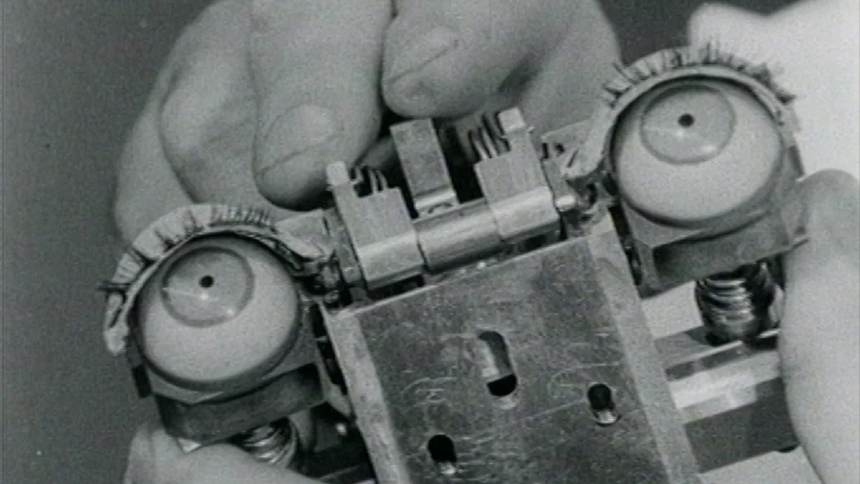
By turns exhaustive and exhausting, Valerie Veatch’s (Love Child, Me at the Zoo) latest documentary, Ghost in the Machine, takes an exhilaratingly deep dive into the history, development, and the current state of so-called AI (artificial intelligence, its evangelical supporters in and out of Silicon Valley (Elon Musk and Sam Altman, especially), and the host of problems --some economic, some political, and some climate-based -- associated with ill-defined, problematic technology.
Starting not in the present or even distant past, Ghost in the Machine opens with a brief reminder of the world’s first chatbot, “Tay.” Released into the wild in 2016 by Microsoft on Twitter, it flamed out almost immediately, embracing antisemitism and Holocaust denial before the Powers-That-Be figuratively and literally pulled the plug. Obviously, what passed for AI in 2016 wasn’t ready for primetime, but it also doubled as a warning of things, few of them positive, to come over the next decade.
Separated into eight broad chapters, Ghost in the Machine hits the rewind button and starts at the end of the 19th century and the beginning of the 20th century, when the eugenics movement was explicitly created to “prove” the superiority of Western Europeans (Caucasians) over every other so-called race. It was then — and remains — a project to rationalize Western-style imperialism and colonialism. It was also used to justify the superiority of white men and their unquestionable intellectual powers over women, confirming their status as, if not masters of the universe, then the world.
From there, Veatch’s documentary explores the introduction of AI into the scientific vernacular, first at Stanford as a purely speculative concept and later, as Stanford became the linchpin for the development of computer science and technology, semi-conductors among them, as the end-all, be-all, as a worthy goal for scientists, philosophers, and tecnologists to achieve, if not in the 20th century, then in the 21st. The dangers of misuse, of manipulation, and misapplication were rarely, if ever, given more than a passing mention, dismissed out of hand as over-reactions to net-positive technology.
Ghost in the Machine's subsequent chapters speed-runs through snippets of interviews with experts in practically every related field (science, sociology, psychology), interspersed with archival footage of Musk, Altman, and others promising a techno-utopia once AI, however vaguely defined, becomes fully functional. Musk, Altman, and the others make little mention of the widespread, potentially catastrophic effects of AI replacing human workers across every strata of economic activity or swapping out typically everyday activities or interactions with chatbots who do our thinking for us.
Ghost in the Machine’s methodical, chronological approach takes the viewer to the current day or thereabouts, and a key, often unacknowledged problem associated with AI and its promise of answering every question or solving every possible problem imaginable: Data centers. Popping up not just across the United States, but across the world, data centers ingest enormous amounts of energy (electricity) and use massive amounts of water. For both energy and water, AI data centers run into scarcity and cost issues, the latter (water) being the greater, more disturbing problem, one that all the greatest tech minds in the world can’t easily solve.
As a warning, cautionary tale, or even a call to action, Veatch’s documentary undoubtedly succeeds, but it also demands a level of concentration and attention atypical of the format in its current iteration. Watched in a single sitting, Ghost in the Machine will certainly provoke thought and conversation about the current and future state of AI. The most diligent of viewers, however, will be left on the wrong side of depleted, a function of Veatch’s natural inclination to cram as much relevant information into the shortest possible running time.
Ghost in the Machine would have benefitted from either a longer, more leisurely running time or an expansion into a three- or four-part miniseries. That, in turn, would allow Veatch to dig deeper into the subject of each chapter or combine relevant chapters into a single one. It would have also allowed the 30-odd talking heads Veatch interviewed for the documentary additional time to develop their individual points in greater, more granular detail. An occasional contrary point-of-view, even one easily debunked, could have helped too.
Whatever its faults, Ghost in the Machine ends as it begins, as essential, vital viewing. In fact, it should be required viewing for anyone interested in the ongoing AI debate or in AI in general.
Ghost in the Machine premiered at the 2026 Sundance Film Festival.

Do you feel this content is inappropriate or infringes upon your rights? Click here to report it, or see our DMCA policy.


