European Film Awards 2026 Interview: SOUND OF FALLING Director Mascha Schilinski on Transgenerational Trauma, Radical Subjectivity, Quiet Violence of Memory

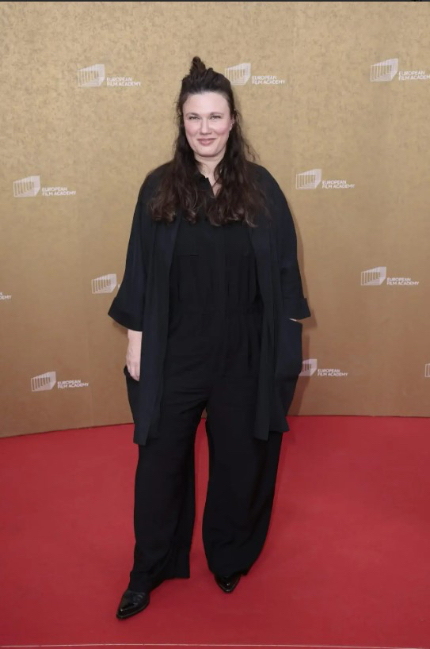
Mascha Schilinski’s Sound of Falling, is a film built around sensations that resist clear articulation: unease without origin, memories without stable images, trauma without a single historical event to point to.
Speaking at a recent roundtable following the film’s premiere run, Schilinski repeatedly returned to the idea that the film was less about reconstructing the past than about listening: to inner states, to suppressed histories, to the low-frequency hum of something being wrong, long before it becomes visible.
At the 38th European Film Awards, Sound of Falling emerged as one of the most widely recognized European titles of the year, earning nominations including Best European Film, Director, Screenwriter, Cinematography, Composer, Casting, Costume Design, and Make-up & Hair, before ultimately winning Best European Costume Designer for Sabrina Krämer.
The film, which moves through different generations of girls living on the same rural farm, emerged from an unusually intimate writing process. Schilinski co-wrote the script with Louise Peter, a longtime friend she has known since adolescence. “The most important process for me was the collaboration with my co-author, Louise Peter,” she said. “We were together in school, and this was so important for this film because it was all about trust.”
That trust translated into a form of sustained, almost therapeutic excavation. “We were talking two years every day, ten hours per day,” Schilinski recalled, “to find out these hidden tiny little feeling stories that you have no name for, and that you always try to avoid or repress.”
What interested them were not explicit biographical traumas but sensations that seem to come from elsewhere, untethered from personal memory. “These are things you’re maybe not even aware of, because they feel like they’re coming from somewhere else. You don’t have the link in your own biography.”
Schilinski describes this as a “permanent diffuse feeling of unease”, a sensation without weight or anchor, but one that persists. “It seems weightless. There’s no genuine anchor there within our lives, but it’s there nonetheless,” she said. “And we wanted to listen very carefully to that.”
That inward listening shapes both the film’s narrative structure and its radical subjectivity. Sound of Falling does not explain itself; instead, it immerses the viewer in overlapping emotional states that move across time.
This approach also informed Schilinski’s work with the film’s young cast, which she describes as both a privilege and a responsibility. “Working with all these kids was such a huge responsibility,” she said. “They are incredibly smart. They have such a good feeling for what is wrong, what is right, what works, what doesn’t.”
At the same time, the thematic material, death, repression, inherited fear, required constant vigilance on set. “I was always afraid of this boomerang effect,” Schilinski admitted, “that things underneath the surface could come up in the team or between the actors.” The tension between artistic immersion and ethical care was ever-present. “I was really in this tension that everyone is secure and that nothing happens.”
Motherhood, which might seem to offer a new interpretive lens on a film so deeply concerned with childhood and vulnerability, did not fundamentally alter her relationship to the material. “As a mother, I always thought there will be something that I don’t know before,” she said. “But surprisingly, it’s not. All these things that I always thought it must feel like this, it’s actually exactly so.”
The film’s English and German titles offer another entry point into its internal logic. The original working title, The Doctor Says I’ll Be All Right, But I’m Feeling Blue, stayed with the project for four years before being abandoned. “I loved this title very much,” Schilinski said, “but I was the only one. It was just too long.”
Sound of Falling emerged as a more precise metaphor. “For me, there is actually no sound when things are falling,” she explained. “But we are in this radical subjective perspective of the characters. When something breaks inside a person, there is a sound, only audible to them.” It is, she added, “loud on the inside, but quiet on the outside.”
The title also gestures toward the film’s temporal structure. “We are falling through time,” Schilinski said. “Almost like falling through time and space.”
The images, she explained, were conceived as a collective stream of memory “as if all the people who lived at this farm are dreaming or remembering at the same time.” Like the falling sensation in dreams, the movement is unstoppable. “We can do nothing about it,” she said. “And then we wake up.”
The German title, In die Sonne Schauen (Looking into the Sun), arose partly from linguistic necessity; the English phrase does not translate cleanly, but it also reflects one of the film’s primal images. “Looking into the sun is very painful,” Schilinski said. “It’s almost like looking into the face of death. And these girls are looking for a very long time into the sun, or into the face of death.”
Although the film spans much of the 20th century, Schilinski resists framing it as a historical panorama. Instead, it occupies liminal moments, periods just before or just after catastrophe. “We are never immediately in war,” she explained. “We are before the First World War breaks out, or after the Second World War.” For Schilinski, that atmosphere of anticipation is deeply contemporary. “This feeling that something is changing and you can feel the first signs, I think we are in such a moment now.”
The setting itself emerged almost by chance. The production eventually settled in the Altmark region in northern Germany, part of the former GDR. “When we arrived at this place, I had the feeling this could be a vessel for all these thoughts,” she said.
Extensive research followed, but always in service of interior states rather than historical exposition. “We were not interested in the huge historical things,” Schilinski stressed. “Only in the moments where history really hits the lives of these characters.”
Much of that research uncovered what she calls “tiny, untold stories,” particularly those of women. “We found books written by men, and only two written by women,” she said. “And in between these idyllic descriptions, there were half sentences like, ‘A woman has to be made so she’s not dangerous anymore,’ or ‘I live for nothing.’” The shock lay not just in the content but in its tone. “They were written in the same banal, pragmatic way. You could almost overread them.”
Those gaps, what is omitted, repressed, or forgotten, became central to the film’s form. “The images you don’t see in the film are even more important than the ones you do,” Schilinski said. Trauma, as she understands it, is not about factual accuracy. “It’s not about whether this or that happened,” she said. “It’s about the feeling that remains.”
Children, for Schilinski, are uniquely positioned to navigate that terrain. “Kids are born into these concepts,” she said. “They have no idea where they’ve landed, but they sense the rules.” What fascinates her is how children test those rules. “They move through the world like detectives, trying to decode everything. And in doing so, they push these concepts to their absurd limits.” For cinema, she added, “that is incredibly powerful.”
In Sound of Falling, beauty and brutality coexist without hierarchy: tender images collide with moments of cruelty, sunlight with gore. Schilinski sees this not as contrast but as fidelity to perception. “I wanted the audience to really jump into the heads of these girls,” she said. “There is no explanation. You just hear fragments, like when you pass strangers on the street and catch half a sentence.”
That refusal to clarify may be the film’s most challenging, and most rewarding, gesture for audiences. For Schilinski, it is the only honest way to approach memory, history, and the quiet sound of something breaking long before anyone else hears it.
Cover image courtesy of 38th European Film Awards Berlin 2026, Sebastian Gabsch.