
Sundance 2026 Review: SACCHARINE Turns Body Horror Into a Study of Appetite and Identity
Natalie Erika James uses ghostly body horror to explore binge eating, approval-seeking, and the psychic fractures of biracial identity.

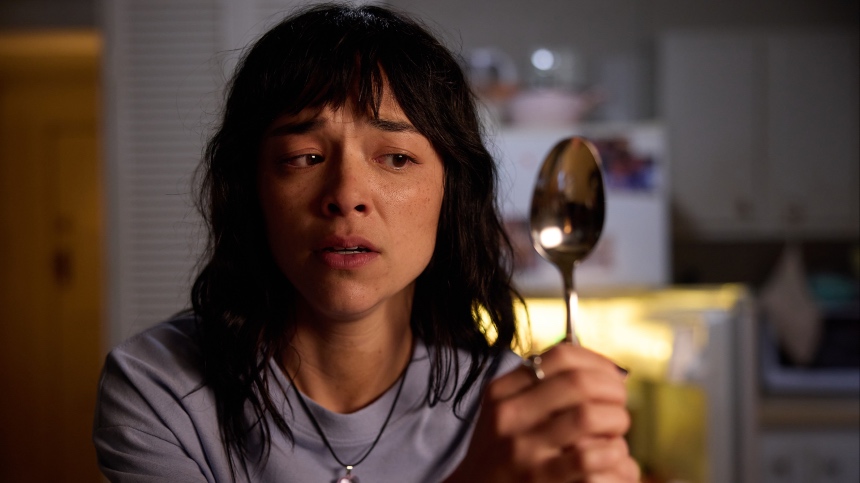
Natalie Erika James's Saccharine -- her third feature, and perhaps her most nakedly personal, following Relic and Apartment 7A -- is a film obsessed with doubling.
A Sundance Midnight selection, it presents itself as both an old-fashioned ghost story and a sleek piece of modern body horror, subgenres that begin to bleed into one another almost as soon as the film starts. Its protagonist, Hana (Midori Francis), shares James's Japanese-Australian background, and the film's tensions -- psychological, cultural, corporeal -- are consistently framed as a struggle not between identities but within them, a state of perpetual internal negotiation.
Hana is caught between two bluntly opposed stereotypes: the disciplined medical student and the compulsive binge eater. The opening montage, which features food being shoved into a mouth in reverse -- suggestive of bulimia -- unfolds against audio seemingly lifted from a sex scene, a queasy conflation of appetite, shame, and release that sets the tone for what follows. James is less interested in balance than in fracture: Hana doesn't straddle these identities so much as ricochet between them, often violently.
Her self-consciousness manifests everywhere. At the gym, she fixates on Alanya (Madeleine Madden), an Instagram-famous instructor who functions simultaneously as an aspirational ideal and an object of desire. When Alanya invites Hana to join a 12-week diet-and-exercise study, Hana initially balks, her hesitation rooted in low confidence and self-surveillance.
Even after she signs on, she turns to a shortcut: an illicit pill called gray, unapproved by Australia's Therapeutic Goods Administration but recommended by a former classmate who was once a target of fat-shaming but has reappeared with suspicious confidence. Meanwhile, at medical school, Hana's dissection group is assigned a severely obese cadaver, its presence exerting a strange gravitational pull on her already splintering concentration.
When Hana tests the contents of the gray capsules, she discovers that they contain human ashes. The pills are prohibitively expensive -- $5,000 AUD at a minimum -- which leads her to a grotesque solution: siphoning material from the donated cadaver, a transgression that collapses professional ethics into personal desperation. The drug works, perhaps too well, and James wastes little time in revealing that its benefits arrive bundled with consequences that are not merely physiological, but moral and psychological as well.
Nearly all of Hana's decisions trace back to a single, corrosive impulse: approval-seeking. She distrusts Alanya's steady regimen in favor of gray's accelerated promise; when Alanya later expresses concern over Hana's rapid weight loss, Hana reads it not as care but as rejection. Achievement, in Saccharine, is indistinguishable from self-erasure, a process the film treats as both seductive and catastrophic.
James extends her horror vocabulary beyond ghosts and prosthetics to the act of binge eating itself. For viewers familiar with eating disorders, these scenes may be the film's most punishing. Food is stripped of pleasure; even when Hana douses her doughnuts in syrup, nothing looks remotely appetizing. Compulsion is staged as possession, another iteration of the film's central duality: desire as both hunger and haunting, agency and surrender.
Hana's biracial identity deepens this internal conflict. Her Japanese mother (Showko Showfukutei), long-suffering to the point of self-abnegation, reaches a breaking point while caring for Hana's mobility-impaired Australian father (Robert Taylor), whose presence inevitably recalls Brendan Fraser in The Whale. The cultural clash between self-sacrifice and perceived selfishness mirrors Hana's own psychic battleground, lodged uncomfortably between inheritance and rebellion, duty and resentment.
The film's scares are effective, if not subtle. Robert Mackenzie's sound design and Larry Van Duynhoven's prosthetic work carry equal weight, and James adheres to the familiar slow-burn rhythms of prestige horror. The climax is heavily telegraphed, its moralism echoing the cautionary bluntness of Tales from the Crypt.
Yet the film's social implications -- its diagnosis of a collective, culturally reinforced nightmare -- lend it an unsettling force. Saccharine may not surprise, but it knows exactly where to press, and why the pressure hurts.
The film premiered at the 2026 Sundance Film Festival.

More about Saccharine (2026)
- Shudder in July: Highlighting a Strong Lineup of Features: FACES OF DEATH, SACCHARINE, NIGHTBORN, EXIT 8, And TOUCH ME
- Now Playing: SACCHARINE Hunger Horror, TUNER Crime Drama, PASSENGER Stalker Thriller
- SACCHARINE Review: Ghost Story Bleeds Into Modern Body Horror
- Opening This Week: SACCHARINE Gets Hungry, TUNER Commits Crime, PASSENGER Stalks Relentlessly
- SACCHARINE: Trailer & Poster Premiere For Natalie Erika James' Body-Image Horror


