
Morbido 2026 Review: TALKING TO A STRANGER, Gigi Saul Guerrero Shines in a Distressing Maternal Nightmare

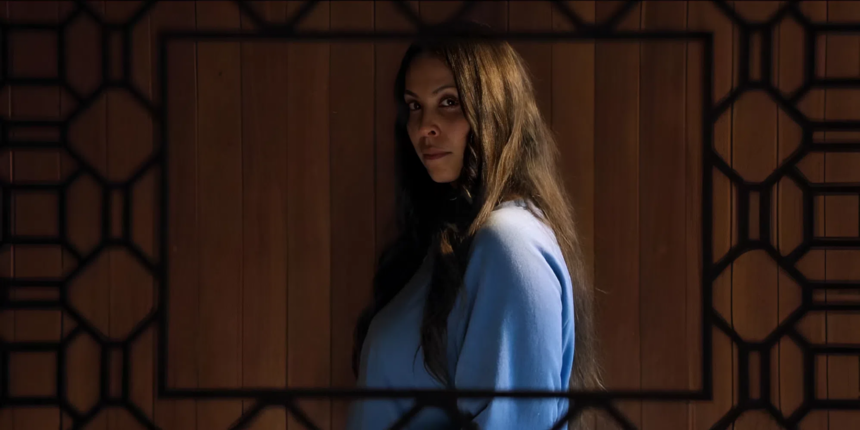
Watching Adrián García Bogliano’s Talking to a Stranger, the first thing that hits you is just how heavy and uncomfortable the ride is. It skips the cheap scares to leave you with a lingering, knots-in-your-stomach unease. Right from the jump, you know you are locked into a grounded, distressing psychological trip rather than a standard popcorn horror movie.
Patricia is overwhelmed, trying to manage a household with a teenager, a young son, and a baby on the way. During a chaotic moment, she loses track of her boy, Chris. It causes a house fire that kills him. The guilt and grief break her. To get through the trauma and insomnia, she leans on prescription pills, keeping herself numb and living in a haze.
That is when a demonic entity moves in. It feeds on her grief by pretending to be Chris, starting conversations that Patricia cannot distinguish from reality. The more she listens to it, the further she drifts from her husband, who feels like his wife has been replaced by a stranger. As her mental state unravels, the house falls apart, forcing the family to realize that a monster has taken over their home.
Fast-forwarding four years later, the story follows Patricia’s fragile, medication-induced worldview as the demonic entity exploits her history of breakdowns. By taking the face of Chris, the spirit twists "Middle Child Syndrome" into a supernatural trap, convincing Patricia that her youngest daughter, Tere, stole Chris's space in the family. This manufactured resentment fractures the household until Patricia's husband, Andrés, and her sisters, Hanna and Norma, stage an intervention, bringing her to an unorthodox hypnotherapist named Sarah to break the entity's hold.
Adrián García Bogliano drops the audience straight into the action with little to no preamble—"And we’re running, we’re running, stay with me now, we’re running…”—before settling into a slow-burn psychological nightmare. Ditching jump-scares and CGI, he uses a claustrophobic domestic setting and a raw, character-driven performance from Guerrero to subvert traditional supernatural tropes.
Talking to a Stranger uses maternal horror to channel real-world anxieties about motherhood through a supernatural lens. The film builds dread by weaponizing maternal guilt, letting the entity derive its power from Patricia’s self-blame over the fire and forcing her to confront her fear of failing as a protector. Her mental state has been in tatters ever since his death, and when we join the story, she has just suffered another breakdown—one of many she has endured over the years. This ongoing trauma isolates her, creating an emotional barrier with her husband that turns her into a stranger in her own home. The narrative also twists basic nurturing instincts, transforming Patricia's urge to hold, feed, and comfort her son into the exact mechanism the entity uses to drain her control.
Talking with a Stranger joins the pantheon of maternal horror films like The Babadook, Hereditary, and Under the Shadow, tracking a mother's psychological collapse through a supernatural lens. Like The Babadook, it traps a grieving parent in a claustrophobic space where the line between a demon and a mental breakdown blurs. It shares that Hereditary kinship by using family grief, letting the face of a deceased child exploit vulnerability. The film also mirrors Under the Shadow by highlighting how the exhaustion of daily domestic life leaves a mother open to a predatory force. By skipping jump-scares for emotional dread, Bogliano delivers a psychological collapse that rivals the genre's best.
Gigi Saul Guerrero delivers an unfiltered performance in her leading debut, leaving nothing hidden on screen—including an unexpectedly revealing scene that grounds the film's vulnerability. Seeing her handle a role with that level of physical and emotional exposure is a milestone. We regard Gigi as a friend and have supported her filmmaking career from her DIY beginnings with Luchagore Productions to her feature film directorial debut, Culture Shock, and on. We hung out we traveled back West, but our favorite place to catch up was at the Morbido Film Festival, where we crossed paths at least three times during our tenure. Watching her step into the spotlight and expose that depth on screen shows how far she has come since her early indie days. We can continue our friendship supporting her as an actor as well.
While the ending does not ruin the movie, the climax left me wanting more because it misses the chance to land that punch of utter defeat. As Patricia's journey wraps up, catching up with the aftermath rather than witnessing her final collapse directly saps the ending of its tragic weight. Maybe we are asking for too much despair, but watching the tragedy happen in real time would have felt a lot more satisfying and haunting than just dealing with the fallout.
Skipping the final moment of Patricia's collapse feels like an emotional shortcut that shifts the payoff the audience earned. After spending the movie watching her suffer, get deceived, and fight to overcome the demon's intent, you expect a punctuation mark to her story. Cutting away to the aftermath instead of letting us witness the climax in real time alters that emotional contract. It turns what should have been a visceral tragedy into abstract information, leaving the investment stranded without the weight it deserved.
Even with an ending that leaves you wanting more, Talking to a Stranger is worth a watch. Fans of Bogliano will get what they want from a director who refuses to play it safe and keeps trying new things. If you like Guerrero, her lead debut is a must-see for the emotional tragedy and despair she brings to the screen. It is a heavy, dark psychological trip that horror fans should check out.

Do you feel this content is inappropriate or infringes upon your rights? Click here to report it, or see our DMCA policy.


