
Echoes: HANGING BY A WIRE, Pakistan's First Academy Award Documentary Entry, Was Shot Entirely on a Phone

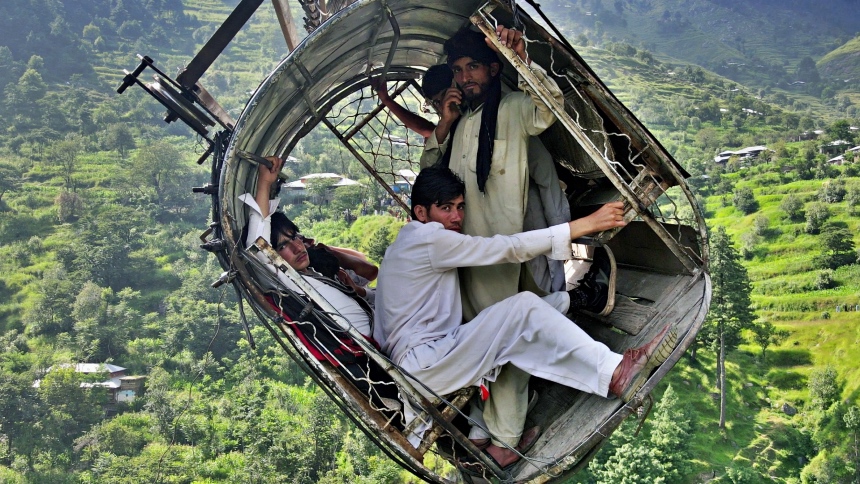
On the morning of August 22, 2023, people in the Allai Valley, Khyber Pakhtunkhwa, looked up.
No one could believe their eyes when they saw a cable car hanging hundreds of feet above, suspended by the last cable that was supporting it. People were terrified that, at any minute, the cable car, containing eight people, including six children on their way to school, would come smashing down.
It was obvious that media outlets were recording the entire incident, which was being reported live on all television screens across Pakistan. It was the same impossible image that showed people wailing from inside, asking for help, desperate to do something that would save their lives.
Something else happened on the ground, however. Someone reached for their phone, recorded the videos, and started sharing them over WhatsApp and social media accounts. Who knew those images and videos would become part of a film that three years later was chosen as Pakistan's official entry to send to the Academy's international feature category?
Hanging by a Wire is directed by Mohammed Ali Naqvi (Mo Naqvi), who is the chairman of the Pakistan Oscar Selection Committee and a member of the Academy of Motion Picture Arts and Sciences. The film is hailed as a major milestone in Lollywood's history, since it is the first time a documentary film is selected as an official Oscar selection from the country, as per Deadline.
After administrative hurdles, confusion, and documentation issues prevented Pakistan from submitting an official Oscar entry last year, things have taken a positive turn this year. Hanging by a Wire debuted at the 2026 Sundance Film Festival and gained positive reviews, despite minor criticism. (See our review by Mel Valentin.) What's more fascinating is that the film won the Sabeen Mahmud Award for Courage in Cinema at the Mosaic International South Asian Film Festival (MISAFF) in Canada recently, as Dawn reported.
What went on behind the camera? Ordinary smartphones were recording something that was happening in real time. It was made by people who were not thinking of film festivals or had any intention of making a documentary. They were local community members, onlookers on the ground, rescuers, and even a local village resident, who used a drone to capture the aerial footage.
These raw videos were later compiled by the Emmy-nominated filmmaker. He couldn't simply collect videos scattered across the internet and stitch them together into a documentary, as doing so would violate ethical and legal boundaries. He held a "tribal council" with the local families and rescuers, inviting them to co-author the film, as confirmed by a Sundance blog.
There were TikTok videos, Instagram, and Facebook accounts that uploaded the footage with the author's profile, hence making it impossible to get the videos just like that, and without notifying the owners who recorded and posted them. They had to talk to the people and get permission to get the videos directly from them.
The result is a documentary that reportedly plays out like a thriller, combining drone footage and cellphone recordings with dramatic recollections performed by people who were actually there. From actual survivors and local rescuers, such as zip-line experts Sahib Khan and Ali Swati, some news broadcasts were part of the process. It is understood that the reconstructions were necessary to understand what went on behind the camera when darkness engulfed the valley and shooting live videos was no longer possible.
Those who remained at the site during the incident did more than watch from the sidelines. They came forward to help rescue the people stranded 900 feet above the ground. The tragedy highlighted the valley's glaring lack of infrastructure, but it was these people who came forward to transform the entire valley, interestingly.
The Battagram community had already watched itself become a news story in 2023. Naqvi told when these participants later watched the documentary, they saw their roles changed in the process, but in a positive way. They were no longer people being represented as the outsiders; they were helping decide how their experience would be reconstructed and remembered.
Inherently, filmmakers, cameramen, or journalists have cameras to record real-time incidents, but this time, a teenager in a remote Pakistani village was able to record something capable of travelling around the world and making history. Pressing the "record" button does not simply mean you know you are capturing history. You never know which ordinary moment unfolding in front of your camera might one day become a first visual record of history; a history of now, an Academy Award submission.
Echoes is an opinion column on film and television from the perspective of a writer based in Pakistan.

More about Echoes
- Echoes: What Does a 13-Minute Oscar-Qualifying Short Film Mean for Pakistan's Short Film Industry?
- Echoes: Pakistan Wants A Film Industry. Does It Have the Crew to Build One?
- Echoes: The Changing Art of Pakistani Film Posters
- Echoes: Pakistan Has An Indie Film Movement. Why Aren't We Talking About It?
- Echoes: 10 Pakistani Performances That Deserved Far More Attention


