TONY Review: Linklaterian Warmth Wafts in on a Summer Breeze in Matt Johnson's Bourdain Biopic
Canadian prankster Matt Johnson grows up in a delightful coming-of-age origins story of Anthony Bourdain.

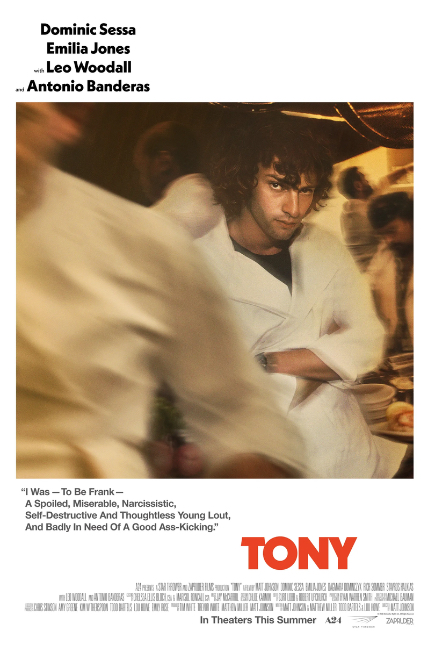
Spoiled. Narcissistic. Self-destructive. Thoughtless. Badly in need of a good ass-kicking. These are phrases the late, great food guru Anthony Bourdain used to describe his teenage incarnation in his self-affacing autobiography, Kitchen Confidential.
The same terms could be equally applied by adorable enfant terrible Matt Johnson to his past self; he's expressed similar sentiments of being weary with the precious, impolite and rebellious young creative he once was. His indefinable brand of affectionate bro comedy, vérité camerawork and distinctive Canadian dryness doesn't quite line up with Bourdain's lyrical work as American's foremost culinary connoisseur...or does it?
While the two are professionally worlds apart, does Johnson's own self-interrogation make him the perfect director to bring Bourdain's early years to life? The lively and bittersweet Tony makes a great argument for this sweet and sour pairing.
The Holdovers' Dominic Sessa is a young Bourdain, known casually to his friends as Tony and strictly to his mother (Dagmara Dominczyk) as Anthony. Brimming with braggadocio, his application to Vassar College to write the next great smart-ass American novel is rejected, and sends him into a spiral that lands him in Provincetown, Massachusetts, hangdog and hungover in search of his high-school crush, Nancy (Emilia Jones).
One drunken brawl leaves him without cash and at the mercy of local chef, well, Chef (Antonio Banderas), a tough but fair taskmaster who lets him sleep on his porch hammock in exchange for a summer's worth of potwashing at his fast-seafood greasy spoon, The Flagship. This botched summer break proves to be the most important in young Anthony's life, gradually forging the legendary figure we sorely miss in salt water, cocaine and fire.
Taking a snapshot of Bourdain in this relatively short period is both an electrifying and curious choice to capture such a colossal cultural presence. The low stakes are key to its success; in rooting Tony's motivations simply in a 'get the girl' grindset, he is written here with underqualified wile and reckless guts, displaying a kernel of greatness that will be beaten, buffed and polished into a diamond at some point down the line. The film doesn't necessarily reach that crucial moment, and that's okay; that's not what Johnson has in mind, instead opting for something your senses can drink in.
Forever a great appreciator of people and places, Johnson's appetite for the local flavor of Provincetown is where Tony thrives. Set in a 1975 packed to the gills with nostalgic sights like drive-in screenings of Jaws, joyrides in electric blue muscle cars and cold ones with the boys, the idea of a hangout flick has rarely been as enticing as this, and its precise August release date makes this the perfect piece of counterprogramming to the billion-dollar blockbusters in the other auditoriums; in many ways, Tony feels like more of an escape than The Odyssey or Spider-Man.
Johnson finds some Linklaterian charm in the proceedings. Although the relationship between Tony and, well, everyone else is frequently combative, there's a warm naturalism to much of the drama that chases the kicked-back vibe of Dazed and Confused and honestly gets there.
While working from a Blacklist script by Todd Bartels and Lou Howe and rewritten by Johnson and Matthew Miller, there's still plenty room for lively improvisation, led promisingly by podcaster success story Stavros Halkias as a salty, seasoned seafood chef who gives Sessa no quarter when it comes to nasty, raw insults. Standing dangerously on the sidelines is volatile oyster shucker Sal (Leo Woodall), whose unpredictable energy brings an element of tension to the comedy; while his colleague is all boorish fun and games, Woodall guards something darker behind his boyish charm and bemuscled biceps.
Sessa's gangly frame stood frozen in place while the whirlpool of broken dishes and burnt lobsters threatens to swallow him whole is the film's north star; with his authentic 70s look (right down to his face, like that of a beloved character actor seen only in gritty New York crime dramas) and baritone voice, Sessa's arrogant con-man take on Bourdain cements his status as one of the most promising young stars in the industry, starring in every scene and holding his own against other acting veterans and under the great legacy of Bourdain himself.
Sessa's ebb-and-flow chemistry with Antonio Banderas is a delight; Banderas brings some serious elder statesman heft to a role that is purposefully mysterious and eternally wise, his purring vocal tones used sparingly and effectively throughout. This father-son/mentor-mentee relationship informs what Bourdain will become most strongly, and is the most pleasing classical biopic element that Johnson offers up.
Less deftly played is the relationship between Bourdain and his future wife, Nancy Putkoski. Although Emilia Jones brings real-deal girl-next-door loveability to the role, she is severely underserved by a script that feels only interested in her as an extension of Tony's desire, despite so much of the film's drama hinging on how Tony's selfishness ruins her life little by little. At times, it feels like the first ever female role that Johnson has ever directed, and particularly highlights the discrepancy between how well he can portray warm, complex, sometimes homoerotic relationships between men and how badly he paints heteronormative, romantic ones.
Even so, this is just one way Johnson has attempted to evolve as a filmmaker here, and he succeeds with flying colours in every other area. Working with Paul Thomas Anderson collaborator Michael Bauman as his cinematographer, he opts for a more composed visual style versus his more frenetic work with Nirvanna the Band the Show cameraman Jared Raab, yet retains the liveliness of his previous features' distinctive looks. Additionally, fellow Nirvanna the Band band member Jay McCarrol lends his soulful scoring to Tony's gradual learning curve, free from the shackles of the Nirvanna creative enterprise that saw him emanate the styles of other more famous composers; here, he is free to express himself with grace and elegance, and hits the tone note-perfect.
The more you think about Johnson and Bourdain as parallel figures, the more knotted-up Tony gets as a film. With its shifting, complicated thoughts on how the harm caused by reckless youth breaks and heals its characters, Tony is both biographical and autobiographical, organically fitting in with Johnson's own affection for and frustration with man-children finding their way in the world, and also doing justice to Bourdain's own rich and complex life.
There are plenty parts left unknown in this amuse-bouche of a three-course life, but any more may have been an indulgence.
The film expands nationwide Friday, August 21, via A24 Films.