
Fantasia 2026 Review: HER PRIVATE HELL, A Nightmare Neon Opera

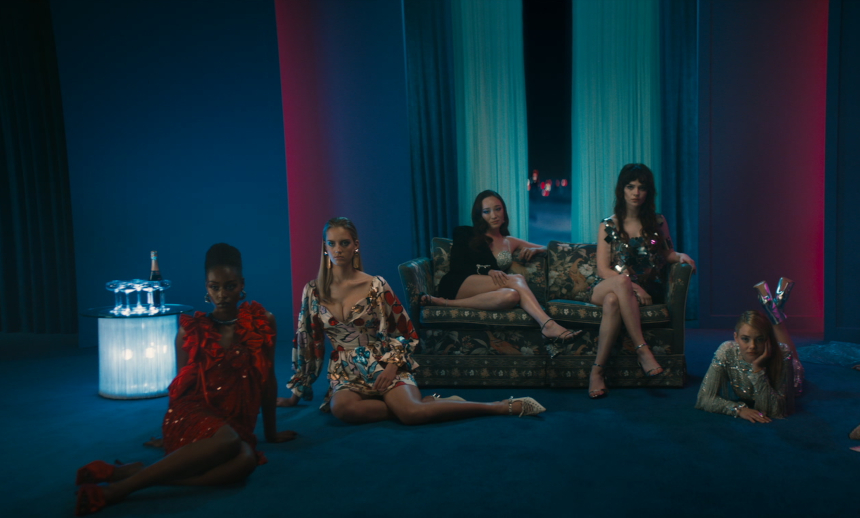
At one point in Nicolas Winding Refn’s oblique, morally agnostic, performatively high-camp melodrama, a character pontificates, “You know, this movie is not going to fix us.”
They are probably right. The director is far more interested in mise-en-scène still-lives over coherent storytelling in his latest film, Her Private Hell.
Like the mist that hides the neo-futuristic (and simultaneously retro-futuristic) city of glass towers, there is little, narratively, to hang onto, and yet here is plenty of handsome imagery. The movie is a neon dream which nods to late 1960s couture-classics like Barbarella and Danger Diabolik, the black-gloved Giallos of Mario Bava and Dario Argento, and the contradictory, dystopian urban architecture of Blade Runner.
Exteriors are drenched in pink and blue, and interiors ooze warm yellows and golds. Characters are clad in dark leather that squeaks and creaks with a satisfying ASMR, studded with blinding diamonds. Sequins, GoGo Boots and pomade abound. In other words, the production design is the star of the show here. This is the kind of style-exercise where the story is veneer-thin, the characters thinner, but the visuals dazzle and bewilder.
This is Refn’s first feature film since 2016’s The Neon Demon (if you do not count his decade-long foray into streaming series TV with Too Old To Die Young for Amazon, and Copenhagen Cowboy for Netflix), and the director seems to have fallen far too far in love with his signature aloof and icy tableauxs. These were hinted at in Drive, Only God Forgives and The Neon Demon, and used to underscore stories grounded (to various degrees) in some kind of attempt of human reality.
Her Private Hell reaches the point where there is no longer any outer world groundedness stitching them together. There is only the dream and inner-state anxieties, which are realized through drifting vignettes, plot fragments, and ideas. This may be intriguing, even invigorating for some, but it will likely be infuriatingly difficult for most. It sure is pretty, even when horrendous acts of violence are committed, resulting in gushing fountains of blood, or eyes punctured with sharp objects.
The story is of Elle (a fairytale name if there ever was one) who has serious daddy issues. A memorable, if fleeting, cameo from Dougray Scott is as her father, demonstrates he can look comfortable and cocky on a couch, apply eyeliner and highlights to his brows with the best of them, and hold court with his girls.
Elle’s father married one of her former friends, which makes her about the same age as her step-mother. He forces the pair of at-odds women together in his expensive and enormous penthouse flat in the sky, and tasks them with collaborating to make a film adaptation of a campy comic book called Candy Floss. We see fragments of the drawn page, and the ‘finished’ film involving colourfully attired, space-faring women scampering around in tight outfits on a planet made of crystals and shooting their retro-laser pistols at one another.
Meanwhile, in a phantasmagorical post-World War II Japanese city of wood and paper lanterns, an American soldier named Private Kay searches for the Yakuza who killed his daughter. He will move heaven and earth (whilst theatrically straightening the crisp shirt of his military uniform) to find the “Leatherman” killer who took his daughter from him. He trades verbal barbs and a fist full of brass knuckles with the Japanese constabulary, whose cruisers are iconic white Porsches. Because of course they are. All of these narrative layers upon layers fold, echo, and wrap around one another. Sometimes they take digressions which never completely pay off, other times they are forgotten entirely.
Octogenarian Italian composer, Pino Donaggio, is very familiar with this kind of moody nightmare, having cut his teeth with Nic Roeg’s Don’t Look Now, and done the music for many of Brian DePalma’s films -- notably Blow Out, Dressed to Kill, and Body Double -- as well as Dario Argento’s Trauma. Coming out of semi-retirement, he infuses the movie with an unsettling sonic romanticism that in its best moments, recalls Bernard Hermann’s score of Vertigo.
A couple of visual observations that contradict or echo its score: Her Private Hell is completely absent the colour green, signature colour of Hitchcock’s classic, and the ruby-red rain coat from Don’t Look Now makes a kind of appearance here, as a leather overcoat on Elle, as she drowning in her own nightmarish reveries and oblique prophecies. This might just be my imagination at work in the kind of free-form cinema history digression that the film seems to be going for.
It is all right there in the title, though. Her Private Hell is a trauma-infused fever dream, for which we never really meet any of the characters outside of the narrator’s anxious mind. We watch the free association fantasy, as she, Elle, processes the confusion around her father and her wicked step-mother, and perhaps an out of control film production she is involved with. Side-characters, practically video game NPCs, ominously repeat phrases like, “It’s not what the mist hides, it is what the mist brings.” Trauma comes in all forms. This movie is not going to fix us. It’s all a bit performative. Good luck.
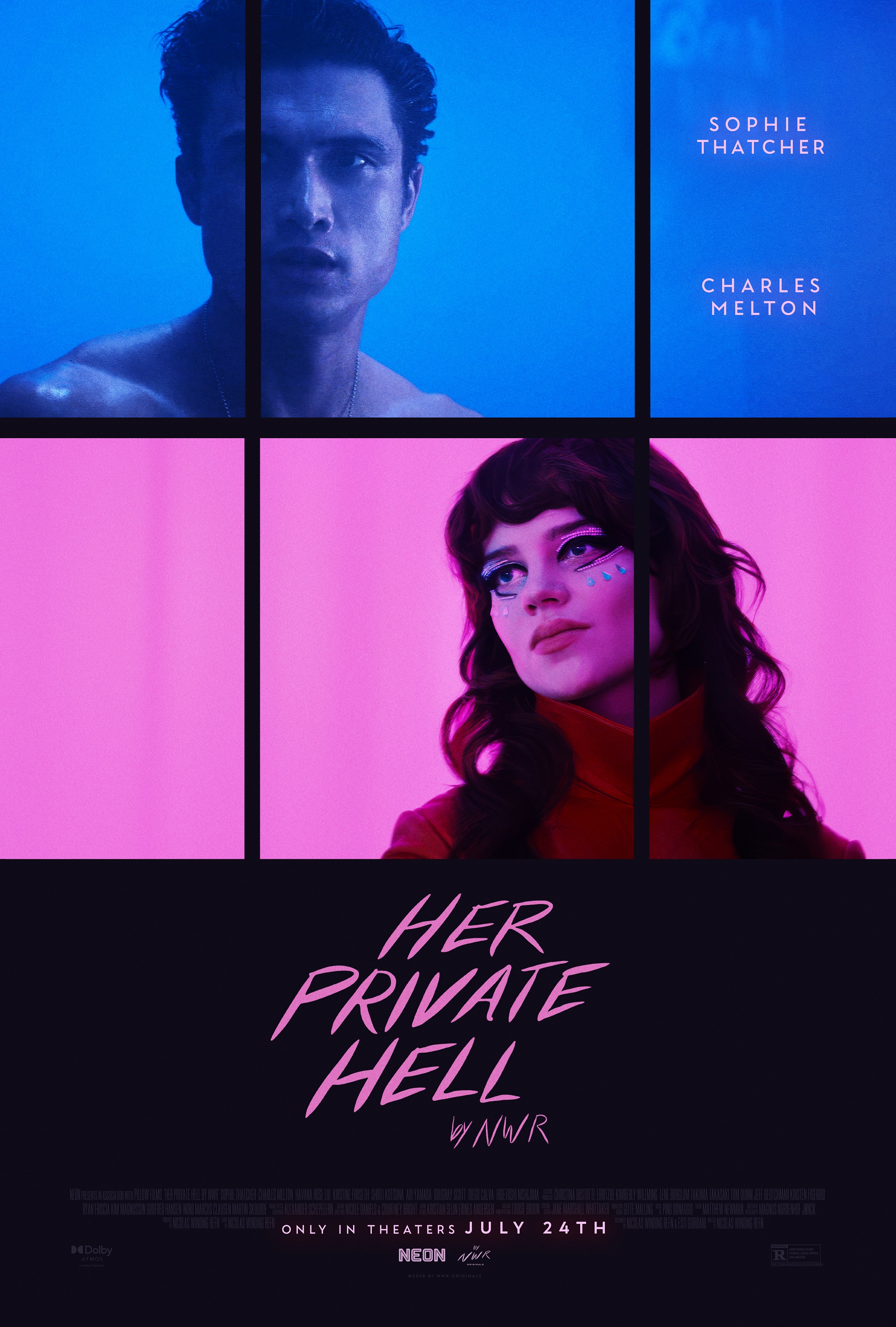
The film screened as the opening night presentation of the 2026 Fantasia Festival. It will open throughout North America on Friday, July 24, only in movie theaters, via Neon Releasing.
Her Private Hell
Director(s)
- Nicolas Winding Refn
Writer(s)
- Esti Giordani
- Nicolas Winding Refn
Cast
- Sophie Thatcher
- Charles Melton
- Havana Rose Liu




Do you feel this content is inappropriate or infringes upon your rights? Click here to report it, or see our DMCA policy.
More about Her Private Hell
- Fantasia 2026 Wrap: All Our Reviews
- Now Playing: HER PRIVATE HELL, SHEEP IN THE BOX, MANHUNTER: THE FINAL CUT
- Opening This Week: HER PRIVATE HELL by NWR, SHEEP IN THE BOX by Kore-eda, MANHUNTER: THE FINAL CUT by Mann
- Fantasia 2026: Raising the Curtain on the 30th Edition of Montreal's Smorgasbord of Genre Cinema
- Fantasia 2026: Final Wave Announced, HER PRIVATE HELL & FREAKS PART II to Bookend 30th Edition

Around the Internet
Recent Posts


