Sound And Vision: Corin Hardy

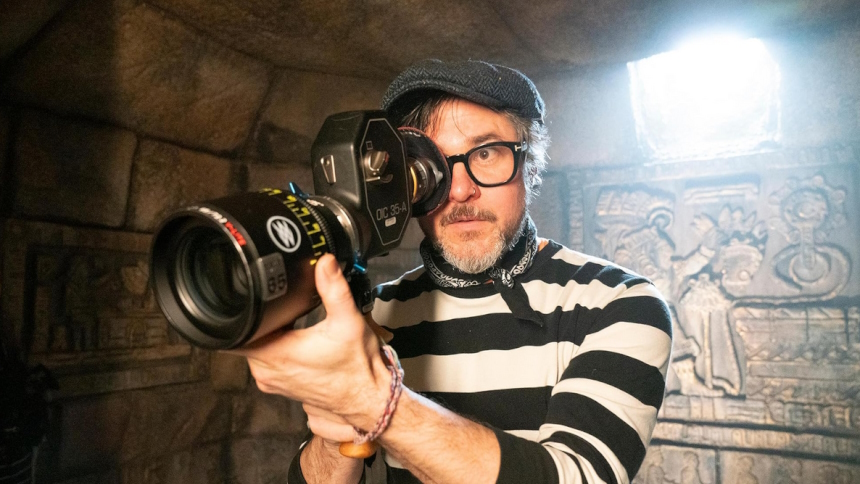
In the article series Sound and Vision we take a look at music videos from notable directors. This week we look at selected music videos by Corin Hardy.
Corin Hardy is best known as the director of The Nun, part of the Conjuring-universe, and the recent Whistle, a horror feature about an Aztec deathwhistle summoning death. Lesser known, but quite great is his earlier music video and short film output. Hardy started out as an animator with the excellent stop-motion short Butterfly, which straddles the line between early Tim Burton and the cinematic output of graphic novelist Dave McKean. This influence can also be seen in his early music videos, where the McKean influences are most overtly present in his music video for The Horrors' She Is the New Thing. The Burton-aesthetic is most noticeable in his music video for Keane's Somewhere Only We Know (see below), which focuses on a cute-creepy woodland creature. Hardy would later rework his own short Butterfly into the music video for Keane's Bedshaped, sanding off some of the rougher edges in the process. It is something that runs as a throughline in his career, where the potential is often not reached fully. And where the darker, more idiosyncratic tendencies, seep through the cracks, without fully becoming a flood.
Still there are many thematic throughlines between both his music video and feature work, which reveal that we are indeed dealing with an auteur, even if he works within the ballgame of big Hollywood-horror franchises. See for instance his debut feature, the underrated The Hallow, still his most artistically successful film to date. The woodland creatures from Somewhere Only We Know become a sort-of-inspiration in this folk-horror about changelings and fae, perverting the cutesy image of the earlier music video in something much darker and unnerving.
That the changelings in the film itself act like a sort of stop-motion creature, a sort of puppet-facsimile of the humans they replace, is a theme that runs throughout the entire output of Hardy. Stop-motion is in some ways the act of breathing life into dead things, a theme that runs throughout many of his music videos and films. Sometimes overt, like in the music videos for The Prodigy's Warrior's Dance (see below), in which inanimate garbage from cigarette-packaging and other disposed materials, come to life, dance around and burn the whole place down. Sometimes it is less overt, like in the ode to Lotte Reiniger's The Adventures of Prince Achmed, the first still surviving feature length animation, in the cut-out animated music video for Guillemot's Annie Let's Not Wait.
There is also the music video for Paolo Nutini's Pencil Full of Lead, which has been mostly scraped of the internet (and which can only be found here), quite possibly to avoid a backlash to a music video in which a claymation facsimile of Nutini crosses the boundary with a few of his dancers. It is played for laughs, and even though the women get revenge on Nutini, it feels more than a little misplaced in the current day and age. Still it fits with the theme of animation as a sort of unalive-halfstate, in which a character can be murdered and rebirthed in ways that a usual human being can't.
The death-scenes in the recent Whistle are sort of similar to this theme as well, where the characters get murdered by a death god, in the way they normally would have died in a much later stage if they hadn't blown a damn Aztec death whistle. The way this plays out in the film is that the characters are manipulated by an unseen force, almost like meat puppets, in ways that make the deathscenes feel like stop-motion animation. In Hardy's films and music videos alike, animation is a form of death and resurrection alike.
This ties into a larger theme of religion and resurrection, that is most present in The Nun, where the titular religious figure is being perverted and desecrated into something evil. The same theme runs throughout Whistle, where the current youth pastor is also a lowlife criminal and the main human antagonist. The double-sidedness of religious figures is also present in his music video for Biffy Clyro's God and Satan (also below), where a ritual animates the dead band members in ways that feel both deeply Christian and slightly occult. The customing is somewhere between old-timey religious, and folk-horror inspired paganism. It's the dichotomy in the title of the song itself, and also plays into the theme of animation as birth and rebirth, where the bandmembers are quite literally animated corpses. It has a deeply devout respect for death, as is present in most of Hardy's work. Death is inevitable. Something to be revered, to be taken seriously, and as Whistle shows, not to be fucked with.
The theme of rebirth from death is present in the short Butterfly, and therefore in Bedshaped (also below) as well. That there is another form of soiling and desecration going on as well, in this rebirth, is that both the music video and the short film use a public restroom lavatory as the place of this spiritual death and re-awakening. There is a run-through theme between the changelings in The Hallow, the demon-nun in The Nun, the warrior-garbage in Warrior's Dance, or the desecrating death-doppelgangers in Whistle. The idea that first someone must be soiled, perverted or cast away, before an eventual rebirth, maybe as something good, maybe as something evil, but always stronger. It shows up in the final music video I want to single out, for the naff tune by John Newman, called Losing Sleep (finally below). It uses the theme of rebirth, as a dark baptism in water, and a phoenix-like rebirth in fire, as a source for horror images. It precedes a lot of similar imagery in Whistle, and therefore can't be missed when discussing Hardy's music video work. I feel he is very underrated as a music video director, even though his strongest works are his earlier ones. That there is a very clear and strong sense of thematic obsessions cannot be denied, though.