Berlinale 2026 Review: NINA ROZA, Child Prodigy Reopens a Migrant Father's Unfinished Past
Geneviève Dulude-De Celles situates a cross-border art-world story within an intimate study of diasporic return, using the investigation of a rural child prodigy to examine authorship, cultural projection, and the unresolved fault lines of migration.

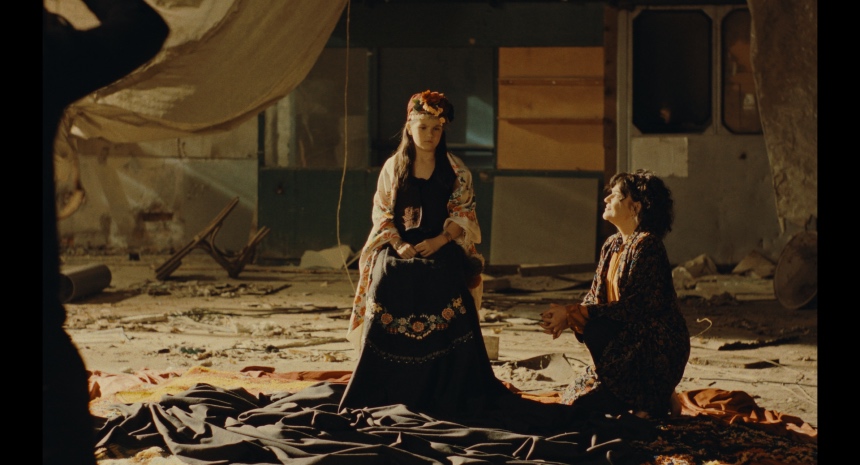
Geneviève Dulude-De Celles builds a drama that begins as a professional errand and gradually turns into a private reckoning in Nina Roza.
Art curator Mihail (Galin Stoev), based in Montreal, learns of a viral sensation in rural Bulgaria: Nina, an 8-year old painting prodigy who has converted a livestock barn into a studio. Skeptical of both the narrative and the market apparatus forming around it, he travels to Bulgaria expecting to expose a fabrication. Instead, the journey reopens unresolved attachments: to a country he has treated as a closed chapter, to a grief he has kept contained, and to his daughter Roza (Michelle Tzontchev), who has recently reentered his life with her young son.
The film marks Dulude-De Celles’s second feature. Her earlier work has examined adolescence as a threshold state. In A Colony, she traced a rural teenager’s social dislocation through a restrained observational approach, using nonprofessional performers and natural light to foreground vulnerability without sentimentality.
In Nina Roza, she remains focused on interior lives shaped by systems beyond the protagonists’ control. What shifts is scale. The narrative moves between countries, placing Nina within a diasporic framework rather than a contained rural environment.
In Bulgaria, Mihail’s inquiry into the origins of Nina’s outsider tableaux and the conditions of their production begins to blur with personal memory. Three decades earlier, he left the country with his young daughter after his wife’s death. He adopted the French name Michel and built a new life in Montreal, gradually becoming estranged from Roza.
Encounters with Nina and her family prompt a recalibration. His speech begins to slip back into Bulgarian, despite his insistence that he still thinks in French. The investigation becomes secondary to a reckoning with familial and linguistic dislocation.
The film increasingly adopts the structure of a homecoming story. Mihail revisits relatives living in a multigenerational household and confronts paths not taken. The emphasis shifts from migration as socio-economic condition to the persistence of belonging within a community that has continued without him.
Mihail’s professional detachment erodes as he grows close to Nina, who is portrayed as willful and self-possessed. At nine, she articulates clear limits. The prospect of relocation to an Italian residency, arranged by gallery owner Giulia (Chiara Caselli), provokes resistance rather than ambition. Nina is positioned outside the calculations of curators and collectors, including Mihail himself, whose authority becomes increasingly compromised.
Dulude-De Celles employs a motif of doubling. Nina and Roza echo one another across generations, while Mihail projects aspects of his younger self onto the child. The story at times leans on schematic contrasts between rural Bulgaria and metropolitan Montreal: communal outdoor life against interior urban spaces, extended family structures against solitary existence. The art world subplot ultimately functions as a framework for Mihail’s psychological return rather than as an independent critique of cultural commodification.
Cinematographer Alexandre Nour Desjardins maintains an observational neutrality consistent with the director’s earlier work. The visual strategy mirrors the thematic split. Montreal is rendered largely through enclosed interiors that compress space and context. In Bulgaria, the camera privileges exterior settings and group interactions, suggesting permeability between private and communal spheres even within material constraint.
Nina Roza centers on a form of detachment particular to a single parent who believed relocation offered resolution. While the film occasionally simplifies the opposition between rootedness and mobility, it frames Mihail’s trajectory as an examination of self perception rather than redemption.
The suggestion that remaining at home, even within economic precarity, may offer a different coherence than success abroad emerges less as prescription than as a reflection of his unsettled perspective.
The film enjoyed its world premiere at the 2026 Berlinale. Visit the official site for more information.
Nina Roza
Director(s)
- Geneviève Dulude-De Celles
Cast
- Chiara Caselli
- Michelle Tzontchev
- Galin Stoev