Rotterdam 2026: BAZAAR (MURDER IN THE BUILDING), On Lions in the Highlands, Or, The Eternal Life of Alfred Hitchcock

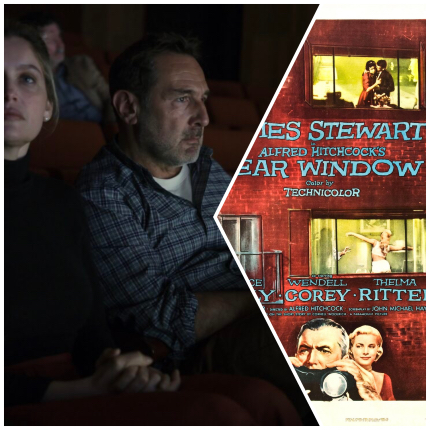
With Bazaar (Murder in the Building), Rémi Bezançon delivered the intended closing film of IFFR: a playful homage to filmmaker Alfred Hitchcock.
One of Hitchcock's finest films, Rear Window, is about watching, listening, and cinema itself. Photojournalist Jeff, accustomed to a wandering life, is confined to his home with a broken leg in a cast. Even more than by his injury, he is bound to his telephoto camera, used as he is to viewing the world through a lens. From his wheelchair he observes the apartments across the courtyard in Greenwich Village, New York, where he lives. Jeff is played by James Stewart, one of the most beloved actors of the 1940s and 1950s -- the very period in which the story is set.
In 1954, when Hitchcock made the film, many critics regarded him as a skilled craftsman who provided solid entertainment for mass audiences, but little more. Writer and film critic Graham Greene, for instance, found his work superficial and lacking psychological depth. The celebrated filmmaker Orson Welles even called Rear Window the worst film he had ever seen -- until Hitchcock's Vertigo was released, which he considered even worse. Still, Welles' criticism that Hitchcock's films sometimes looked "lit like TV shows" did touch on a point.
Meanwhile in France, a new postwar generation of film enthusiasts had emerged, including writers such as Rivette, Chabrol, Truffaut, and Godard from the magazine Cahiers du Cinéma. For them, Hitchcock represented the prototype of the auteur filmmaker: someone who, through his style and vision -- in Rear Window especially themes of obsession and voyeurism -- and through his creative and technical innovations, stamped his films with a unique signature. Truffaut and Chabrol wrote -- now famous -- books about Hitchcock and thus became pioneers of what would grow into a substantial Hitchcock library of study and admiration.
In his film, Bezançon brings these elements and much more together in a layered narrative that is both pastiche and an original story. François (Gilles Lellouche), a writer of spectacular fin-de-siècle detective tales, lives in our digital age in an apartment overlooking a Parisian courtyard. His writing -- and his writer's block -- unfold at home. His wife Colette (Laetitia Casta) is a professor of film studies specializing in Hitchcock. The film alternates between her lectures and the events unfolding around the courtyard.
When a new couple moves in across the way -- the man an actor (Guillaume Gallienne), the woman a theatre director -- curiosity grows. François and Colette attend a performance at their new neighbors' theatre. Later, entirely in Hitchcock style and using binoculars, Colette witnesses an argument between them. Suspicion takes hold: the beginning of a delicious crime comedy that is a feast of recognition for Hitchcock aficionados.
Through carefully constructed crosscutting between Colette's lectures and the couple's mounting suspicion, we receive informal lessons in Hitchcockian suspense -- letting the audience know what threatens while keeping the characters in the dark. The MacGuffin appears, Hitchcock makes a cameo, and in a brief lesson on Psycho, a fair amount of blood is already spilled.
Taken together, this makes the well crafted Le Crime du 3e étage, aka Bazaar (Murder in the Building), an ideal, upbeat conclusion to the IFFR.
The film served as the closing night presentation of the 2026 International Film Festival of Rotterdam.