European Film Awards 2026 Interview: SENTIMENTAL VALUE Filmmakers Joachim Trier and Eskil Vogt on Intergenerational Cinema, Creative Control, Why European Films Are Winning Again


With Sentimental Value, Joachim Trier turns away from the millennial subjectivity that defined much of his earlier work and toward a more layered, intergenerational terrain.
His pivot was underscored in Berlin, where the film became the major winner at the 38th European Film Awards at the Haus der Kulturen der Welt. Written as his sixth collaboration with Eskil Vogt, the film marks a shift in scale and perspective: from the interior lives of young adults in flux to the quieter, more sedimented emotional architectures of family, memory, and inheritance, the very qualities that, in Berlin, translated into the ceremony’s strongest sweep across the top categories.
Speaking before the ceremony, Trier was careful to frame Sentimental Value not as a departure but as a continuation, a reorientation of long-standing concerns. Where the so-called Oslo Trilogy traced the uncertainty of early adulthood, this new film examines what happens when those uncertainties calcify over time and across generations. “We’re dealing with multiple age characters now,” Trier noted. “It’s a more polyphonic story. We’re following different generations, rather than staying inside one subjective perspective.”
That polyphony is embedded not only in the film’s structure but also in its central metaphor: the Borg family house in Oslo, a space that functions as both anchor and obstacle. Vogt recalls that the house emerged almost accidentally during development. While he and Trier were writing, Trier’s mother repeatedly called about the attempted sale of a long-held family property.
The interruptions gradually reframed the screenplay. “We were already working on a story about two sisters,” Vogt explained, “but we were looking for something that could give the film a wider sense of time, something beyond just the immediate drama between the characters.”
The house became that device: a physical container for unresolved emotion, generational memory, and deferred decisions. It also allowed Trier and Vogt to step back from purely psychological conflict and introduce what Vogt describes as “a perspective of duration, of things that outlast individual lives.”
This architectural approach mirrors the film’s broader formal strategy. Sentimental Value is deliberately slower and more diffuse than The Worst Person in the World, its narrative weight distributed across characters rather than concentrated in a single protagonist. The Borg sisters -- Nora, an emotionally volatile stage actress, and Agnes, the more pragmatic sibling -- are positioned not as opposites but as parallel responses to the same paternal absence. Their father Gustav, a once-celebrated filmmaker who reappears after years of estrangement, occupies equal narrative ground.
Trier has spoken openly about his interest in granting Gustav as much complexity as his daughters, resisting the temptation to frame him as a simple antagonist. “Human relationships are always more complicated than that,” he said, adding that the film’s ethical tension lies precisely in Gustav’s partial self-awareness, his ability to recognize regret without fully understanding its consequences.
This refusal of moral clarity extends to the film-within-the-film, a late-career project Gustav claims to have written for Nora, only to later cast a young American star as her substitute. The move risks reopening wounds the character has never allowed herself to articulate.
Trier describes the dynamic less as a commentary on America versus Europe than as something more intimate. “It’s about the impossibility of playing someone’s daughter,” he said. “It’s personal, not geopolitical.”
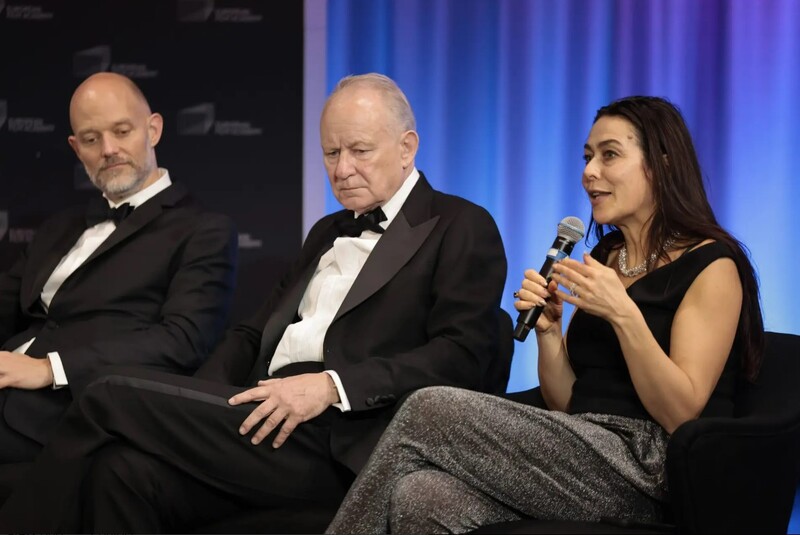
Eskil Vogt, Stellan Skarsgård and Maria Ekerhovd
Still, the film is acutely aware of the contemporary film industry landscape it depicts. Gustav’s negotiations with Netflix, and his momentary confusion when asked whether the film will also screen in cinemas, register as dry, self-reflexive observations rather than satire. Trier is careful not to frame these moments cynically. Instead, they reflect a generational dislocation, a filmmaker formed in one system navigating another without quite understanding its assumptions.
That sensitivity to context extends beyond the screen. Trier and Vogt both emphasized the importance of European collaboration in bringing Sentimental Value to life. The film is a Norwegian-led co-production involving partners from Sweden, Denmark, Germany, France, and the UK. For Trier, this is not merely logistical but ideological. In a moment marked by rising national conservatism, he sees transnational production as a quiet counter-gesture. “In the arts, at least, we’re still holding hands,” he said.
The director was equally candid about why European films have found renewed visibility in the U.S. awards ecosystem. In his view, the shift is less about changing tastes than about absence.
“The American industry has largely stopped making films for a mature audience,” he argued. “That leaves space for international cinema, not only European, but also Asian and Latin American.” For Trier, this opening represents opportunity rather than assimilation. His long-standing collaborations with U.S. distributor NEON, who boarded Sentimental Value early in development, are cited as examples of partnership rather than compromise.
If Sentimental Value resonates particularly strongly with actors, Trier attributes that to process rather than theme. He and Vogt work extensively with rehearsal, rewriting, and adjustment, a method Trier describes as “tailoring” rather than improvisation. Roughly 95 percent of the dialogue is scripted, he insists, but intention remains fluid. Characters evolve through the actors who inhabit them, not through wholesale textual change. “Sometimes you don’t change the words,” Trier explained. “You change how they’re meant.”
This openness has also shaped the reception of the film’s female characters, which have been widely praised for their specificity. Vogt resists any notion of a formula. “We never sit down and say, ‘Now we’re going to write a female character,’” he said. “We write a character who is interesting. Gender isn’t a decision point, psychology is.”
That philosophy reflects the duo’s broader understanding of cinema as a humanist medium. While neither Trier nor Vogt identifies Sentimental Value as an explicitly political film, both acknowledge that politics inevitably surface through context and reception. Trier notes that Oslo, August 31st was widely read as political abroad, despite not being conceived as such. “Politics can mean many things,” he said. “We try to start small, with individual situations, and see what themes emerge.”
In a period of heightened global anxiety, that modesty feels deliberate. Vogt recalls that during the writing process, the accumulation of daily news made it difficult to work at all. Their response was not escapism, but focus. “We closed the door and took comfort in making something,” he said. “Art can challenge, but it can also reconcile. It can create a space for empathy.”
That, ultimately, may be Sentimental Value’s quiet provocation: not a statement about cinema or family or history, but a belief in attention, in looking carefully at how people misread one another, and how those misunderstandings echo across time. As Trier put it, reflecting on the film’s title and its resonance beyond objects: “The possibility of empathy feels very important right now. It’s probably the best thing we can offer.”
Images courtesy of the 38th European Film Awards Berlin 2026, Sebastian Gabsch.