European Film Awards 2026 Interview: RIEFENSTAHL Filmmaker Andres Veiel on Myth, Guilt, Fascist Aesthetics

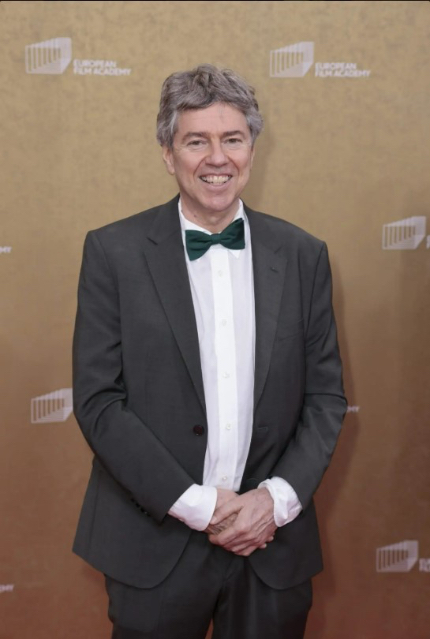
By the time German filmmaker Andres Veiel agreed to take on Riefenstahl -- which became a nominee for Best European Documentary at the 38th European Film Awards, a feature-length documentary built almost entirely from the estate of Leni Riefenstahl -- he was already aware that the project would demand years of intellectual, ethical, and emotional proximity to one of cinema’s most controversial figures.
“Just the idea to deal with a horrible, strange figure like Leni Riefenstahl for years. it was not so thrilling,” Veiel admits. “In the beginning, there was a lot of distrust.”
The project originated not with Veiel but with producer Sandra Maischberger, who gained access to Riefenstahl’s estate in 2017, after the death of her husband Horst Kettner. When Maischberger approached Veiel in 2019, after seeing his Berlinale-selected Beuys, the archive already comprised some 700 boxes of material. “She had the expectation that I would be capable of dealing with a lot of archive footage,” Veiel recalls. “And of course, it was really a challenge.”
What ultimately persuaded him was not reverence for Riefenstahl’s legacy, but the possibility of finding something genuinely new. “The main question for me was: will we really find a new approach in all these findings?” he says. The answer, eventually, was yes, not because the archive exonerated Riefenstahl, but because it allowed Veiel to examine her self-mythologizing from the inside.
“I wanted to be as open as possible,” he explains. “Meeting her in person would have meant being confronted with her myths, her lies, her legends.” Working through the estate instead revealed “a lot of gaps, a lot of lies, and a lot of myths,” but also private films, draft memoirs, and personal notes that allowed Veiel what he calls a “close-up” view of her psychological machinery.
Central to Riefenstahl is the director’s refusal of both demonization and absolution. “It doesn’t mean to exonerate her. It doesn’t mean to excuse her or apologize for any of her deeds,” Veiel stresses. “But to keep this ambivalent approach between a clear, fact-based reconstruction of her guilt, and on the other hand, to see her still as a human being. Because that’s the danger. She is not a monster. She is one of us.”
That insistence on proximity, on Riefenstahl as a prototype rather than an aberration, is the film’s most unsettling thesis. Veiel frames her not as an artistic genius corrupted by politics, but as a willing participant in fascist ideology whose aesthetic brilliance was inseparable from its worldview. “You cannot separate ideology and aesthetics,” he says flatly. Even Olympia, often cited as her most formally accomplished work, is for Veiel “a celebration of strength, superiority, healthiness, and at the same time, a contempt for weakness.”
The film’s most damning discoveries underscore this entanglement. Veiel recounts a letter found in the estate from an adjutant during the Polish campaign, describing how Riefenstahl gave a stage direction to German soldiers, “Jews off”, after which 22 Jewish civilians were murdered. “Her direction was not ‘kill the Jews,’” Veiel notes. “But the result was that they were killed seconds later. And that changes everything about her responsibility.”
Equally revealing is what Riefenstahl did not do. Veiel points to her cameraman on Olympia, Willy Zielke, who suffered a psychotic breakdown and was forcibly sterilized under Nazi racial laws. “She could have intervened with one phone call,” Veiel says. “She didn’t. Why? Because she was convinced. She loved Mein Kampf.”
Riefenstahl’s lifelong insistence that she was “unpolitical” collapses under archival scrutiny. Veiel cites a 1934 interview with the Daily Express in which she claims to have carried Mein Kampf with her during the shooting of The Blue Light, calling herself “an enthusiastic National Socialist” after reading its first pages. “Somebody who is unpolitical wouldn’t say this,” Veiel remarks dryly. “Whoever makes a propaganda film about a party rally is a political person.”
Yet Riefenstahl is as interested in psychology as it is in history. Veiel traces a continuity of violence from Riefenstahl’s childhood -- an abusive father, later sexual assaults -- to her adult identification with power and aggression. “I have to survive by identifying with the aggression,” he explains, describing what he sees as her internal logic. “If I’m not strong, I get killed.”
This psychological reading culminates in Veiel’s analysis of her relationship to truth itself. “You can see a development,” he says. “In the 1950s, she’s rehearsing lies like an actress learning lines. Later, those lies become her truth.” In Veiel’s view, Riefenstahl did not merely deceive others; she constructed a parallel reality as a form of self-defense. “She produced her own truth.”
That immobility, her total lack of remorse or inner transformation, also explains why Veiel never considered a fiction film. “There’s no inner movement,” he says. “She’s like a stone. That’s why so many fiction projects failed. What do you do with a character who never changes?”
The film’s contemporary relevance is explicit. Veiel describes Riefenstahl as “a warning out of the future.” Its reception in the U.S. and internationally has confirmed his sense that the film “hits a nerve.” “We can use Riefenstahl as a mirror,” he argues, pointing to the resurgence of nationalist rhetoric, the celebration of strength, and the reduction of the world into “them and us.”
In Germany, the response has been both robust and revealing. With over 140,000 admissions, Riefenstahl has performed unusually well for a documentary. Screenings for students have generated long post-film discussions. “They say, this is our future,” Veiel recalls. “And that’s sad and hopeful at the same time.”
Veiel is careful not to position himself outside the problem he diagnoses. “I wouldn’t say I’m a hero,” he admits, when asked whether contemporary filmmakers might face similar seductions. “If somebody offers you unlimited money and freedom, that’s seductive. And maybe later there’s censorship, because you want to make the next film.”
This is ultimately why Veiel insists on proximity rather than moral distance. “It doesn’t make sense to put her in a coffin and sink her to the deepest point of the Pacific Ocean,” he says. “The dangerous part is to accept she’s one of us.”
Were Riefenstahl alive today, Veiel suspects the response would be litigious rather than conciliatory. “She would sue me,” he says, noting her history of legal action. Still, he draws a line he refused to cross, excluding intimate footage filmed shortly before her death. “She’s still a human being,” he says. “And I put limitations between me and what was possible.”
That ethical boundary, between exposure and exploitation, analysis and absolution, defines Riefenstahl as both a historical excavation and a contemporary intervention. For Veiel, the film is not about settling accounts with the past, but about understanding the mechanisms that allow fascism to appear seductive, rational, even beautiful.
And that, he suggests, is the most uncomfortable lesson of all.