
European Film Awards 2026 Interview: SIRAT Director Oliver Laxe on Shock Therapy Cinema and Why Films Must Risk the Abyss

At the 38th European Film Awards, Sirāt emerged not just as a highly nominated title but as one of the night’s most honoured films.
Leading the field with nine nominations and ultimately winning five craft awards -- Best Cinematography (Mauro Herce), Best Editing (Cristóbal Fernández), Best Production Design (Laia Ateca), Best Sound Design (Laia Casanovas, Yasmina Praderas & Amanda Villavieja), and the inaugural Best Casting Direction award for Nadia Acimi, Luís Bértolo and María Rodrigo -- were all marks that confirmed the film’s formal command, even if it did not secure the evening’s top prizes.
For Oliver Laxe, this momentum was less about ceremonial bumpers and more about a method rooted in the body, in rhythm, and in an instinctive relationship between image and sound, a sensory logic that precedes narrative in his working practice.
He describes his process with a disarming literalness. “First and foremost you have to know that I dance the images,” he says, tracing the film’s genesis back to nights spent in raves, where the desert arrived as a vision before it was ever a location. Living in Morocco at the time, he says he began “developing the script in my head dancing,” and when writing, he worked “really atmospheric,” describing “atmospheres,” with music functioning as a guiding structure, “no fear,” as he puts it, a kind of internal compass.
If Sirāt’s sound design and score feel unusually foregrounded, less accompaniment than architecture, Laxe insists this wasn’t a conceptual overlay. It’s simply how he perceives cinema. His sensitivity, he says, is “really related with sound,” with “the structural layer of image and sound,” and he tends to build scripts through musical associations, “introducing my scripts like links from musics.”
For that reason, rather than composing in-house, he opted for what he calls a “casting of musicians.” He was looking for an artist who could “dialogue with the techno,” match the cathartic energy he associates with folk music, and still push toward something “more ethereal, transcendental… through ambient,” using “the pure material of sound.”
That emphasis, sound as a physical and emotional engine, does not, in his telling, displace narrative so much as re-order it. Laxe calls himself “a junkie of images,” and insists that an image is never silent: “An image has sound. I feel it. I feel the space, I feel the sound.” Storytelling remains important, he says, but it functions as “an instrument,” a tool to perceive the image more fully, to register “the shadows,” to access something “intangible.” That, for him, is where cinema approaches poetry.
The desert, in Laxe’s biography and filmography, is less backdrop than summons. He recalls making You All Are Captain and premiering in Cannes in 2010, then feeling what he calls “a call from the desert.” “Life is like this,” he says. “If life wants something from you, it will push you.” The push led him south, toward Morocco, and toward images of “tracks… crossing the desert.” In 2011 he moved to a palm grove, where he later made Mimosas, but he says the seed of Sirāt was already present, forming in parallel.
The title, he suggests, is best understood less as doctrine than as a proposition. For him, “the way to yourself is the way to your soul, to come back home.” He returns repeatedly to the idea that life’s logic is not identical with desire: “Life sometimes won’t give you what you are looking for. It will give you what you need.”
Even pain, he argues “even the loss of your kid, of your child,” can be “a mercy.” Asked, implicitly, whether this worldview is spiritual, Laxe answers without hedging: “I am” a believer. Human beings, he says, are not “swimming… chaotically.” There is “an order of things,” a “creative intelligence behind the thing,” and cinema, at its best, can reconnect us to that strangeness. Film is the art that can remind us we live in “a magical world.”
That belief is inseparable, in his practice, from nature, not as aesthetic, but as authority. Laxe is blunt about rejecting landscape-as-postcard. “I’m not shooting in the nature because nature is cool, beautiful, look at this frame, no,” he says. He shoots in nature because “nature is manifesting,” and because the “voice of the divine” becomes “more clear in the nature.”
The desert, in Sirāt, was not simply endured; it intervened. He recalls storms breaking planned setups, overturning intention, then insists the disruption was “perfect.” “Even if you have a lot of money,” he says, “what you want to shoot, life will give you the opposite.”
The humility he associates with weather and terrain is also genealogical. Laxe describes himself as “a son of peasants” — his father emigrated to France, his grandparents were farmers, and he speaks of life “on the orbit of nature” as an education in scale: “You feel you are nothing. You feel you are a zero.” He frames that not as nihilism, but as health: “the healthy dimension of humankind.”
Back in Galicia, after Fire Will Come, he bought the house where he had shot and has lived there since the pandemic. It is, he says, his “space of power,” where he can “link to my ancestors.” Making Sirāt, he adds, was “healthy”, a process of “healing” and “cleaning” lineage pain. His grandparents, he notes, were not church people, “the church was not in the mountains,” but he still calls them believers, because nature itself “makes you believe.” Every day it tells you: you are nothing.
If Sirāt moves toward rupture and metaphysical terror, Laxe frames it as therapeutic rather than merely punishing. The therapy, he says, is not about self-mythologising; it’s about “connect[ing] more with my wound.”
He credits rave culture, ravers, he says, “show the wound,” “show the scar.” They don’t hide it the way society does. Western societies, in his view, are “the most neurotical” because “we don’t love us,” so we fabricate “idealistic image[s] of ourselves” and identify with them. His own work on Sirāt resembled a decision to “stop to make films and connect with this,” to approach freedom through exposure rather than concealment.
That logic extends to his view of cinema’s survival. He speaks about the body with the vocabulary of psychotherapy, he is studying Gestalt, he says, and repeats that “the body has memories.” A cinema is not only an intellectual space; like a dance floor, it is a place where the body “connects you to your fragility or to your strength.”
He describes the rave as a “collective ceremony” in which the body “will give you information” and “will heal.” For him, the ritual is ancient, “thousands and thousands of years,” a cultural constant: to go into nature and dance, to connect.
From that perspective, the model for spectatorship is not leisure but labour. He invokes Ancient Greek tragedy: people did not go to Sophocles for fun, he argues; they went “to work,” “to make catharsis, to transform.” This is where his argument becomes explicitly industrial. If cinema, and theaters, want to survive, he says, films must again become “an experience, a catharsis for spectators.”
He calls Sirāt “shock therapy,” insists it’s “something you only can believe in a cinema,” and says he has been struck by audience testimony over the past weeks. “I know we did sorcery,” he says, describing a film that “penetrates you” and “shakes you, but in a good way.”
The “wound,” in his vocabulary, scales from the personal to the collective. We are broken, he says, first through “this child wound,” a “hole of love” we patch with “a mask or a neurosis.” But there is also a “transgenerational wound,” and beyond that a “collective wound” that the film plugs into.
When you watch Sirāt, he says, you “feel pain,” not melodramatically, but necessarily. The point is to “hold this wound,” to connect to it. Community, in that frame, becomes a survival technology: as Laxe puts it, the wound “doesn’t have flags.” It has no genre, no nationality; it is “international, interpersonal, intergenerational.” In that dimension, he says, “we are all the same.”
Casting, too, is described as immersion rather than selection. Laxe says they “went to raves,” with a scouting process that involved moving through those spaces “looking for people with cinema in their faces.” He speaks with particular intensity about Nadia (a long-term collaborator), calling her “the most talented person in my team,” “a wolf,” someone who can smell what a film needs before it can be rationalised.
In the lineage question, inevitable in this context, Laxe aligns himself with Béla Tarr and Andrei Tarkovsky in the most concrete way: not by aesthetic comparison, but by a shared faith in the complexity of the image and the moral weight of spectatorship. He calls Tarkovsky “the master,” “the sheikh,” and emphasizes that he was “also a believer.” He speaks about the need for “masters,” borrowing a Sufi formulation, if you don’t have a master, “the ego is your master,” and argues that suffering and seeking are part of the apprenticeship, even if certainty never arrives.
For industry readers, the most pointed section is his account of fear, creative and financial. He claims he had no “dilemmas,” but admits he had “a lot of fears,” and frames fear-management as the job itself: if you hide fears, “not good.”
The wider industry, he suggests, is trapped in calculation because it is frightened, hence the sameness of so many films. He cites Pier Paolo Pasolini to make a producer-facing point: what spectators secretly take from a film is the “freedom” of the filmmaker. In fearful times, he argues, that freedom becomes the most valuable energy cinema can transmit.
He describes Sirāt as a leap: “I jumped to the abyss.” He embraced the possibility of failure because, in his practice, “even failure will make me grow.” If he fails, he says, life may want something else of him, “maybe to be a peasant again.” The attitude reads less as romantic posturing than as an attempt to keep authorship intact in an ecosystem that rewards risk-aversion.
He is equally clear about one structural “red line”: theatrical respect. He describes himself as “lucky” because the film was backed, for the first time in his career, by television/industry infrastructure, after years of low-budget work. But the partnership mattered because, he says, it respected cinemas.
He states he will “never work” for a platform that doesn’t respect theatrical exhibition, “that we screen on cinemas.” The trust, in his telling, was placed “more than on the script,” and he treats that as the key.
Audience figures, he cites half a million domestically and 700,000 in France, become, for him, proof of an under-estimated spectator. The film may be “really radical,” he says, but also “really popular.” The conclusion isn’t triumphal; it’s corrective. “We have to believe more on them,” he argues. “They are more sensitive than we think. The body knows.”
Even so, the final note is not about prizes or visibility. It’s about cost. Laxe shrugs off ego as an old problem, he’s been dealing with success since his mid-twenties, he says, since Cannes, but describes a different desire now: “I really want to serve.” He wants cinema to “heal this wound,” to “elevate the level of conscience,” even as he admits how difficult that is.
And then, unexpectedly for a director whose work is often read as elemental and severe, he closes on something almost domestic: what’s most painful about being a filmmaker, he says, is that he wanted a “normal life”, “family life, simple”, in his home. He calls his life in Galicia a paradise: he doesn’t “need nothing,” he has everything there. The balance is still an open question. “We’ll see if I found the balance,” he says. “Hopefully.”
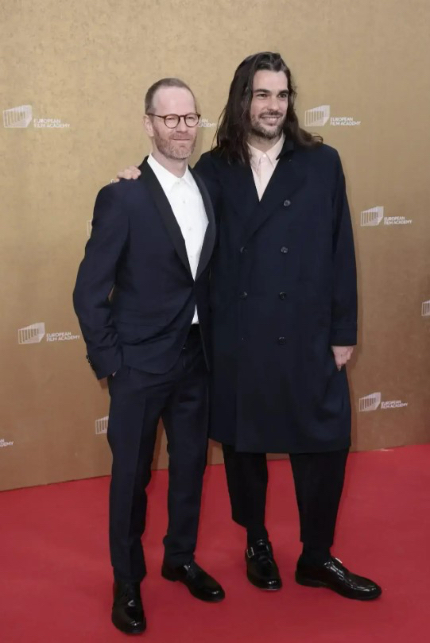
Cover image Joachim Trier with Oliver Laxe, courtesy of the 38th European Film Awards Berlin 2026, Sebastian Gabsch.

More about Sirat
- Rotterdam 2026: What The Audiences Liked Best
- 98th Academy Awards Nominations: International Films
- European Film Awards 2026: SENTIMENTAL VALUE Dominates
- European Film Awards 2026 Preview: SIRĀT Holds the Strongest Position in This Year's Race
- SIRĀT Official Trailer: Oliver Laxe's 'Meditative And Loudly Disorienting Journey' in Cinemas February


