European Film Awards 2026 Interview: DOG OF GOD Directors Lauris and Raitis Ābele on Adult Animation, Rotoscoping, Blender

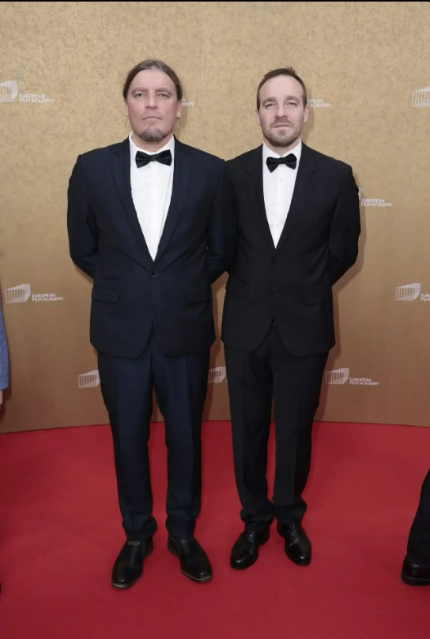
Adult animation is often discussed as a market category. Lauris and Raitis Ābele speak about it as a production problem, and, increasingly, as an aesthetic opportunity.
Their 2025 animated comedy horror Dog of God, based on the heresy trial of Thiess of Kaltenbrun, is rooted in 17th-century Livonia and Latvian folklore, but its most contemporary edge may be the way it was made: a deliberately hybrid workflow that embraces rotoscoping logic, distributed labour, and a “results-first” attitude to software. Dog of God received two nominations for the 2025 European Film Awards: Best Animated Feature Film and Best European Film.
“We started with Dog of God as a mystery, a folk tale,” the brothers say, describing the early conception. “And then it became about genre, how far we can push it while still staying truthful to the feeling.” Set in the Livonian village of Zaube, Dog of God builds toward a public trial in which a man named Thiess reframes himself as a werewolf, less monster than shamanic agent, operating within an older cosmology that collides with church authority.
The film’s tone moves between grotesque humour and creeping dread, but the brothers are explicit that it was never meant to smooth those shifts into a single “accessible” register. “It doesn’t have to reach the right audience,” they say. “It has to reach its audience.”
That clarity, about audience specificity, also shaped formal choices. The film’s adult animation identity is not just about content. It’s about rhythm, discomfort, and a willingness to let scenes stretch or turn strange. “You need patience,” they say. “Some films demand that.”
The project began with an ambition that could have leaned toward live action, but practical realities quickly defined the medium. “At first we thought it could be live action,” they recall. “But then you need a house, locations, everything. In animation you can go anywhere.” For a story that depends on communal paranoia, ritualised power, and folkloric rupture, the ability to build worlds without permissions is not merely logistical, it becomes expressive. Animation allows the Ābeles to stage an entire village psyche.
In the conversation, the brothers returned repeatedly to rotoscoping, not only as a technique, but as a reference point for how animation can sit between live action and graphic stylisation. They cite that “inner rate” period, earlier experiments in the region with rotoscope approaches and adaptation-driven animation, as evidence that the language exists locally, even if it rarely becomes a scalable model.
What matters for Dog of God is not whether every frame is classically rotoscoped, but that rotoscope principles -- anchoring motion to a physical logic, preserving human timing, allowing “wrongness” in the line -- feed the film’s tone. In adult animation, that often becomes a shortcut to credibility; here, it becomes a pathway to unease. As the brothers frame it, rotoscope sensibility is useful because it keeps the work from becoming “too clean.” The film’s human behaviour, its bodily hesitations, its coarse reactions, needs to feel recognisable even when the world is tilting into folklore and horror.
When the discussion turned technical, the Ābeles were blunt about the state of tools: there are more options than ever, and many are inexpensive or free. The real question, in their view, is not “which software is best,” but “how do you keep production moving when people use radically different setups?”
They describe a workflow that industry people will recognise immediately: a production anchored by a core artistic direction, but executed through a patchwork of tools and personal habits across a dispersed team. “We had students,” they say, coming from an art-school environment and working partly off-site, often on personal machines. “Sometimes seven, sometimes… more. It was not easy to put everyone in a studio, but it was easier that they worked on their own computer, back home.” And those computers ran whatever they ran. “One girl is working on a stolen Photoshop. One is doing [it] on iPad… We don’t care on what program. The result is what matters.”
The implication is clear: Dog of God was built on a tool-agnostic production culture, closer to an indie game pipeline than a conventional animation studio. Blender enters here not as a buzzword, but as a practical hinge, a widely available, interoperable environment that can sit alongside drawing tools, compositing workarounds, and inconsistent home setups. The brothers also emphasise the danger of “poster thinking”, the impulse to standardise everything until the film looks uniform and slick. “You can’t do animation as a poster,” they argue. “You can’t just put [everything] next to next… and it’s identical.” Their approach accepts variation in order to preserve life.
The discussion also touched, briefly but pointedly, on contemporary automation, AI-assisted workflows, rapid generation, the lure of speed. The brothers’ position is pragmatic: tools can reduce friction, but they don’t solve authorship. They describe the fantasy version of the process, prompt, reference, two hours, output, and the reality: animation still requires decisions, taste, correction, and coherence. Their underlying point aligns with many small-scale European productions right now: AI may compress certain steps, but it does not replace the work of aligning dozens of micro-choices into one consistent world.
Dog of God premiered at Tribeca in the Escape from Tribeca section, a slot that effectively announces the film’s identity to international buyers and programmers. “It gave it orientation,” the brothers say. “People learned about the film.” They note that reception differs by territory, not just in taste, but in programming culture. In some places, the film plays as a “late night screening”; elsewhere, it can sit in regular repertory-style programming. For adult animation, this matters: where the film lands in the schedule often determines what kind of audience it is allowed to find.
Only later do the Ābeles move toward the institutional layer, but when they do, it is tied directly to production reality. In the European system, they suggest, auteur animation can still be funded without being bent into a product category. “In Europe, we know the system,” they say. “The auteur.” Public funding, co-production structures, and festival ecosystems make it possible to pursue films that are not “for everyone,” as long as they are formally and culturally legible.
They also note the paradox: animation is expensive everywhere, but in Europe the logic is not strictly commercial. “It’s not supposed to reach the right audience,” they repeat, reframing success as targeted impact rather than mass access. Dog of God is instructive not simply as a completed film, but as a model: adult animation developed through the European auteur framework, executed with a distributed team, and held together by a flexible toolchain that treats Blender and other accessible software not as a limitation but as infrastructure.
It is also a reminder that rotoscope thinking and the wider family of “in-between” techniques that preserve human timing, remain potent strategies for adult genre animation, particularly when the goal is not polish but tension. “We try to put boundaries in the world,” the brothers say. “And then we break them.” In Dog of God, that breaking happens in the story, heresy, witchcraft, werewolf myth, but also in the workflow itself: a production that rejects a single pipeline in favour of a handmade, interoperable approach, where the only non-negotiable is the final sensation the film leaves behind.
The cover image courtesy of 38th European Film Awards Berlin 2026, Sebastian Gabsch.