New York 2025 Review: PETER HUJAR'S DAY, A Portrait of an Artist as a Young Man in 1970s NYC
Ira Sachs' newest film stars Ben Whishaw and Rebecca Hall.

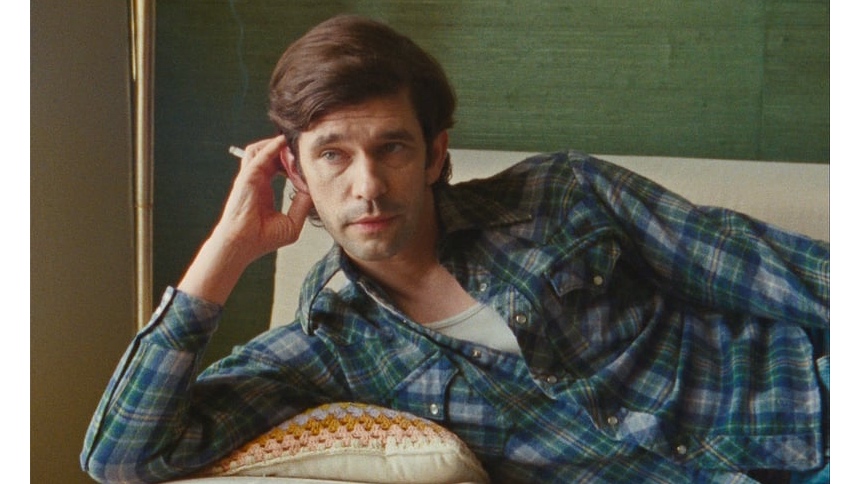
As an unexpected rhyme to Kent Jones’ Late Fame in the 2025 New York Film Festival program, Ira Sachs’ Peter Hujar’s Day arrives as a dramatization of the transcript of an interview Hujar gave his friend, writer Linda Rosenkrantz, in 1974.
In Late Fame, there is a scene where Willem Dafoe’s character, a postal clerk who used to write poetry, is trying to get back into a creative mood and goes to a deli to buy cigarettes – “The kind the kids at NYU smoke” – and is then appalled when he hears the price. In Ira Sachs’s new film, the topic comes up frequently, too, as Ben Whishaw, playing famous photographer Peter Hujar, recounts his previous day in detail, including the cost of smokes, food, and drinks, as well as the cost of creating art.
The film that, like many previous works of Sachs, had its premiere at the Sundance Film Festival, is a deceptively simple piece, which started as an idea for a short but then daringly grew into a 76-minute feature. The daring part is obvious: even with Hujar being an iconic figure, known for his portraits and the famous “Come out!” photo for the Gay Liberation Front, this movie is by no means a traditional biopic, despite the brave marketing efforts to pass it as such.
Instead, it really is 76 minutes of two people on screen, one of them vocalizing every minor detail that happened to him the day prior, starting with “I woke up”, and the other one – Rebecca Hall as Linda Rosenkrantz – offering leading questions and encouragements from time to time. It is also honestly impossible to look away from for any of that, even when nothing remarkable is being said or done.
While Rosenkrantz’s original concept for the material she was gathering with the interviews was to show how we don’t really do much during our seemingly busy days, Sachs’ idea, as he recounts, was to give us a glimpse into New York of a certain era, when everyone was making art and no one was earning any money for it.
Both of these ideas intertwine seamlessly, as Whishaw’s monologue provides us with a nonchalant insight into the artistic world of 1970s NYC, which includes Susan Sontag, Allen Ginsberg, Lauren Hutton, and, of course, William S. Burroughs (also notably mentioned in passing in Late Fame). All the while, Whishaw's performance remains a masterclass in not only making something routine sound fascinating, but also in creating a great illusion of unrehearsed spontaneity.
The film also has touchingly relatable (and therefore hilarious) moments for everyone familiar with the inherent, glorious weirdness of New York, such as the cliquishness of its various districts. At one point, Hujar recounts his phone call with Ginsberg, whom he was supposed to take pictures of at the latter’s apartment. During the conversation, the photographer suddenly realizes his real-estate-based privilege: it turns out, he lives several streets above and a few avenues closer to the center of Manhattan. Under the unexpected duress of this social divide, he spends several minutes recalling his thought process regarding the appropriateness of wearing a coat to the Lower East Side, only to end up wearing a red leather jacket.
Peter Hujar’s Day, in its quiet way, balances the details about both New York and the art world that have since changed drastically and the ones that are seemingly timeless. Juggling commercial jobs to continue creating what you really wish to create, and then wondering about the time and effort these jobs take away, surely remains relatable.
Endlessly melancholic nostalgia seeps through the beautiful pastel-colored shots, though, a nostalgia for what was irrevocably lost: a belief in an absolute power of art and its direct correlation with success, something that makes it possible to hope against hope that namedropping Susan Sontag is a viable way to sell more books and solve financial woes.
Peter Hujar's Day
Director(s)
- Ira Sachs
Writer(s)
- Ira Sachs
Cast
- Rebecca Hall
- Ben Whishaw