Locarno 2025 Interview: FOLLIES Director Éric K. Boulianne Talks Non-Monogamy, Fake Bushes, and That EYES WIDE SHUT Orgy Scene

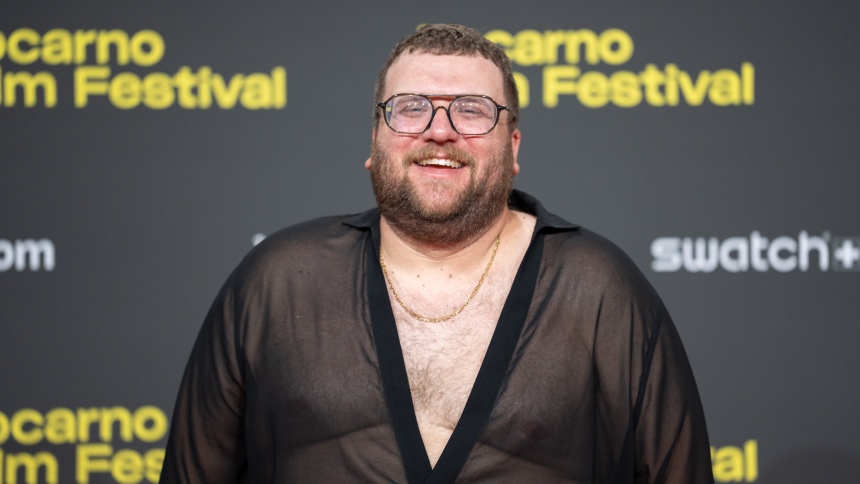
Canadian filmmaker Éric K. Boulianne delivers a raw, slyly comedic, and unexpectedly tender exploration of modern intimacy in flux in his latest film, Follies. Set within the evolving dynamics of long-term relationships, the film follows a couple tiptoeing into the uncharted waters of ethical non-monogamy, not with idealized libertinism, but with a refreshingly grounded sense of awkwardness, miscommunication, and emotional vulnerability.
Shot on 16mm with a stripped-down six-person crew and a mumblecore spirit, Follies is as much a product of personal reflection as it is of cultural observation. Boulianne, who also plays the lead role, draws directly from his own monogamous life while dissecting the rising social discourse around open relationships, a topic no longer confined to academic theory or podcasts but lived and negotiated in the day-to-day experiences of couples around him.
In conversation with Screen Anarchy, Boulianne speaks about navigating real-life sex clubs, shooting unsimulated scenes with porn actors and friends, and choreographing intimacy. With references ranging from Scenes from a Marriage to Easy and Shortbus, the filmmaker unpacks the tensions between authenticity and artifice, graphic realism and good taste, always with a self-deprecating wit and an insistence on collaborative, transparent filmmaking.
--------------------
Screen Anarchy: Why did you decide to make it about open relationships? Because it feels like, in the last three or four years, starting with documentaries, books and podcasts, people really began talking about polyamory and open relationships. It almost feels like some kind of social shift within certain generations.
Éric K. Boulianne: Yeah, in certain generations for sure. For me, it really came from where I am in my own life. I’ve been in a monogamous relationship for 20 years now, we have a kid, a small kid, and then suddenly some friends started telling me they were in open relationships. Then more and more people around me were in some kind of non-monogamous setup.
And I thought, am I the only one left? [laughs] Of course I wasn’t, but it gave me this feeling of: fuck, it’s been 20 years, we’ve got all the normal couple struggles, and I started imagining what it would be like at our stage, with a child, if we opened the relationship. What kind of challenges would that bring?
So I sat down with the co-writer Alexandre Auger, and we started brainstorming. Then we really dove into reading about polyamory and non-monogamy. And it struck me as really interesting, because I’m sure there are models out there beyond the typical monogamous vision that can actually work. Especially in younger generations, it seems much more fluid.
I’m not saying I want to live that way personally, but for a film, it felt like a great subject to try to capture, seriously, not just as a joke. The characters are really trying, even if there are comedic moments. And narratively, I think it raises questions we should be asking ourselves: how could it work? That’s really where the idea came from.
Was there heavy research behind the script?
Oh yes, a lot. I even went to a real libertine sex club, talked with people around me, learned the vocabulary, like what kinds of relationships exist. I wanted to analyze that, which is why the film even has these chapters about different types of relationships.
Not everyone I met, but some people, were very open. After 20 years in the same relationship, I thought, oh damn, people really do talk about this openly now. There’s even one actress in the film who lives in an open relationship. She and her partner have two kids and they seem pretty happy.
And it sounded so simple on the surface, but it actually comes with a lot of real communication, real discussion. That struck me as narratively very strong.
But regarding your script, why did you decide to keep it within the bounds of ethical non-monogamy? Because more drama lies outside of it.
I don’t know, it just felt right for the script. I wanted to approach it from a perspective close to my own life, my own relationship. It’s about those first steps into open dynamics, not a grand study of non-monogamy or ethical versus non-ethical practices. It’s simply the story of this couple dipping their toes in, discovering: oh, there’s this other possibility out there.
For me, it was about the beginning of that process. That’s why I didn’t take the characters further down the road, you could easily imagine another movie where they go deeper, but this one wasn’t about that. Also, I wasn’t so sure about the non-ethical angle. Infidelity, betrayal, that’s been told countless times. It didn’t feel like the story I wanted to tell here.
I couldn’t help thinking of the mumblecore movement. Watching your film, the first thing that came to my mind was Joe Swanberg’s Netflix series EASY. Is there a real connection?
Totally. I started as a screenwriter, but when I wanted to make this feature, I wanted it quick and raw. I definitely had mumblecore in mind, their films had scripts but a lot of improvisation, the image was raw, they shot fast. That energy was something we wanted.
But I wouldn’t call this a mumblecore film. The influence is there, yes, but we were more interested in finding that tone, that sincerity, that openness. Films like Funny Ha Ha were a big influence. The Color Wheel too. Even classic ’60s and ’70s films, like Scenes from a Marriage or La Maman et la putain, had a strong impact.
On set, “Mumblecore!” became a running joke. Anytime things dragged, like if it took too long to set up a shot, I would yell “Mumblecore!” It became the answer to everything. [laughs] But yes, the movement influenced me a lot. I also rewatched Easy, because it has a couple navigating an open relationship. I didn’t want to just repeat the same thing, though, I wanted to take it somewhere else.
So no Woody Allen influence?
[laughs] Of course there is. But now it feels like you can’t even name him, it’s like Voldemort. Still, I can’t deny it. His films were the first I saw when I was young, and they had a big impact on me. The way he portrayed relationships, how he mixed humor and intimacy, it shaped me. Whether I like it or not, it’s there.
When you say mumblecore, does that also mean the shooting was done in a kind of punk spirit?
Yes and no. I wouldn’t call it punk exactly, but the approach was very stripped down. We just shot without overthinking. The crew was tiny, six people. The DoP François Messier-Rheault handled most things himself. Because we shot on film, he had a camera assistant, but there was no electrical department, no big setup. Lighting was raw, sound was just one person with a boom.
I didn’t want wireless mics, I wanted it to feel looser. So it was this mix: very simple, very raw, but still organized. We shot in 21 days. At first, we had no government funding, Quebec films are often funded publicly, but we just started anyway, with $2,000 from our own pockets and some art funding. Only later did we get money for post-production. At the start, it was just: let’s do this.
When did the decision come that you would be starring in the main role?
I had made this short film a couple of years ago called Making Babies. I was acting in it, and it really became the blueprint for this feature. It dealt with similar themes of intimacy, though the story was different, it was about a couple struggling with infertility. But in that short, we explored intimacy and sexuality in a way that felt real and natural, not sexualized, and that approach shaped how I wanted to make the feature.
I was in the short film too, partly because I’m not a trained actor but I knew the tone I wanted, something very natural, almost like not acting at all. I felt I could get there myself. Plus, I have the body that I have, and I wanted to make a statement about what kinds of bodies we show on screen. I was ready to go fully nude if necessary, so I thought: why not? It worked in the short, I loved acting, and for the feature I said, “I’m gonna do it again.”
Also, with my co-star Catherine Chabot, we’d been looking for a project to do together for a long time. We’re good friends, so when this film came up it felt like the perfect fit. From the start, I pretty much knew I was going to act in it.
That must have meant a lot of rehearsals before shooting?
We rehearsed mainly the intimacy scenes. We had an intimacy coordinator, and every scene was carefully discussed beforehand, even choreographed. Sometimes we’d literally be in Catherine’s living room, mapping out: “Okay, you go there, then I go here…” That way everything was clear and safe.
But beyond those scenes, we didn’t rehearse much. A lot was improvised, especially with the kid. I didn’t want to over-control it. I also didn’t want to shoot like: okay, let’s film, then watch playback, then redo. That wasn’t the vibe. I wanted to put my faith in the team.
We did have a little camera monitor system, even though we shot on film, we could record digitally at the same time and check the image. Sometimes they’d ask me, “Do you want to see it?” and I’d just say, “Do you think it was good?” If they said yes, we moved on.
But you still did several takes?
Not really. Since we shot on film, time was limited. Usually one, maybe two or three takes, then move on. I actually wanted that imperfect feeling. There are moments in the film where an actor stumbles over a line, but it felt authentic, so I kept it. If the vibe was there, that was enough.
Sometimes I’d rewatch for the more emotional scenes, but most of the time I trusted the DoP, the first AD, my co-stars. It was a team effort. Sure, I was the director, but everyone pitched in. That was one of the things I loved most about making this film, it really felt collaborative, like friends working together with a good vibe. That’s why I do it. Otherwise, I could just stay behind the desk and write. But the pleasure of filmmaking is the teamwork.
Were there any surprises in the editing room?
For sure. Sometimes I’d try to make a scene live entirely in one shot, very minimalistic, no coverage, and then in the editing room I’d think, shit, maybe I should’ve grabbed three or four extra angles. But then again, that’s what we had, and I learned to love that.
That’s the beauty of shooting on film. With digital, people shoot the rehearsal, then shoot again, and again, you end up drowning in images. In the editing room, you can do almost anything. But for me that’s also kind of depressing, because you can do too much. Shooting on film forced us not to overshoot. We had what we had, and most of the time, it worked.
Of course, the editor would sometimes say, “We could use more shots here,” and I’d be like, “Yeah, maybe, but fuck it, this is what we’ve got.” [laughs] And honestly, I liked those surprises.
But then you drop in something like the EYES WIDE SHUT orgy scene, and I’m thinking: this must have been fucking expensive. You keep saying the film was low budget, and I can’t put those things together.
That’s the funny thing. At one point, it really was a low-budget film. But then when we started showing it around, getting feedback, our producer said, “Stop saying that. Just own it. If you keep telling people it’s small budget, they’ll only see that. It doesn’t feel small, so don’t apologize.” And he was right.
For the Eyes Wide Shut orgy scene, we found extras, we found this huge mansion that was already perfect, no real set dressing needed. Costumes? Mostly cheap orders, Amazon stuff. And yeah, we had all these extras in masks, and when the character goes from the ground floor to the big dance upstairs, it’s literally the same people in the same costumes. [laughs] I can see it, but it goes by so fast you don’t really notice.
We concentrated our resources on two big set pieces: that masked party, and then the sex club sequence, the one with men jerking off. Those were the heavy lifts, where we knew we needed more extras, more costumes, more production value. The rest of the movie is bedrooms and two-shots of people talking. So we poured the budget where it mattered.
But even so, it had to be one of the most expensive scenes?
For sure, in our budget that was probably the top. But again, we found ways. There’s this weird rule in Quebec: you have to pay the first 50 extras, but after that you don’t. Which is fucked up, but that’s how the labor law works. Luckily, our producer knew all the loopholes. He’s been around forever, knew how to stretch every dollar, where to spend, where not to.
We also had this thing where basically everyone on the crew got the same day rate, a half-fee. And beyond that, everyone was sort of a co-producer, meaning if the film makes money, we share. That’s how we managed it. But to be honest, I wouldn’t want to repeat that. It’s not fair financially. People deserve to be paid well, it’s a job.
This film was different. Everyone came in knowing the deal, and they were okay with it because it felt like a family project. I’m incredibly grateful for that. But next time? I want a proper budget. I want to pay people right and bring the same crew back, because they invested so much in this one.
But you make it sound so easy that you just put together 50 extras willing to undress and jerk off on camera. Was it really like that? Did you go through a casting agency that just sent you 50 dudes ready to strip?
[laughs] Not at all. At first, we went to an extras agent. She flat-out told us: “It’s not possible. You won’t find 15 naked men willing to jerk off. Change your scene.” I was like, really? Then a friend of the producer stepped in. She just went on Facebook, found a nudism group, and posted: “We need extras for a film.” Suddenly she had a hundred candidates. We had more than enough to choose from.
All men?
Yeah, all dudes. And we sent them a sheet: full nudity, partial nudity, or no nudity. A lot of them checked full frontal. Like, “I don’t care.” So we were set. But I also wanted one real, graphic masturbator, someone who could actually perform. For that, we went with a porn star.
Oh, really?
Yeah, a Canadian porn star. That was the weirdest call I ever had to make. I’m not in that business, so I was like: “Okay, I need someone for a scene. No partner, no girl, no boy, just yourself. You’ll be on screen, you’ll be jerking off.” So yeah, we had three or four porn actors in the film, people comfortable with nudity. And the guy jerking off? That was just his job. Total professional.
That actually opens up the bigger topic, the difference between pornographic images and reality. Because a lot of people imagine orgies as this glamorous thing, but in reality, many say it’s just a bunch of dudes and very few women.
Exactly. And that’s what I wanted to capture. I did my homework, I went to a sex club on a real night, just to see. Asked questions, talked to couples. In that particular club, singles weren’t allowed, only couples or threesomes if a guy was invited. But I asked: “Okay, are there clubs with single-guys nights?” And they said: “Yeah, but those are basically just a whole bunch of dudes. You’ll have three people actually fucking, and 20 guys standing around them jerking off.”
And I thought: that’s a great image. Let’s use that. Because I wanted to talk about sexuality, but also show the awkward side of it. Sex isn’t always cinematic. Sometimes it’s clumsy. Sometimes it’s funny. Like, “Sorry, my leg’s in the way.” That’s real life. So I filmed it in wide shots, not trying to be sexy.
So the orgy scene is cringe, but also real.
Yeah. If you wanted to parody it, you’d do exactly that: a bunch of dudes and two women who aren’t available. But it’s not parody, that’s the reality I was told about.
For me, there’s something funny in that, but also true. I didn’t want it to be a giant joke. There are scenes where the sexuality is more beautiful, like with the throuple, they’re just having fun, and I wanted to show that fun too. But I was never going to cut into close-ups of tits and dicks just to be voyeuristic. That wasn’t the point.
Were there any red lines regarding nudity?
The line for me was about staying in good taste. I wanted the film to be generous, to reach a wide audience, even if it was explicit, it shouldn’t tip over into something that just feels pornographic. And of course, working with porn actors, there were moments where they’d ask: “Do you want us to fuck?” And I had to say: “No, tone it down. That’s not this movie.”
For them, that was mind-blowing. They were like, “What the fuck do you want us to do then?” [laughs] And I’d say: “Do your thing, but no penetration.” I could have gone there, it would have been easy, but it didn’t fit the tone. This was still a comedy.
I knew the image of the guy jerking off would work, it would be funny in context, but beyond that I wanted to keep it on the line. Crude, raw, yes, but not so graphic that you lose the audience. Because people aren’t used to being confronted with pornography in a commercial feature.
But porn is everywhere these days.
Sure, but you don’t see it in fiction films. That’s what fascinated me. I’d watched Shortbus, 9 Songs, The Brown Bunny, all those films with unsimulated sex. And I was fascinated, I’d love to push it further. But here, it just didn’t feel right. The tone needed to stay light. Those explicit images would’ve shocked too much.
I was also surprised that your lead actress Catherine Chabot was comfortable with some of the nudity.
Oh, everything was discussed beforehand. Every single scene. She’d even ask to rewatch things on the monitor: “Can I see what that looks like?” And I’d always say: “Of course, it’s your body. You have to be okay with it.”
On a giant screen, sure, it looks different. But she wasn’t fazed. Honestly, that wasn’t the hardest part for the actors. They were comfortable. Catherine especially, she’s used to being nude on stage. And for her, the foursome scene was funny. Because it’s not sexy, it’s about the awkwardness of trying to leave a foursome gracefully. [laughs] Which is impossible. That was the point.
You did not want to use prosthetics or fake bushes as a fig leaf?
I hate that shit. Even in Hollywood now, you see dicks everywhere, in White Lotus or Euphoria, but they’re all prosthetic. And they’re gigantic! Fucking twelve-inch rubber dicks. What’s the point? Show real bodies. It’s not that complicated.
So we just used what the actors had, what they were willing to show. No fake bushes, no fake dicks. Real bodies, real people, in a safe and organized environment. And for me, the film isn’t graphic, it’s natural. But because people aren’t used to seeing that, they think it’s shocking. For me, it’s tame.
But there’s always controversy. At Sundance this year, for example, there was drama over screen-grabs being leaked online. And in your case, you’re the director and acting in the sex scenes.
Yeah, of course. But come on, everyone knows Mr. Skin exists. The actors knew going in that screen-grabs would end up on the internet. What can you do? When I made Making Babies, there was a full-frontal scene of me. Sure enough, my dick’s on the internet now. And I don’t give a shit. I didn’t do it for that purpose. I did it for artistic reasons, for the story. If someone wants to jerk off to it, fine. That’s not why it’s there.
Still, your film is a comedy with kids in it. How do you reconcile that? Kids acting in a movie they probably won’t even be able to see for another several years?
It’s all about communication. First, the kids were never on set with nudity. Those scenes were shot completely separate. Of course, in the editing room, you can end up with a cut where a guy’s putting his finger up my ass, and then the next shot is a pool party with kids. And yeah, the first kid you see is my own kid. People were like: “That’s bold.” [laughs] But honestly, that’s real life.
When you have kids, your sex life changes. You fuck when they’re asleep, you fuck when you can. That’s just how it is. And that’s what I wanted to capture: the reality that parenting and sexuality coexist. For kids in my film, I would like to make a PG cut, just for them, so they can see themselves in the movie and have a souvenir.
And their parents were really open about it?
Yeah. When we started talking about open relationships in the film, I asked: “Do you want us to avoid giving too much information to your daughters?” And they said: “No, we’ve already had those conversations with them. It’s fine.”
So I thought, perfect. They were super open. I think that’s beautiful. My daughter especially, she’s really curious about movies now, always asking: “What’s it about? What scene am I in?” And I just tell her: “You’ll see it someday.” But really, it was about constant communication with the parents—making sure they were comfortable.
So there won’t be any controversy like with Ulrich Seidl´s SPARTA, where the parents of the children starring in the film claimed they were misled?
Not at all. They knew everything from the start. I wanted zero controversy. They had the script, they knew exactly what the film was about.
Did they see a working version?
I don’t know if they’ve seen it yet, probably not. But they trusted me. They’d seen my previous work, they knew my approach. And because the themes are so sensitive, I wanted to do everything properly, so that no one could come out later and say they’d been misled.
Everyone involved was happy, everything was clear, the mood on set was good. That’s exactly why we had an intimacy coordinator, why we rehearsed carefully, why I kept showing things to the actors.
I’m not a despotic director. I want people to feel free and safe when they’re doing this kind of work. It’s important when you’re dealing with subjects like these.
And what’s next for you?
I’ve got two projects right now. One is another comedy, though with drama mixed in, it’s about suicide watch. A group of friends taking shifts to watch over their friend who’s at risk. It’s heavy, but I want to find the comedy in that kind of solidarity.
And the other is a baseball movie. It’s about the Expos, specifically the 1994 season, when they had their best team but then the strike killed everything. We don’t have the budget to recreate the actual Expos, so it’s about a smaller, working-class team inspired by them. A proletarian baseball film set in the 90s. So those are the two main projects I’m working on now.