Karlovy Vary 2025 Review: THE VISITOR Observes the Subtle Rituals of Letting Go

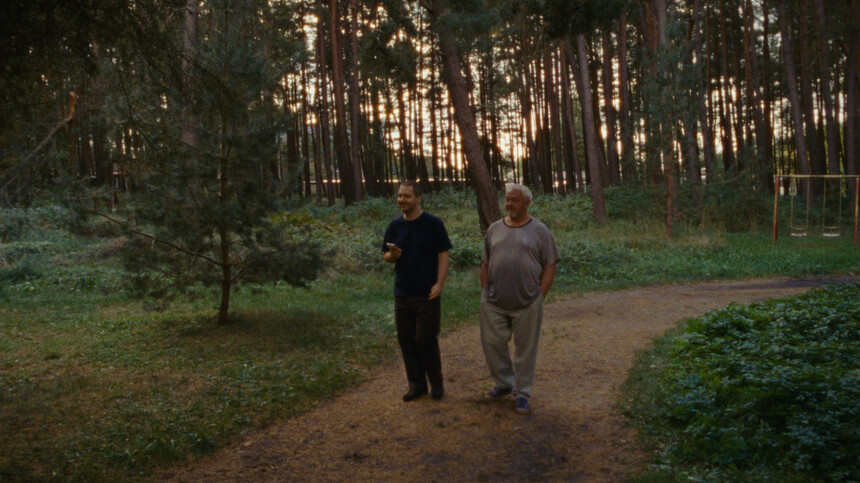
There is a peculiar stillness to The Visitor, the feature debut of Lithuanian director Vytautas Katkus, that resists any overt assertion of significance. Rather than impose meaning, the film invites the viewer to drift alongside its protagonist, Danielius (Darius Šilėnas), who has returned to his hometown in Lithuania after years abroad to sell his late father’s apartment. The task lingers not due to indecision, but a quiet, almost ambient inertia.
What unfolds is less a narrative than a series of suspended gestures, conversations that never fully develop, aimless walks, spaces that resonate more with memory than presence. Set in a summer resort town just past its prime season, and on the margins of Danielius’s own history, the atmosphere feels provisional. Both the place and its people seem to linger in a state of anticipation, as if waiting for something to conclude, or quietly begin anew.
Katkus, who established his voice through a series of formally restrained and atmospherically attuned short films, extends that trajectory in The Visitor. From Community Gardens (2019) to Places (2020) and Cherries (2022), his work has consistently explored themes of rootedness, absence, and the emotional imprint of place. Often collaborating with non-professional actors and drawn to the overlooked margins of urban environments, housing estates, overgrown lots, empty crossroads, Katkus shapes his narratives less through conventional plot than through mood, rhythm, and spatial texture.
Katkus’s background as a cinematographer is evident in the film’s visual composition. Co-written with Marija Kavtaradze, The Visitor continues his exploration of place as an emotional proxy. The neglected apartment, a damp underpass, an indifferent stretch of beach, a forest path, these are not simply settings but sites of temporal layering and displaced identity. Katkus avoids overt contrasts between past and present, choosing instead to superimpose them, often within a single frame. A walk through a familiar landscape becomes, in his treatment, a quiet excavation of memory.
-thumb-800x450-99366.jpg)
In this sense, The Visitor is less about returning home than about recognizing that “home” may no longer exist in any fixed form. The film unfolds through loosely connected episodes: Danielius reconnects with former acquaintances, revisits places from his youth, and moves through daily life with a quiet mix of detachment and longing. Conversations dissipate mid-thought; encounters carry a sense of both intimacy and remove. At its core, the film is structured around absences, a father who is no longer present, a former self that cannot be reclaimed, a town that remains familiar yet somehow altered.
Katkus’s choice to shoot on analogue film lends the work a distinctive tactile quality. The visible grain and softness in the image introduce a subtle unpredictability that echoes Danielius’s interior state. Time is rendered not as a linear progression but as an atmosphere, the weight of the past pressing gently against the present. The town, emptied of its seasonal crowds, functions as an echo chamber. What lingers are gestures, impressions, tonal shifts, not resolutions or dramatic peaks.
The film tends toward observational realism. It neither explains nor documents; instead, it opens space. The camera lingers, not only on faces, but on rooms, windows, the edges of streets. Its pacing is deliberate, even withholding. Katkus does not guide the viewer through a character’s arc, but invites them to enter the character’s tempo, to experience the suspension, the ambiguity, the quiet that follows absence.
The emotional and spatial architecture developed in Katkus’s short films finds space to evolve in The Visitor. The film is composed of ellipses, the unspoken, the unresolved, the in-between. Danielius does not seek resolution; he remains just long enough to recognize that he no longer belongs.
The Visitor maps a visual psychogeography of personal history, tracing how places once central to one’s identity become estranged in the present. Danielius belongs to this town only in memory; his present self is already elsewhere. Katkus captures a quiet ceremony of farewell—the final gestures of detachment following the death of Danielius’s last living parent, a moment that severs the remaining ties to home.
What unfolds is a sensitive portrayal of separation, attentive to the emotional weight such transitions carry. The film’s light, at times even playful, social interactions quietly mask a deeper melancholy, the recognition that departure is final, and return unlikely.
The Visitor
Director(s)
- Vytautas Katkus
Writer(s)
- Vytautas Katkus
- Marija Kavtaradze
Cast
- Saule Bliuvaite
- Hanne Mathisen Haga
- Egle Gabrenaite