Karlovy Vary 2025 Interview: THE VISITOR Director Vytautas Katkus on Visual Memory, Emotional Landscapes, Making Fiction Feel Real

With his quietly evocative debut feature The Visitor, Lithuanian cinematographer-turned-director Vytautas Katkus delivers a meditative portrait of return, dislocation, and emotional impermanence.
Set against the waning light of a seaside town at summer’s end, the film follows Danielius, a man caught between two geographies and emotional states, as he returns from Norway to his native Lithuania to settle the remnants of a former life. What unfolds is a delicately observed narrative, where spatial memory and visual atmosphere are foregrounded over traditional plot mechanics.
Katkus, whose background as a cinematographer includes selections at Cannes, leans into his formal instincts here, favoring long takes, ambient rhythms, and intuitive camerawork to evoke a world shaped as much by absence as presence. Co-written with long-time collaborator Marija Kavtaradzė, The Visitor walks a line between fiction and reality, often blurring the two through a hybridized approach that allows improvisation, real locations, and non-actors to inform its subdued emotional texture.
In conversation with Screen Anarchy, Katkus reflects on the visual logic behind the film’s construction, the collaborative roots of his storytelling process, and how directing emerged not from ambition, but from the need to make a specific kind of cinema , one that exists in the quiet spaces between people, images, and time.
Screen Anarchy: You’re originally a cinematographer. And in your feature-length directing debut, you’re using a lot of spatial storytelling. How did you visualize the film's concept? How did you plan places you wanted to shoot, and what was the logic behind the locations?
Vytautas Katkus: For me, the environment, the space where the character lives, is very important. There are a lot of reasons. One of them is, as you mentioned, I’m a cinematographer. I used to work, and still work, as a cinematographer. But from the very beginning, my main focus was always on images, on the surroundings, on everything visual. And I’m not as good at, you know, working with actors.
Of course, I try to do my best, but I don’t have a background in that. I didn’t have the academic knowledge of how to work with actors. What I did have was academic knowledge about the image, so that’s what I lean on more. I feel more confident, more safe, when it comes to the image, the environment, how it all connects to the actors.
And I really want to tell stories not just about one character and another character, but about the character in their environment. How the environment shapes them, how it matters, even if they don’t have a strong connection to it. The environment still exists and plays a role.
For me, it’s one of the main ways to create atmosphere, to create emotions. And that doesn’t mean you always have to use wide-angle lenses. It’s more about sometimes focusing on the environment, like a close-up of an actor, but also a close-up of a bench, or a chair, or something else. It still should be connected somehow, in a way that makes sense emotionally or visually.
Filmmaker Marija Kavtaradze is credited as a co-writer.
Yeah. We’ve known each other for almost 20 years, I think. From school, more or less. We went to different schools, but we both attended this one cinema club for high school students. We started to learn more about cinema there. And then we studied together. She studied directing, I studied cinematography, but we were in the same year. And we’ve always been good friends.
When we talk about movies or our projects, we talk more like friends than professional colleagues. It’s not like, “Okay, let’s meet and you’re the director and give me advice.” It’s more like, we’re having dinner, spending time with other friends, and we naturally start talking about what we’re working on.
Also, the cinematographer of all Marija’s films, Laurynas Bareiša, is the same person who edits all of my films. So we’re all very closely connected. We studied at the same time, Marija, Laurynas, me. Other directors and cinematographers came a bit later, but we all had some classes together, so we know each other from the Academy. So yeah, we’re also very good friends. And in a way, it’s just friends doing things together.
Why did you pick Marija to co-write the script?
Because for short films, in each of them, I talked with Marija, with Laurynas, with friends, I didn’t ask them to help, exactly, but I would share the script, and we would discuss it, give feedback, things like that. But short films were a bit different, because in all of them, the script was kind of strict, very concrete in a way. And I knew I’d have the possibility to change things later, during rehearsals, during production, and so on.
So for shorts, the script was more of a technical thing, like, just something to work from. But for a feature, I knew it had to be something else. More professional, more developed.
Because of funding? Or the scale of the production?
Both. It’s just longer, longer pre-production, it takes more time, more planning. And for me, the script becomes a kind of document where all my pre-production thoughts have to be included. So I started writing, not a full script, but more like a treatment or an outline. Then, in some random conversation with Marija, I started to explain what I wanted to do.
And she just really loves to write. In general. She's very good at it, and she enjoys the process. That doesn’t mean she wants to write every script, or write other people’s scripts, but she loves writing. And she knows how to do it. Her sister is also a screenwriter and playwright. So yeah, she’s been writing for years.
So I was telling her the story, and she said she’d like to join. It made sense, at that stage, the idea looked more like it would be eight or nine different ...not short films, but chapters. Vignettes, more or less. Each one dealing with a different perception of loneliness or solitude. At first, we didn’t even know who the main character would be. Some chapters had the same character, others didn’t.
Marija thought it would be good to have a second opinion. And I really wanted her to join, because I knew she’d help a lot, do a lot of work, and bring a lot to the project. So we started writing. And while we were writing, we also went to some workshops, like Torino FilmLab.
There, we got the advice that it would be better to keep one main story and have intermissions or episodes within that framework. So Marija joined in a spontaneous way, but at the same time, it was kind of inevitable. Like, maybe I would have tried to write it alone, and after two months realized it wasn’t working, and then asked her. But she came in before that, and I’m really happy she did.
Since you’re more of a visual person, how do you write a script?
That’s a good question. Marija helped a lot. What I really liked about working with her is that we didn’t have strict rules about how to write. Sometimes she would write something, sometimes I would. Sometimes I’d write a scene, and she would change or edit the dialogue. And vice versa. So it was very collaborative.
So you both wrote dialogue and action descriptions?
Yes, both. It wasn’t like “You do this part, I do that part.” It was very fluid. Like I might write a scene with dialogue, and then Marija would revise some of it, and the same the other way around. It was collective work.
For me, it was really important that the script could somehow communicate the atmosphere, something of the visual language. Not in terms of describing shots, but just conveying the feeling of how the movie should look, how it should feel.
So I’d try to explain that to Marija, what’s important in a scene, what the atmosphere is. Not necessarily how it should look visually, but what kind of emotion or tone it should have. And with her writing skills, she tried to translate that into the script. I really enjoyed being in Torino FilmLab because we were working on the script, but at the same time, we were already having discussions with directors, cinematographers, producers. So it wasn’t like, first you write the script, and then later you go to different departments. Everything started together, from the very beginning.
And I really liked that. It helped me understand the story better, helped me write it better, and helped me understand what we were actually doing. Because, you know, you're writing something, and in a year you’ll want to visualize it. But it should first and foremost be a film, and only secondly, a script.
Where did the story come from?
I think it’s not exactly about immigration, even though you can interpret it that way. It’s more about memory, about the past. We decided the main character should live in another country just to make the emotional approach a bit stronger. And everything happens in a small town, again, to give it more intensity.
But many of the characters and stories come from personal experiences, mine, Marija's, or our friends. Things we experienced or heard about.
So there are fragments of real lives in there?
In a way, yeah. Not 100% copy-paste, but definitely inspired by real people. And actually, there are some characters playing versions of themselves.
Really? From the beginning you wrote it that way?
Yeah, from the beginning. For example, there’s one young woman Vismantė Ruzgaitė, we knew from the start we were writing a character based on her, and after the script was finished, we would ask if she wanted to play the part.
Is she a professional actress?
No, she’s a good friend. We studied together, she’s a photographer. What I really like about her is her expressiveness, she can be explosive, but also very calm. That contrast. From the very beginning, I saw her as this character. So yeah, we wrote the role for her.
There were also smaller characters. And during casting, we realized, okay, let’s change what was written in the script and bring in this or that real person instead, and use elements of their real stories.
And how did she react to playing a version of herself? Did she have any objections or corrections?
No, not at all. We’d already worked together on a short film, so we knew each other a bit. I told her, "This is you, if you don’t know how to act, it probably means I wrote it badly, or that you just need to remember how you would do it. And we’ll find the solution together.” So the idea was to give her freedom, to act as she wanted.
Of course, I gave her some direction, but the background was real. Of course, we changed some things, it's impossible not to, but the foundation was based on her actual story.
The film has a slow-burn rhythm and feels very natural. It doesn’t feel tightly scripted. So I was surprised to hear you say it was fully written. Was there no improvisation?
Actually, I really wanted there to be a lot of improvisation. I wanted a script that left space to change things during pre-production.
During rehearsals? Or while shooting?
Both. From the very beginning, the idea was to allow for a lot of freedom during rehearsals and while filming. But I think most of the improvisation happened during rehearsals. We found new directions while working with the actors, and then we took that improvised material into the shoot.
On set, it wasn’t completely free, it was guided. We knew where a scene should start and where it should end. Yes, it was still improvisation, but more controlled, not something that would change entire scenes or the structure of the film. We also tried to shoot as chronologically as possible.
Really?
Yeah. It wasn’t fully possible, but we filmed exteriors in chronological order, then moved to interiors and filmed those in sequence, and then came back to the exteriors for the second half of the film. So it was kind of chronological. That helped us keep the improvisational spirit alive.
We also shot a lot of documentary-style material. I thought that during editing, the story might change significantly. But in the end, we kept the structure of the script, because it worked. We saw in the edit that the script was holding up.
So yeah, there are documentary fragments and improvisations, but also a solid script behind it. I really enjoy improvisation. With Saule Bliuvaite [the director of Toxic who has an episodic role in The Visitor], for example, we also improvised visually quite a bit. But I think improvisation doesn’t just start on set. If it does, it probably means something went wrong earlier.
As a cinematographer, improvisation starts in pre-production. As a director, it starts when writing. We improvised while casting, while rehearsing, while rewriting. So improvisation is already a part of the whole production process. It’s more about flexibility.
When you did the rehearsals, was it just table reads? Or did you use the actual locations?
I really wanted to rehearse in the real locations, but we were doing pre-production and rehearsals in Vilnius, and filming near the seaside, which is the other side of Lithuania. So we started rehearsals in our production office in Vilnius.
Later, we did rehearse in the actual locations, but by then we’d already gone through some of the scenes. I also rehearsed with Darius Šilėnas [the lead actor] in my apartment, to get out of the “four-walls” setting and into something with a kitchen, a bed, something more practical.
What mattered to me was seeing the connection between characters. While writing, we already knew that the young woman, our friend Vismantė, was our number-one choice for her role.
But for the lead role, for the father character, we hadn’t decided yet. We did a casting call, and that’s how we found Darius. He’s not a professional actor, he studied directing and now works as a film editor. But I’ve known him for many years.
He applied through the open casting?
Yes, I think Marija called him. We studied together at the Academy, he was a bit older, but we overlapped. I remember back then, directing students had to take acting classes as well, so he had some basics. And I chose him because I wanted his emotional presence, not theatrical performance.
His character doesn’t have to go “crazy” on screen. It’s more minimalist, more about inner states.
You were saying it’s more about “condition”, like inner condition, emotional state?
Yes, exactly, emotional condition. And I really wanted to see how he would act together with the other actors. So even during casting for other roles, he was often involved. Those casting sessions became rehearsals for him too. I really enjoyed that process, having him involved from the start.
Same with our casting director, Rugilė. She was with us all the way, from early casting through to rehearsals and even during the shoot. If I needed to check something, or felt unsure about how far we could go with a scene, I could always turn to her for input. So yeah, it was very collaborative all the way through.
What drove you or changed your mind, why did you want to try directing in addition to cinematography?
Honestly, I don’t really know the answer.
Because you already had your cinematography work shown in Cannes, which is a big achievement.
Yeah, but still, when I was in film school, I really knew that I didn’t even want to look at directing. It felt too hard. A director, to me, was a bit like an alchemist. It’s that kind of job.
And also, when we were studying, we had acting classes, and for me, that was a complete no-go. Like, how? Why?
I was much more into the technical side of things. Cameras, lighting. The more lights, the better. The more equipment, the better. I was really into how to create atmosphere, how to use tools to build something.
But after I graduated from the Academy, I realized, okay, there are not many projects here that need that kind of equipment or budget. So the first years after school were not hard, but kind of strange. I kept thinking, “I’m still waiting for the project.” I shot some commercials, worked as a camera assistant, but I felt like I was waiting for real cinema.
At that time, I wasn’t really into documentaries at all. But then I met a director Austėja Jurgelionytė, she had studied together with Darius, and she’s a documentary filmmaker. She invited me to shoot her documentary around 2014 or 2015. I said, “Okay, but I don’t have anything in common with documentaries.” And she said, “It’ll be really short, like, half a year.” Well, we ended up working on it for six years.
At first it was supposed to be her graduation film. But later she realized the story was strong enough to turn into a feature-length documentary. And over those six years, even while I was doing other projects on the side, that one really opened my eyes, about cinema itself.
I started watching more documentaries, filming more documentary work, and it taught me a lot, not just about documentary, but about filmmaking in general. I began taking inspiration from documentary while working on fiction, and vice versa. That’s how I discovered hybrid cinema. And I fell in love with it, not just with cinema again, but with a different kind of cinema than what I had studied in the Academy.
In school I had already discovered filmmakers like Tsai Ming-liang, but this process helped me discover many more. I started watching a lot of hybrid films. And I realized that some fiction films I loved were really more about observation than control. Not about directing someone to do something, but about watching. I really liked that.
And then, one time, I was with my parents at our summer garden house, and this one story came to me. I wrote it down, just so I wouldn’t forget it. I didn’t know what it would become. That was in 2015 or 2016. But I couldn’t forget it.
Over time, in my head, that story slowly started turning into a kind of script. Not officially. Just thinking: “Maybe that part could be a scene. maybe this character could be added…” and so on. Eventually, I wrote the script for Community Gardens. And my first thought was: What if this film was made without a director? But I quickly realized, that’s impossible. I thought maybe I could ask Marija or Laurynas to direct it, and I’d just do the cinematography. And I know they’d do a great job, the actors would be great, everything would be solid.
At the same time, I thought, I really want to try this for myself. I wanted to make a film that felt visually and atmospherically like the filmsI was watching. In Lithuania, at that time, and even now, there aren’t many directors working in that space between fiction and documentary.
Back then it was either fiction or documentary. Not both. There were no directors doing what Apichatpong Weerasethakul or Tsai Ming-liang were doing. Now, more and more are trying to merge the two. But I really wanted to do something in between.
So that’s how I tried it. It wasn’t that I wanted to become a director, I just really wanted to make that kind of cinema. If there had been a director in Lithuania working that way, and they asked me to be their cinematographer, I would’ve said yes immediately. I would’ve been happy just to shoot the film. But since that didn’t happen, I decided to try directing myself. And visually, even in my short films and in the feature, it’s very important to me that it doesn’t look like it was made by a cinematographer.
What do you mean by that?
I mean, I don’t want the film to scream, “This was shot by a cinematographer.” It’s not about the cinematographer having full freedom to show off or do whatever they want. It’s not about flashy visuals.
So does that mean that as a director, you’re not giving detailed instructions? You’re not doing multiple takes and making changes between them? How do you actually direct or coordinate things on set when it’s time to shoot?
Of course, I do give instructions, some scenes I know exactly what needs to be done. But most of that is figured out during pre-production and rehearsals.
For some scenes, I really want the actors to feel free. I don’t give them precise instructions at all. I just say, “Do whatever you want, like we talked about before.” If there’s a dialogue in the script and they feel it works, great. But if they feel like they want to add something, or take something out, or bring more of themselves to the scene,then let’s go for it.
But when we’re actually shooting, things are, in a way, quite precise and clear. A lot of decisions have already happened in pre-production. There are definitely moments on set that are spontaneous, and I love those, but other scenes are very strict, either because we’ve already rehearsed them or because we’ve improvised and locked in a version beforehand. So it’s a mix.
How many takes, on average, do you usually shoot? Fewer or more? Because you also have these longer sequences, where the camera is moving quite a lot...
Yeah, that’s something I’ve thought about a lot. One of the reasons we shot on Super 16mm film is because I was afraid that if we shot digitally, I’d go crazy. I’d just keep shooting take after take, “Let’s go again, let’s go again, who cares?” But film forces you to concentrate. It helps me focus, and the team too.
It’s important to know that we don’t have the luxury to do 10 takes of everything. If there’s a reason to do more, then we do it. But I always ask myself: Why another take? Is it because something’s not working? Or are harder scenes coming up?
So yeah, sometimes we do just one take. Sometimes two or three. Sometimes seven. But usually, it’s two or three, maybe four at most. We rehearse beforehand, which helps. Some scenes were shot without any rehearsal because I wanted that feeling of raw improvisation. Others we rehearsed a lot, so much that when it came time to shoot, we just needed one or two takes.
Like the karaoke scene, it felt a bit surreal, a bit dreamlike. Very lingering and strange in a good way. That seemed to come from you directly.
Yeah, some scenes I really wanted to shoot as real events, like karaoke, for example. I wanted to invite a few friends and make it feel natural, but in that particular case, it was just impossible to pull off.
But the birthday party on the beach, that was real. It was Vismantė’s actual birthday. We knew in advance that it was on September 10th, and I really wanted to shoot that scene on that day. She invited her friends. Of course, everyone knew it was staged, but still, it had that real energy.
It feels like you're just beginning to explore this process. Are you already preparing another project as a director?
Right now, I’m finishing some projects as a cinematographer, finishing color correction and things like that. But yes, I’ve started working on a new idea. I’ve been talking with Marija. It’s something I’ve had in my mind for three or four years. A very minimal, minimalistic idea.
Is it a feature project?
I think so, yes, it’s intended as a feature. The whole idea is that everything happens during one day, on a specific event day in Vilnius. Every year when this event happens, I think, Okay, I’ll go, I’ll observe, I’ll write something about it, but nothing ever comes of it. I skip it, I put it off.
Like a celebration?
Yeah, exactly. A public celebration. And this year I realized: before writing, I really need to film it, to understand how the environment works, how people move. Because this time, the environment is very active. It’s important. And you can’t, or rather, it’s better not to, try to control it.
So I filmed something, just as a test. I filmed some characters, some sequences. Now I have some footage. I’ll watch it with Marija, and we’ll see if something can come out of it, if it can be developed into a proper script.
And I really enjoy this process, filming before writing. It gives me an understanding of what it might look like. Of course, it could end up completely different, but at least it helps to sense the shape of it, whether it’s worth pursuing or should be skipped altogether.
You truly are a cinematographer.
Haha, yeah. But this is also how I used to work with Austėja, the documentary director. We would film something, then she’d write something, then we’d film more. It gives a real sense of how things could look, how they might work.
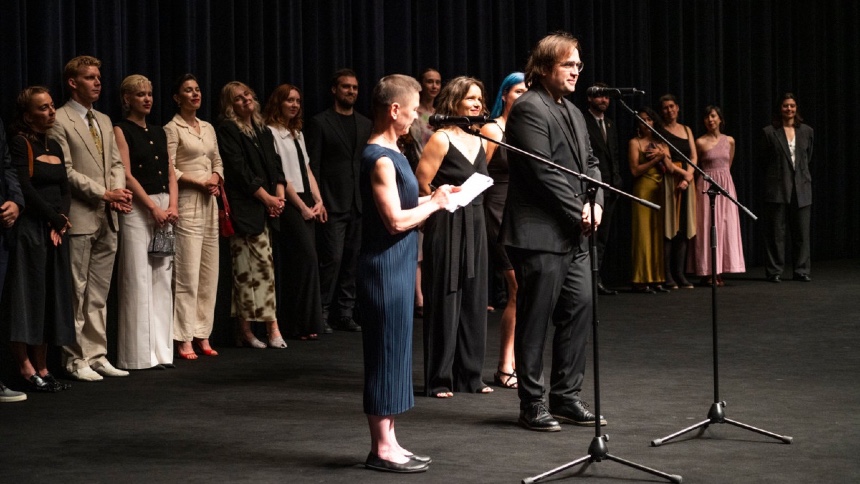
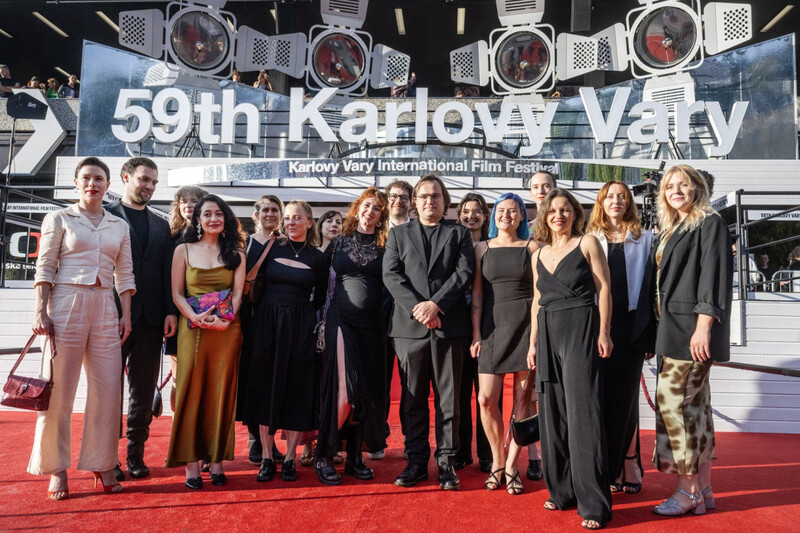
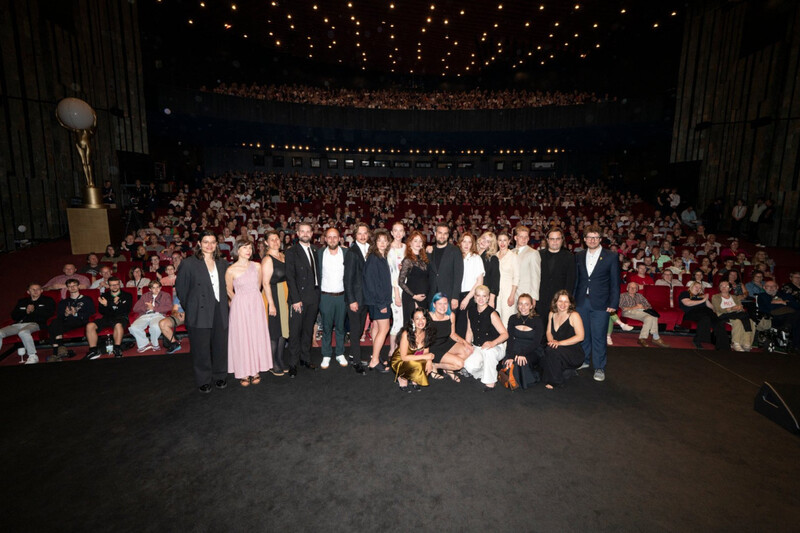
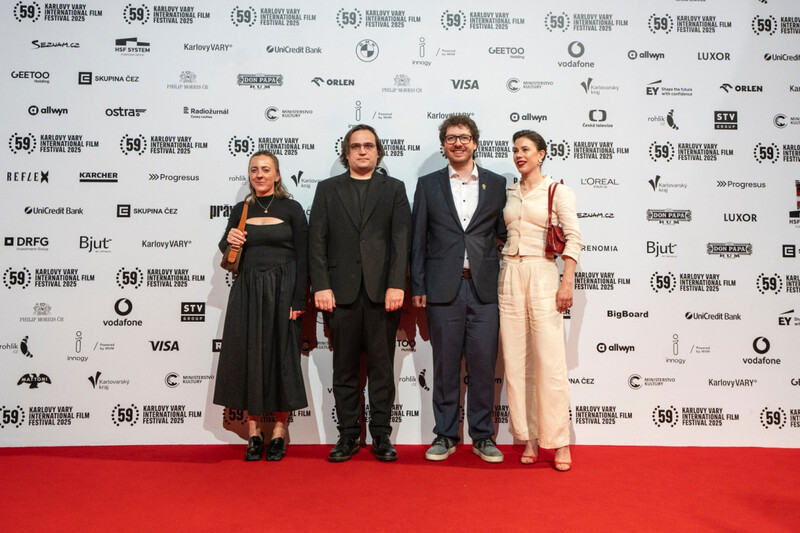
The Visitor won the Best Director Award at the 59th edition of Karlovy Vary International Film Festival.
Photos courtesy of Karlovy Vary Film Servis.