London 2026 Review: INK, Danny Boyle's Unruly and Troublesome Free Press Polemic
A compelling story with dirt under its fingernails, undone by unnecessary controversy.

Who freed the press?
It's been a democratic right that's built civilisations and chipped away at them when they've crumbled, but in today's age of near-limitless information at the palm of your hand, who were the people who gave it to us?
Aaron Sorkin argues it's Mark Zuckerberg; Alex Gibney posits the theory that it's Elon Musk...but Danny Boyle? He points the finger a bit further back at the lesser-known Larry Lamb, the British news editor whose recruitment by now-notorious Australian media mogul Rupert Murdoch saw the revitalisation of The Sun newspaper and (as stated in Boyle's new film, Ink) the subsequent unravelling of Western society as we know it. Is the sordid recent history of our world written less in ink and more in blood? In Boyle's eyes, there's not a lot of difference.
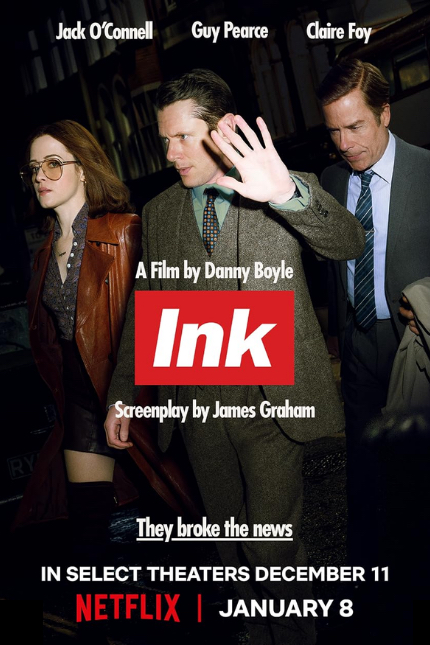
Adapted from screenwriter James Graham's own play of the same name, Ink begins with a tête-à-tête in a Fleet Street restaurant between Jack O'Connell's Lamb and Guy Pearce's Murdoch. Murdoch has just made a bad investment in Lamb's eyes: he's bought the failing fish-wrapper The Sun, forever in the shadow of its big daddy newspaper The Mirror. Nonetheless, Lamb and The Sun have much in common, both dwarfed by the reputation of the best-selling newspaper in the country, and it's time to break free.
Pulling together a similarly embittered crew of journalists eager for something better (including Claire Foy's Jules Davies, a fictional take on women's page pioneers of the era), The Sun promises everything that the other stuffy tabloids are too prim and proper to talk about: sex, booze, domesticated crocodiles in garden ponds, et cetera. But like any rapid rise, there has to come a great fall, and Lamb's commitment to telling not quite the whole truth, but the LOUD truth, soon leaves the paper with blood on its hands.
Pitched like the scuzzy second cousin of Steven Spielberg's The Post, Ink's hyper-formalism pulls a similar magic trick to its well-behaved forbear. While Spielberg put on a clinic on how to utilise a tight space with as much gorgeous, professional blocking as possible, Boyle is throwing anachronistic fastballs, pulling out every cinematic trick in the book to spin the audience's heads and even making some new ones in the process.
The use of iPhone photography feels even more dizzying than it did when photographing zombie killshots in 28 Years Later, with whip pans so fast on gimbles so nimble that it appears like the camera is being literally thrown across the set. The result is a film that convinces you of its furious momentum, leaving the idea of a stage play in the dust as it violently flies through headline after headline in search of a higher and higher purpose.
Never one to shirk his duties, Jack O'Connell's pent-up powerhouse of a leading role follows suit. It's difficult for him to move on entirely from his back-to-back horror villain parts in Sinners and 28 Years Later: The Bone Temple respectively, but that strangely works in his favor here; there's something more than a bit vampiric about this print-obsessed bloodhound on the trail of the cold, hard facts, and his complicated attempt at a quaint Yorkshire accent on the run from his hometown is one of the film's strangest and most compelling assets.
Guy Pearce's Murdoch is, by comparison, a surprising centre of experience and morality; much of Murdoch's real-life controversies have soured his image over a very long career, so it might come as an alarming approach that Boyle humanizes him as a prudish professional, hungry for money but with a reputation to uphold that Lamb cares far less for.
Claire Foy's feisty take on Davies is simultaneously masculine and maternal, holding brusque physical chemistry with O'Connell but lending almost Dickensian no-nonsense kindness to her fellow woman; an early scene with Page 3 model-to-be Stephanie Rahn (Abigail Amin) holds a lot of weight as a self-defeating but realistic display of swinging sixties sisterhood.
There are brilliant faces aplenty in the wider supporting cast too; Brian Gleeson lends serious pomposity as crime editor Brian McConnell, Jonathan Hyde proves to be a vulnerable scene stealer as Murdoch's right-hand man Sir Alick McKay, and former Chronicles of Narnia star Georgie Henley makes a memorable appearance as The Sun's nebulous horoscope lead.
With a cast so brilliantly firing on all cylinders, it makes it all the more disappointing that Boyle has chosen to cut unnecessary corners. The use of generative AI has plagued Ink's reputation since its first screening in Venice, leading to an explosive Q&A in Toronto which had to be cut short due to the vitriol in the room; all this begs the question, 'is it worth getting angry about?'
Categorically, yes.
The first instance comes in the animation of two photos of the Kray Twins, the brutal East End gangsters who may or may not be responsible for Larry Lamb's eye-catching facial scar, a cutaway so naff that it stops the film in its tracks as you struggle to wrap your mind around why it's there.
The second is in a hilariously rubbish deepfake of Margaret Thatcher visiting the dreams of an exhausted Lamb; granted, an impersonator and stand-in did provide voice and on-set reference, but the resulting moment is deflating and distracting as the movement of the Iron Lady's mouth barely matches what's supposedly coming out of it.
Perhaps more covert is the AI-generated mice that scurry around The Sun's filthy offices; these are more convincing in the moment, but AI is AI and it must be called out.
Boyle's insistence on this as good practice feels at odds with the legwork that he characteristically puts in as one of the UK's leading filmmaking voices, rarely one to phone it in and often athletic behind the camera in a way few others of his age are. Clearly remaining a fierce political voice, Boyle's self-immolation in the press tour is unfortunate.
Still, the polemic fire in Ink's belly rumbles and burns through the first two acts with unsettling brio, and perhaps out of historical necessity, the film falters in its last; once the shocking central event dies down, the final act of amorality comes as a strange anti-climax. Add to that an Oppenheimer-style wrap-up that looks to the future of news coverage and shows the respective legacies of Lamb and Murdoch butting heads even to this day, there's the sense that the drama has been moving so quickly that it's forgotten to lay down the evidence for its final flourish to convince.
Proving ultimately to be a solid if middling entry to Boyle's varied career, Ink's legacy might sadly be undone by its brief but crippling use of a controversial technology that feels at odds with its overall thesis; for better or worse, Lamb got dirt under his fingernails to unshackle the British psyche and send it hurtling forward into great and terrible revelations. The same can't be said for Boyle in this sorry instance.
The film screens once more at the 2026 London Film Festival. Visit the official festival site for more information.