
Toronto 2026 Review: DIARY OF A MAD OLD MAN Turns Erotic Obsession Into an Anti-Erotic Meditation
Wayne Wang returns to literary adaptation with a disquieting chamber drama in which senescence becomes its own form of erotic suspense.

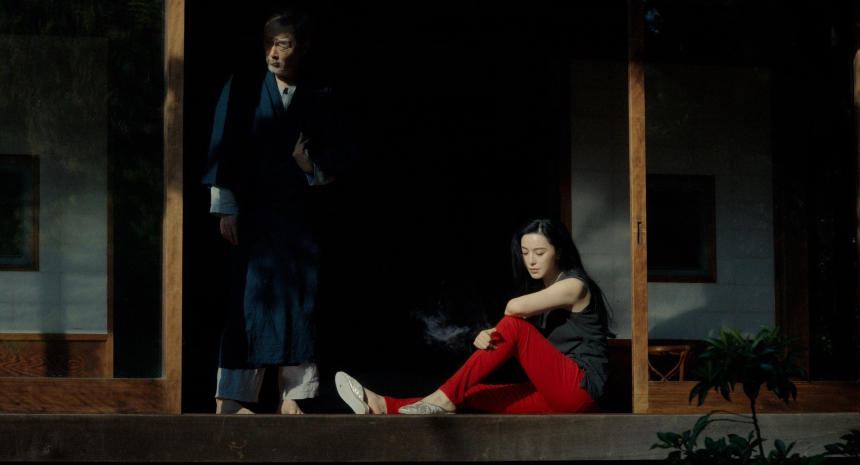
Wayne Wang’s adaptation of Jun’ichirō Tanizaki’s final completed novel of the same name revolves around Utsugi (Lily Franky), a 69-year-old widower recovering from a stroke.
With the left side of his body paralyzed, he remains at home, cared for by his sister-in-law Hana (Yūki Kudō) and daughter-in-law Susu (Fan Bingbing). Wang opens the film with Utsugi sitting at a table in his home office and masturbating, only to fail to reach climax.
The central premise of Diary of a Mad Old Man is the protagonist’s sexual desire, his libido still raging despite his declining health. Yet the opening scene proves to be the most transgressive moment in the entire 119-minute film.
Utsugi is not the typical archetype of the lecherous, perverse patriarch. Susu becomes his primary caregiver, leaving the two of them alone in his large house. When she tells him that, because of the sweltering heat, she is going to take a shower in his bathroom and leave the door open, Utsugi begins to overthink the situation, interpreting it as a possible invitation.
Tanizaki wrote the 1961 novel after suffering a stroke, transforming physical deterioration into a caustically self-aware record of appetite. Wang approaches the material from a similarly personal threshold. Now in his late seventies, he recognizes in Utsugi the indecent persistence of eros under the shadow of mortality.
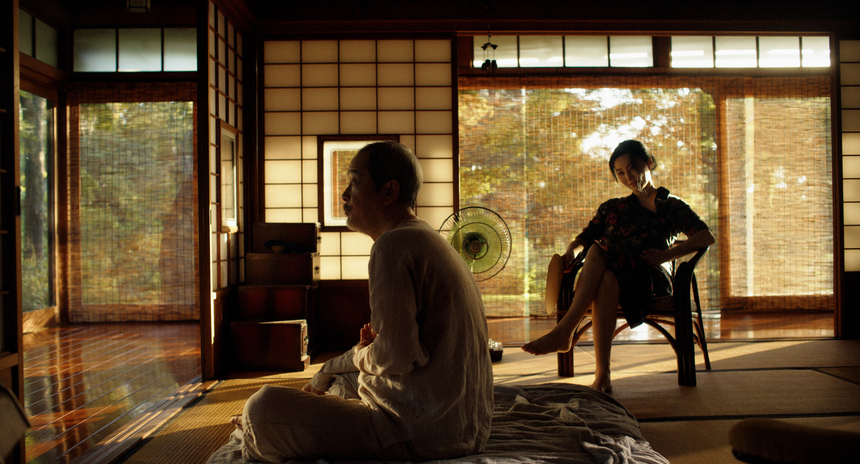
Diary of a Mad Old Man becomes a meditation on late-age eros, articulated through Utsugi’s numerous inner monologues, awkward displays of affection, patriarchal governance of his family, and moments of vulnerability. Wang approaches the material as a chamber psychosexual drama couched in poetic musings, with sudden spikes of lust counterbalanced by bouts of submission. He confines the film largely to Utsugi’s perspective, leaving Susu an enigma whose motivations are never entirely clear, even though the financial troubles of Utsugi’s son gradually shift the situation into venal territory.
As Utsugi, Lily Franky moves through a wide register, from a hermit-like elderly patriarch to full goblin mode whenever Susu’s presence is withheld from him. Franky combines a range of emotions and states, including ridiculousness, pity, vulgarity, entitlement, control, and vulnerability.
Despite the taboo setup, the protagonist remains in a looking-but-not-touching mode, with occasional fantasies projected into his diary. In this regard, Diary of a Mad Old Man remains anti-sensual and non-transgressive despite its premise, mixing sudden bouts of ecstasy with melancholia and intermittent humiliation.
Susu becomes an intriguing character in her own right, although her backstory and character development are withheld until later. Wang’s conception gives her a resistant biography. A former Shanghai bar hostess, she understands masculine desire as a language, a commodity, and a potential danger.
Her apparent solicitude can therefore accommodate several intentions at once. She may be caring for Utsugi, managing him, exploiting him, or allowing him a fantasy whose terms she controls.
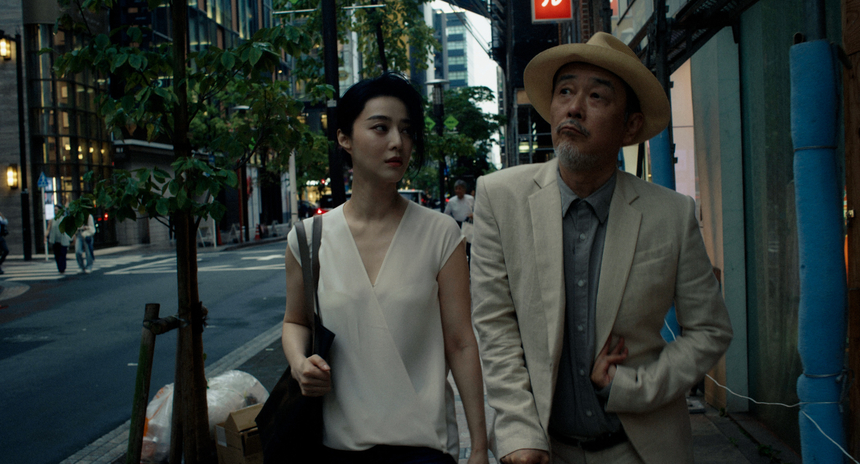
She occupies a family structure in which economic dependence and male authority have already determined the available roles. Her power comes from moving between those roles without entirely submitting to any of them. Fan’s performance consequently becomes the film’s counterweight. While Utsugi records, interprets, and eroticizes, Susu retains the right not to explain herself.
Wang’s Diary of a Mad Old Man is a meditation on the waning male body, in which libido continues to burn even as the flesh becomes decrepit. Despite its premise, the film is surprisingly anti-erotic. Even Utsugi’s fetishization avoids sensuality, as Wang intellectualizes lust until it ultimately transforms into a form of human connection rather than sexual satisfaction.
Diary of a Mad Old Man twists and turns around stereotypical concepts of male sexuality in life’s twilight years, though Wang does not fully embrace them, offering instead a monologic contemplation of desire, dependency, and physical decline. At two hours, the film is decidedly slow-burning and, even for a chamber drama, demands endurance, as the plot advances gradually and Wang preserves the mystery surrounding Susu until late in the film.
Yet this withholding ultimately serves the film’s central ambiguity: Desire becomes less a prospect of sexual fulfillment than a stubborn proof of existence, while affection, manipulation, humiliation, and dependence gradually coalesce into an uneasy form of human connection. The film’s provocation lies not in explicit transgression, but in its refusal to disentangle intimacy from power or care from appetite.



