
Toronto 2026 Review: LOOK BACK Sees Hirokazu Kore-eda Struggle to Bring Tatsuki Fujimoto's Acclaimed Manga to Life
Hirokazu Kore-eda adapts Tatsuki Fujimoto's acclaimed manga, starring Natsuki Deguchi and Aju Makita

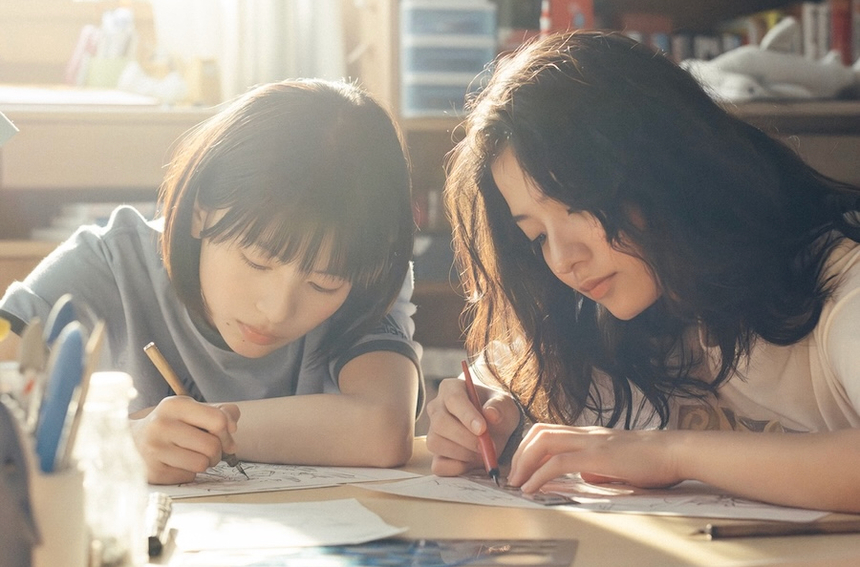
Celebrated filmmaker Hirokazu Kore-eda returns to the pages of Japanese manga for inspiration once again, unveiling this thoughtful adaptation of Tatsuki Fujimoto’s acclaimed 2021 coming-of-age one-shot, Look Back. Reuniting actresses Natsuki Deguchi and Aju Makita, both of whom featured prominently in the director’s 2023 Netflix drama series The Makanai: Cooking for the Maiko House, the film tells the story of two burgeoning young mangaka, who meet in junior high school and forge a life-long friendship.
Look Back was previously brought to the screen in 2024 by Kiyotaka Oshiyama, whose 58-minute anime was met with rapturous praise and no small degree of surprise. Up until that point, there had been only glimpses of this kind of emotional tenderness in Fujimoto’s work, who was best known for creating the visually audacious action fantasy series Chainsaw Man, whose box-office-busting feature Chainsaw Man - The Movie: Reze Arc dazzled audiences at home and abroad.
Kore-eda expands the narrative to feature-length for his live-action adaptation, but does so without tampering too much with the manga’s carefully structured narrative. If the pace does suffer somewhat as a result, it compensates for its languidness with consistently striking visuals, gorgeously captured on 35mm by cinematographer Senzo Ueno.
Look Back opens with Fujino (Furi Nanase), a pleasant and agreeable fourth-grader, sketching fastidiously at her bedroom desk. Despite her youth, she has already developed a talent for composing manga, specifically, witty four-panel yonkoma comic strips, which are printed in the newsletter of her small-town school, and earn her a modest degree of praise from her classmates and faculty.
When asked by her teacher (Kankurō Kudō) to surrender a few column inches to let another girl include her sketches, Fujino affably obliges. The girl in question, Kyomoto (Rokka Okada), is a shut-in, who has been absent from class for some time. The teacher believes that this might incentivise Kyomoto to reintegrate with school-life, and while she does not return to class, her work appears in the next newsletter, and Fujino is instantly awed — and a little intimidated — by the skill and detail of her work.
Over the next two years, the girls’ yonkoma appear regularly side-by-side. At first, Fujino is inspired to exert herself and improve her ability, but later her enthusiasm wanes, and she even quits for a while. Events come to a head on graduation day. Kyomoto has still not materialised, and Fujino is asked to deliver the girl's graduation certificate to her. Finally coming face to face, Fujino is shocked to discover that this girl, whose work has eclipsed her own and made her doubt her own talent for so long, is actually a passionate fan of hers, who waxes lyrical about specific strips from years earlier which have made her laugh and cry.
From that moment, the girls become best friends, and agree to write manga together. Now in high school, Fujino and Kyomoto (played from here on out by, respectively, Natsuki Deguchi and Aju Makita) spend every minute together, working on a 40-odd page one-shot that attracts the attention of serious industry publishers. While Fujino becomes a fount of endless ideas, including the ridiculous “Shark Kick” character (clearly a nod to Chainsaw Man), their friendship also encourages Kyomoto to emerge from her shell. That is until life inevitably finds a way to disrupt their best-laid plans.
Kore-eda has crafted an almost blemish-free reputation as one of Japanese cinema’s most humanitarian and empathetic filmmakers, especially when it comes to portraying children on screen. Through works such as Nobody Knows, Our Little Sister and his Palme d’Or winning Shoplifters, he has brought gifted, naturalistic young performers in front of his cameras, who have displayed incredible authenticity, vulnerability, wide-eyed innocence, and even, when the material demands it, an unshakeable maturity and wisdom that extends well beyond their years.
Look Back is at its best when allowing its actresses to simply exist, to play, and most notably, draw, for us and each other, as though impervious to the struggles and hardships of the outside world. Their partnership creates a safe haven where they can express themselves in peace, and when Kore-eda steps back and lets us observe these young minds, bursting with imagination and newfound talent, the film is nothing short of inspirational, with Furi Nanase, as the young Fujino, the undeniable standout.
Where Look Back fails its material, unfortunately, is in its intrusive efforts to preserve this same purity when the material demands that it move on and the characters engage with the wider world, complete with all its challenges and ugliness. By extending the material to a 100-minute runtime (still relatively short for a Japanese melodrama such as this), the dextrous restraint of Fujimoto’s carefully structured text is diluted, albeit by long, beautifully composed lingering shots of the countryside, the cityscape, or swans flying through the sky.
In the same way, the darker tone of the film’s later, somewhat fantastical sequences, feels muted and softened, as though Kore-eda insists on protecting his young heroines from their prophesied fates. As a result, the film’s climax plays not as it has done in its previous incarnations, like the stubborn, desperate efforts of a vivid imagination to turn back the clock, rewrite the past, and save a best friend from unforeseen tragedy. Instead, Look Back settles gently on a wistful what-if, that lacks the weight or resonance to land with the same resounding impact.
Following the disappointingly inconsequential Sheep in the Box, which premiered at Cannes, Kore-eda’s second offering of 2026 is equally underwhelming. Fans of his work will acknowledge that all the prerequisite elements are in place for Look Back to have been classic Kore-eda, but, while the film looks beautiful, showcases a number of sensitive performances, while also displaying an almost fetishistic admiration for the tools — both traditional and modern — of the manga craft itself — it would appear that the dramatic heft at the heart of Fujimoto’s story has eluded the master filmmaker this time.

Do you feel this content is inappropriate or infringes upon your rights? Click here to report it, or see our DMCA policy.


