Karlovy Vary 2026 Interview: MY FRIEND THE PORN STAR Filmmaker Rosa Friedrich on Deepfake and Intimacy

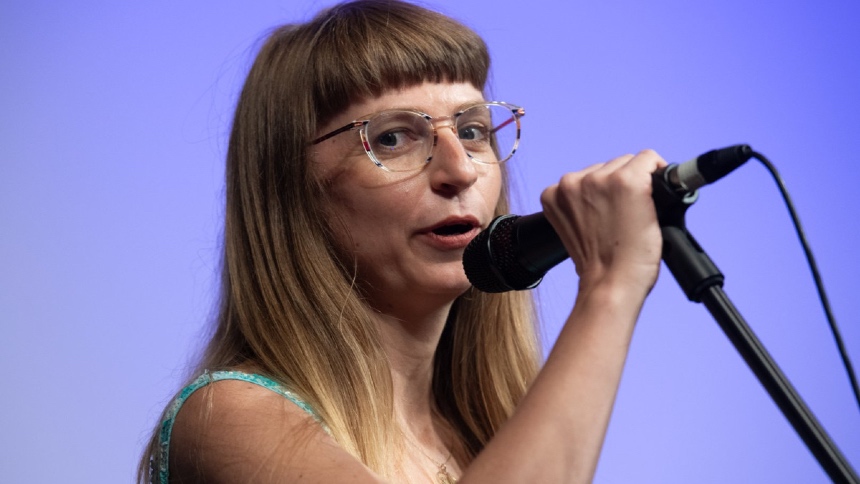
Austrian filmmaker Rosa Friedrich premiered her feature-length debut, My Friend the Porn Star, a playful hybrid documentary, at the 60th Karlovy Vary International Film Festival.
Friedrich appears on screen alongside her friend Timo, whose face is altered with deepfake technology throughout the film, as she follows his attempt to fulfill a long-held dream of acting in an actual porn film.
The endeavor proves far from simple, largely because of Timo’s specific ideas about what such a film should be. Through its twists and turns, My Friend the Porn Star becomes a testament to intimacy, desire, and vulnerability that runs counter to the conventions of mainstream pornography.
Screen Anarchy met with Friedrich to talk about her debut and discuss the making of the unconventional documentary, including its origins in a friend’s long-held dream, the ethical rupture caused by his withdrawal, the use of AI and deepfake as both compromise and concept, and the film’s hybrid approach to documentary, intimacy, and friendship.
Screen Anarchy: You have said you are not really a fan of porn, but you still went into this project. Why did you decide to pursue it?
Rosa Friedrich: I think it is quite an interesting topic because it seems like everybody is interested in it, in a way. It is still something of a taboo, and people feel ashamed. There is something in that which interests me, and I do not think I am the only one.
Normally, when you pitch a story, people might go with it, or they might not. But if you pitch something concerning sex, everybody is suddenly like, “Oh.” And probably it was the same for me. In that sense, it was an attractive topic. But it was not my dream to make a film about porn or sex. It was more that this person interested me the most: This friend who had a dream that was so opposite to his personality.
I always found that contrast very interesting. I could not really understand it, and I think that was what appealed to me the most. I also wanted to make something happen, because I had been listening to his dream for ten years. I saw some progress, but he had never done anything with a partner, only alone. I could not understand why it never really happened, so I thought: Okay, let’s give him this energy to make it happen.
Timo’s idea of making a porn film seems very different from the stereotypical male approach to porn. For him, it is much more about intimacy, closeness, and the way he looks at his own body. Did you know from the beginning that this was his concept?
Yes, I knew from the beginning that his approach was more sensitive and vulnerable. He always wanted to show a more female side of masculinity. And that was also something he felt ashamed about, because he had the feeling that society judged him a lot for this female side.
You are as important a protagonist as Timo. Was it your intention from the beginning to be on screen with him almost all the time?
No. In the beginning, I was not even sure whether I would be in front of the camera. I thought maybe I would go inside sometimes, but during the shooting it was much easier when I was also there, because I could manage a lot more. It was also very good because you could always make a shot and a countershot. I could repeat the question. So the shooting process became quite easy that way.
I see my role more like a moderation. When you see a presenter on television, for example, you might think you know this person, or you like their personality, but actually you know nothing about them, because it is not about them personally. What you get are expressions, the way they respond, maybe their humor or something. But I never wanted to talk about my own sexuality, for example.
I did not mean it in that way. For me, the film is about his dream coming true, but also about your friendship dynamic. What the two of you are dealing with together. In the end, it is more about that friendship than about him fulfilling the dream.
Yes, maybe the friendship is the most personal part of what my character shows. And I was happy with that. In the editing process, we also worked with it because it was something interesting. I mean, it is even in the title, this friendship theme. I think friendship is such an important topic in general. Even my next film is about friendship. So it might be something that interests me a lot and probably most people.
It is interesting that you refer to yourself as “my character.” Is that how you approached the shooting? Did you change your personality for the film?
Yes, I would always say it is a character. In the beginning, I even wanted to change the character more. I wanted to show a person who was maybe a bit afraid of sexuality, to create a bigger contrast. That was the first approach, but then it did not really work so well, so it went more into the background.
But I would say my character there is a bit more easygoing, sometimes asking naive questions, not taking things too seriously. Of course, it is also good if you pretend that you do not know anything, because then people have to answer you. And we need those answers for the viewers. So I think this naive character is quite a good moderator for a film. I like this person, actually. You could use her quite well.
You followed Timo’s journey up to a certain point, but there is also a parallel storyline about the other people you meet along the way, who eventually become central to the final film. Was Timo involved with these other people?
He met most of them, actually. Most of them were people we interviewed or cast for his sex film. He did not meet everybody, but he met most of them. Then afterwards, when the situation got a bit complicated and he did not want to continue, we decided to go on. We created a completely new plot with the other characters making a film together, and he was not involved in that anymore.
In the film, it looks quite smooth, as if you simply switched direction and continued. But was it really that easy in real time?
Afterwards it was easy, yes. It was almost like a vacation shoot. But of course, in the beginning it was very complicated. We had to find a completely new story, a new storyline. It was also a very emotional breakdown, this question of how to continue. We told the funding companies about our problem, and they trusted us. They trusted that we would find another way to continue. And we had to continue, you know. We could not just break it off. We would have had to pay the money back, actually.
When we put everything together and decided to go on with the other people, it became easy with them. But there was this break in between that was very stressful. Above all, the producer felt it, because it was his responsibility to finish the film. Financially, it was his risk. But for me, of course, there was also a risk. If you do not succeed, especially with your first film...
Was Timo contractually obliged to finish the movie? Had he signed a contract?
Yes, he did. But I think it is a bit complicated with documentaries. Although he signed a contract, he is still a human being. Even if you have signed something, there is still this question of morality. We did not want to cross that line. We always had very clear moral standards. Also while editing, we were always thinking about him: How would he feel if we showed it like this? Would he agree with this?
We even continued to use his language. For example, at some point during the shoot, he no longer accepted the word “porn.” So we continued talking about a “sex film,” and we still do that. Also in the logline and everything, we try to continue in that way. I am always thinking: When he reads this, what will he think? He is a human being, and we felt obliged not to cross ethical or moral lines there.
From a human point of view, did you understand why he vanished or quit?
If I try to identify with him and his particular personality, I can understand. I think his personality works differently than mine. If it had been me doing this project, I would not have quit. But I can try to put myself in his shoes.
It is still difficult to answer, because from my point of view, I did not really understand it. And I still do not really understand. But if I try to get into his thoughts, then, yes, maybe it makes sense. It is very subjective. People approach the world in such different ways, I guess.
Do you think there was one breaking point that changed his opinion? In the film, it seems as if after the Hungarian part, something fell apart for him.
No, I cannot say there was one breaking point. It was more of a development. Actually, the last scene we shot was the scene where I ask him about friendship at the lake. But after the shoot, we would not have expected that this would be the last one.
So I think it also happened in the break between shoots. It was not as if there had been a big fight or anything like that.
Did your producer accept the situation, the fact that Timo quit?
Yes. He did not put pressure on him or on me.
So the producers did try to persuade him to continue?
For sure, they did. I think my producer and Timo had the best bond out of the whole team, because the relationship between Timo and me was difficult. We had this double bond: On one level, I was a professional, and on another, I was a friend. I think that made it more difficult.
Dominic, the producer, always had a very good level of communication with him. He was the last person who kept contact and tried to find out what we could do, whether there could be some compromises, and how we could come together again. Of course, we tried to continue, but yes.
If Timo had not quit the project and had finished it according to the script, would the deepfake still have been used, or would it have been his actual face?
Actually, he wanted to show his face from the beginning. Then we decided to change it when he started having doubts. He wanted to show himself, for sure. I mean, this film is about a person who wants to show himself, even in a very intimate way. But he always had those two sides. In the end, the other side got bigger, and then we decided to go on with AI.
But I am not sure that, even if he had later said, “No, I want everybody to see my face,” I would have done it. Because I think it fits perfectly with the theme of the film. It brings so much to it. And also, you never know: Maybe in ten years he comes back and says he has doubts again. Then it becomes a never-ending process. I think we found a good compromise here.
Technically, it must have been a lot of effort to change his face for every scene and keep it natural.
Yes, of course. It was not my work, but it was quite difficult to imagine. We had to be optimistic that it would work, because otherwise we would have had a problem. But I think it is much easier now. Maybe five years ago it would have been much more expensive. I mean, it was expensive, but in comparison, I think it is really cool.
Also with the voice AI, I was very impressed. For example, during the sound editing, we needed some voice where the AI could not understand it properly. So I was speaking into a microphone, and then the AI would make this specific voice, this combination of two people.
I think that was very cool. It is so easy. Maybe dangerously easy, of course. It also has this downside. But we show it. I think that is important: we show from the beginning, and in every frame, that it is a fake.
The other participants did not have their faces changed. Were they surprised that his face had been altered?
No, I think they met him, and they could feel his personality, that he was always maybe a bit doubting. I think it made sense to them. He was never the person who would come into the room and be so confident.
Of course, it was interesting information for them, but they themselves wanted to show themselves. They had no problem with it. We showed them the film at a screening, and they really loved it. That was a very nice screening, actually, my favourite screening so far, seeing how much they liked it.
Were there any instances where you shot scenes with someone and then that person did not want to be featured in the movie?
I think the porn actress at the beginning of the shoot, if we had decided to include her material in the film, we would have had to convince her again. I think we did not have a good start. There were some conflicts, and in the end she did not really want to be in the film. But if we had decided to include that material, then for sure we would have continued to ask her again, to show her the movie.
You never know, maybe she would have had a different impression. And the porn actress whose face is blurred, she also did not want to be seen.
Why would someone who is a famous Hungarian porn star not want her face shown? There was nothing compromising or controversial about the scene.
I think it seemed to be a misunderstanding. We had a Zoom call before, and we had written to her: this is a documentary, this is the concept. It seemed like she agreed to it. But when she came there, she seemed a bit surprised.
She said she did not want to talk about herself as a human being. She does this job, and when she comes home and her boyfriend asks her how her working day was, she just says, “Fine,” and then they never talk about it again.
So I do not know what happened there, or how she misunderstood the communication before so completely. But it seems she was not actually prepared to talk about herself and show herself in such an intimate way. She said that the way Timo wanted to have sex with her was more like having sex with her boyfriend. Timo was interested in a real connection, but that is not her job. For her, it was all fake, and that was her safety.
Did you meet more people along the way who did not end up in the final cut?
For example, we met quite a famous porn actress, I think from the United States. But this was more at the beginning of the film, and I did not like the material because it was not so designed. During the shooting, I decided to get a set designer and to make more beautiful pictures. Whenever I looked at that material, I did not like it from a visual point of view.
And this is not a film about professionals. It is about beginners, about people who are trying something. They do not know so much yet.
Also, Timo and me, we are more like this chaotic buddy couple trying to get into the industry. It turned out that it was better not to show too many professional people, because this field is so big. Our point of interest was the non-professional, very personal approach, the personal reasons why people would decide to show themselves in such an intimate way. I think that is very interesting.
Did Timo go to an actual porn casting, or was that never meant to happen?
We tried to get that into the story as well. I think he had some contacts, and that would also have been a storyline if it had happened. It was actually in the script to follow him there. Maybe in the first script, it would have been like a happy ending: giving him the first steps and then finishing the film by observing him at his first real casting, or maybe just saying goodbye and being very excited about this success. It would have been nice, of course, to give him that step.
But from my point of view, it is also okay this way. Of course, for him it would have been much better. But for me as a filmmaker, it is more about the process. And for me as a person, I think it is very okay not to succeed in something.
Everybody can relate to that. It is so human, and it is so okay. I think it is really relatable not to succeed in this very brave wish or dream. It is a very difficult step.
I am still very surprised by all the brave people there. I would not have done this. I really respect it. Actually, if you think about it in a rational way, there is nothing about it. But emotionally, this whole topic is so difficult.
How big was the crew when you were doing these scenes?
One person for camera, one person for light and all the technical stuff, then sound and set design.
You had a set designer on an average documentary shoot. Why was that important?
I think that is pretty much the way it goes right now. And I mean, I am also more into traditional films. I like to create a picture. I also used my own costume almost like painting into the image. I want to look at the image and feel satisfied with it. So for me, that was a good step in the story.
As I said, in the first shooting block, we did not have that. I looked at the material and I did not like it. Then it got better. We always had a concept. We chose the locations carefully. For example, there is the scene where we are eating sausages, and he is sitting there, and behind him there is this wall with all the sausages. We made that, you know.
It is a hybrid film, and of course there are things that are created. But I would say this is pretty normal in the documentary process now. I think people maybe do not talk about it so much because they do not want to destroy the illusion.
When you say “hybrid,” I usually imagine that some scenes might be staged or reconstructed, but not necessarily that you change the environment or do real set design.
Yes, but I think people often do not even name it as hybrid. Most people just say it is documentary, because it is so normal to do this. Maybe we are just a little bit more honest here.
Your short film was fiction and it was also very visual. I could see that style in the documentary, the neons, the pastel colors, but I was still surprised you did not make this as fiction.
That would not have interested me. With this topic, I was really interested in this specific character. It was about him. That was why I wanted to make the film. Like I said, porn is not the subject I would choose for myself. I was more hooked by this person. And of course, it is very juicy to make a film about porn because everybody is interested in it, I have to say.
People are interested in the 'behind the scenes', because porn is something served as an illusion, and it is actually made in a different way. Were you tempted to show more of how the porn business works?
That is a different film, I would say. I think there are already a lot of films concentrating on the making of porn. That was not our focus. Our focus was personal: the individual reasons why people would do this, their very personal ideas of how they would make their own sex film, what it would include.
After this experience, making the movie, going to clubs and sex exhibitions, did it change your opinion of the porn industry?
In some way, yes. But I would say I am a very tolerant person. I am not very judgy. So for me, it was okay before, and now it is still okay. At the sex exhibition, of course, it was interesting to see this other world: the contrast between really big stars, big business, and then also people where you could feel that they did not really like what they were doing. It was more like life happened to them, and they probably were not even paid properly. You see a big contrast.
But the people we continued with are people who show themselves for themselves, or because they have some vision about it. For them, it is even political to show themselves.
That other side was not our focus. We have it in one short interview, where a person says that actually it is not her dream, that she wanted to do something else. And of course this is very present. It is probably much more present in reality than in the little bubble we showed. But we decided not to focus there.
I was also surprised how easy it was to book a porn actress. If we had made a proper, normal porn film, it would have been no problem. It was only our project, or Timo’s particular idea, that made it difficult. And of course the documentary project behind it. But otherwise it was so easy. The producer has a company, and he could just register on the page. Then he had this contact. You have maybe 300 people you can choose from. It is so easy.
In Austria?
No, in Hungary.
Was it hard to edit the film into its final cut?
The editing process was very long. There was so much material, and we had so many test screenings, which was actually a good thing.
It was very interesting because people always saw different things. Sexuality is also something so individual, and the way people approached the film was always very individual. There was always somebody who liked one scene the most, while everybody else said, “Oh, that was not so interesting.”
It was very individual, but we got so much good information from all those test screenings. And now I am quite proud of the final cut. It was work, but I think we found the right version.
Did you have dilemmas while editing, moments where there were two really good scenes, but you could only keep one?
Sure. It is always very sad to let go of all those beautiful scenes. But, you know, it feels so hard in the moment, and then you wait half a year, and you even forget about them. So, no, there is actually no scene that comes to mind now, after half a year.
I think my editor is more sentimental. It was harder for her to let things go. She said, “It’s so nice, I have seen everything.” All those treasures, people do not even know they exist. But she has them in mind.
How long did it take to shoot the film?
Maybe one and a half years, something like that. But in total, I think it was around 18 shooting days. We just had very long breaks in between.
Did those breaks allow you to change anything? Were you thinking about the project during that time and adjusting it?
Yes. It was good to have such long breaks, because you could go in other directions, or adjust things. It was actually a very comfortable way of shooting.
With a fiction film, you usually have those six weeks, and you cannot really go another way in the middle. Here, there was a lot of time to think about it, and then go back in again. I think fiction films would also be better if we had breaks in between to think about them.
You mentioned that your next project will also be about friendship. Are you continuing with documentary filmmaking, or are you switching back to fiction?
I am switching to fiction again. It is a teen dramedy.
Do you plan to return to documentary filmmaking?
Yes, I might continue with it. My producer and I already have a subject in mind, and we want to continue this kind of filmmaking. Even with my character, I would like to continue.
Really?
Yes. Maybe make a series of documentaries. This naive character getting into subjects she does not know yet, I think that could continue. It could work. But the next topic will not be porn.
Did the friendship with Timo survive this whole ordeal?
Not in the moment. I mean, we had a break many years ago, and then we came back together. So you never know. This friendship could happen again. Sometimes it just needs time.
Were you very surprised by this outcome?
Yes. I would not have expected this.
Cover image courtesy of Film Servis Festival Karlovy Vary.