
Fantasia 2026 Review: TIGHT LETTUCE, Addiction Both Binds and Tears Families Apart

There are many kinds of addiction stories on film, from the invigorating buddy shenanigans of Transpotting to the stylish personal infernos of Requiem For A Dream to the gritty autobiographical redemption arc of The Basketball Diaries.
Harrison Houde’s Tight Lettuce discovers a novel, more intimately Canadian character-driven narrative by way of a multi-generational family-on-hold tragicomedy. One that achieves a heartbreaking melancholy via the unrestrained joy and laughter, against the stark failures of its central character.
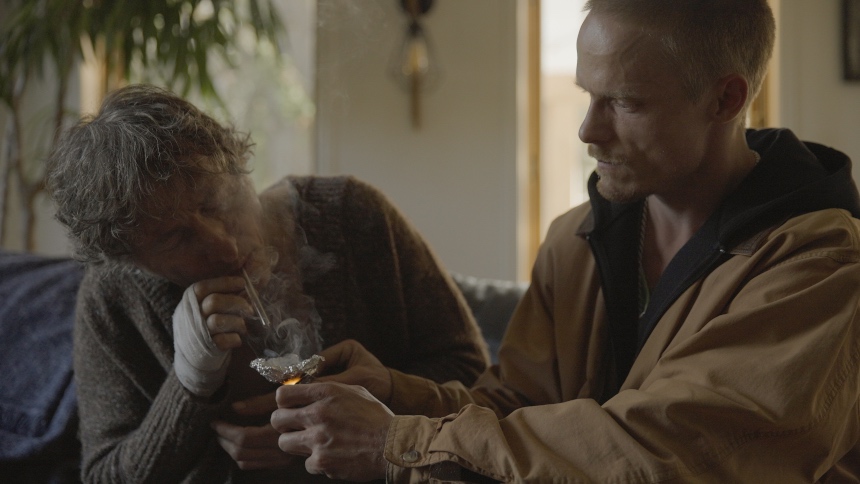
Tooling around on his decalled moped on rural roads somewhere near the Ontario-Quebec border with a shit-eating grin on his face, seemingly without a care in the world, we meet Bodo in all his exuberant glory. An ex-roofer, ex-husband, and almost ex-father to his only child, Joel, Bodo’s dabbling with heroin with his wife in the early days of their marriage has led him to a full fentanyl habit, and a divorce.
Living rent-free in his son’s second home, squatting with his user buddies, and in the quieter moments, which he tries to avoid, but cannot always, pining for his former life. He rents out his own room to whomever is willing to give him drug money, while he sleeps in the closet with only a blanket and his high school year book.
Bodo’s drug dealer, and occasional employer, lives nearby and works out of a massive land-locked boat in the middle of nowhere, with an open-air shutter extension on the upper deck. This is an amusing (and visually never boring) metaphor for Bodo’s existence, as he stomps grapes grown on the property into, presumably, bad wine or jam. This is his meagre income, which he has to fight to receive every blue five dollar bill, back into the next fix.
While this may seem pathetic, and it certainly is, Bodo’s love for the simple things in life -- getting ice-cream on a hot day, canoeing with his adult son, or building a boardwalk for his mother to enjoy the creek on the back of her home -- showcases a bottomless joie de vivre in how he exists in his more lucid moments. This is the tragic potential of what a happy family life could be without the addiction.
His adult son, Joel sees this all too clearly, because Bodo only sees the fun parts, either with his family or with his drugs, and grows hostile in his avoidance of ‘real-life,’ for which the fentanyl ably offers an escape. Bodo has outsourced all aspects of family living to his son, his mother, and even his ex-wife; even though she since has gotten straight and has moved on with another man.
Joel loves his father deeply, as evidenced to his camera constantly capturing the “World’s greatest Dad" placard hanging on his father’s wall, and his defending the potential for Bodo to break free and transform into his own idolized version. But his attempts to keep Bodo alive, present, and on the straight and narrow (including a wacky attempt with a small rehab facility and a not-so-wacky trailer fire) threatens to destroy his own young marriage and early attempts to start a family.
At one point, Joel’s grandmother gently advises her granddaughter-in-law, point blank, to never have kids, perhaps at the worst time imaginable. She knows all too well that they could have been raised "right", and still end up in this current mess. Children, as toddlers or adults, are their own complicated people with their own complicated choices.
The bucolic Ontario countryside, all pick-up trucks and sunsets, offers an ironic palette for the chaos and emotion that ensue. Flipping back and forth between French and English in the tenuously combined extended family make this a distinctly Canadian tragedy, one that is polite and vulgar in varying measure.
Tight Lettuce is both Bodo’s story, and not his story. The film is from the point of view of his son, who with his small Sony handicam has been capturing the lucid times with his father -- and occasionally the drugged out stupors, or rage fuelled frustration of losing his flip-phone while trying to score -- for some time.
It's an attempt to edit all these sides of his father into some kind of video intervention, by showing the him (and us) the good and the ugly. At one point, the dilemma to prepare his father's own fix (because Bodo is unable, but pleading) goes against everything in his own instincts. This is an operatic choice, where either/both is going to end badly, and cements the film as Joel's journey, witness to his father's uncontrolled float down the river.
The source is a true story; we see the actual video footage over the ending credits of the two men, father and son. The profound sadness as a mirror of joy comes from a monster performance from French Canadian actor Emmanuel Bilodeau as Bodo, who often strains to take a breath in his passionate rush towards the next thing in his lust for life. His neck and face are a map of his fun and his failure. The more entertaining this all is, the more heartbreaking the consequences for everyone involved, including the audience.
That the director manages to thread the needle here (for the most part) keeping the film from falling into either broad caricature or maudlin movie of the week, is an accomplishment in and of itself.

More about Tight Lettuce (2026)
- Fantasia 2026: Audience Awards Announced!
- Fantasia 2026: Raising the Curtain on the 30th Edition of Montreal's Smorgasbord of Genre Cinema
- TIGHT LETTUCE: An Introducton to Fantasia-bound Dark Comedy
- Fantasia 2026 First Wave: Smoczyńska's HOT SPOT, Wexler's THE LAST TEMPTATION OF BECKY, And Walker's HOME BODIES Among First Wave Titles


