
San Francisco 2026 Review: EVERY CONTACT LEAVES A TRACE, Poignant, Thoughtful Cine-Essay

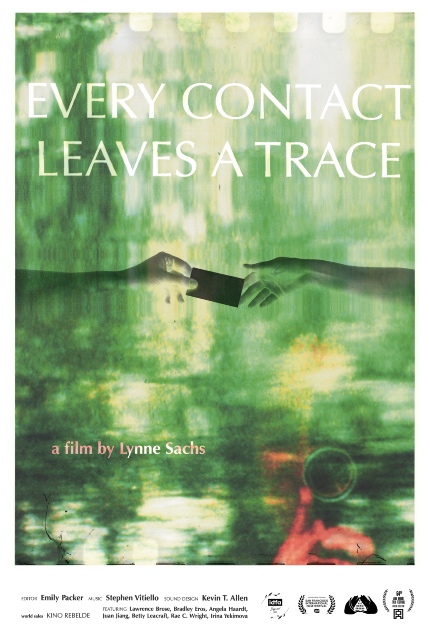
The latest project by filmmaker Lynne Sachs (Drift and Bough, The Washing Society, Film About a Father Who) opens with a quote from the French-born father of 20th-century forensic science, Dr. Edmond Locard: “Every contact leaves a trace.”
The basis for “Locard’s Exchange Principle,” it also doubles as the title of Sachs’ documentary, a deeply personal cine-essay.
With more time behind her than in front of her, a meditative Sachs uncovered a box of 600 business cards dating back to 1990 and the fall of the Berlin Wall. As a young woman and burgeoning filmmaker, Sachs met Angela Haardt, a Berlin resident, a founding member of the International Forum of the Film Avant-Garde, and the director of a shorts festival (1990-1997) where Sachs placed an early short film of hers. Her new film combines archival footage, reminiscences about post-war Germany, and its place in the Jewish-American imagination (more positive than negative for Sachs, the opposite understandably so for her mother)
Decades later, Haardt welcomes Sachs both as an equal and a long-lost friend. Looking back at their initial meeting, the intervening time, and the present, Haardt grapples with German history, identity, and culture, specifically how, when, and where Germans commemorate the Holocaust or deliberately forget it. It's a tragedy that Sachs connects to her own conflicted, contradictory feelings about Israel, Gaza, and Israel’s initially defensive response to the October 7, 2023, Hamas attack on Israel, including the reoccupation of Gaza and the disproportionate effect on the Palestinian population.
Before Every Contact Leaves a Trace ventures too far into Israel, Gaza, or the commingled future of its peoples and the region itself, however, Sachs deliberately pulls back, returning to the original focus of her project, tracking down a select handful from the business cards she acquired over the years. Few are as compelling as Haardt, but they’re still fascinating on their own, sometimes less because of who they are or what they’ve contributed to film and the film community than their relationship to Sachs and the latter’s attempts, sometimes successful, sometimes not, to reignite long-dormant friendships or relationships.
Among Every Contact Leaves a Trace’s subjects, Sachs' most intriguing interviewees include the late Lawrence Brose (De Profundis), a pioneering queer filmmaker who found himself hounded by Homeland Security and ICE for the alleged possession of child pornography. Out of a combination of fear and prudence, Brose pled guilty to a lesser offense (obscenity), in exchange for two years of probation. During that period, Brose couldn’t own or access anything related to the LGBTQ community or risk his probation turning into imprisonment.
Brose’s persecution and subsequent plea deal could — and probably should — have been a documentary in its own right, but in Sachs’ cine-essay, it offers her another opportunity for self-examination, both as an individual and as a filmmaker bound by ethics. Given the seriousness of the accusations against Brose, she considered excising his segment altogether. It’s to her credit that she didn’t.
Even in a truncated form, Brose and his story needed to be heard and seen. Sachs’ ethical conundrum also serves as an opening for much-needed discussion and rumination on the other side of the screen.
Sachs’ other subjects include Juan Jiang, the director of the now-defunct Chinese Women’s Festival; textile artist Betty Leacraft, Sachs’ one-time student turned teacher; Felix and Viva Torres, Sachs’ nephew and niece, respectively (the children of Sachs’ filmmaker brother, Ira); and, in a meta-fictional twist, Rae C. Wright, a performer who serves as a stand-in for Sachs’ therapist. While Leacraft proves slightly prickly under Sachs’ performance-driven direction, Felix and Viva emerge as a charming duo, offering the occasional insight along with warmth of spirit and generosity toward their idiosyncratic aunt.
For some, Every Contact Leaves a Trace will seem overly personal and thus, too slight or of marginal interest. For those willing to look — and just as importantly, listen — Every Contact Leaves a Trace will, like the title of Sachs’ documentary, leave an indelible mark, asking important, open-ended questions about life, art, and mortality. Few have answers, but as Sachs suggests more than once, they’re all the more worth asking.
Every Contact Leaves a Trace premiered at the 2025 IDFA (International Documentary Film Festival) in Amsterdam. It played most recently at the 2026 San Francisco International Film Festival.

Do you feel this content is inappropriate or infringes upon your rights? Click here to report it, or see our DMCA policy.


